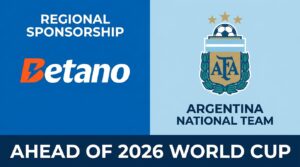
Kaizen Gaming’s flagship brand Betano has been named an official regional sponsor of the Argentina National Football Team, a deal that lands with strategic precision just weeks before the 2026 FIFA World Cup kicks off across the United States, Mexico, and Canada. The partnership ties one of the fastest-growing online sports betting and gaming operators in the world to the reigning world champions. For Betano, the timing is anything but accidental. Argentina’s squad, led by Lionel Messi in what many expect to be his final World Cup campaign, will carry enormous global viewership, and the brand clearly intends to ride that wave across Latin American markets.
What the Argentina–Betano Partnership Signals for the Betting Industry
Sponsorship deals between national football teams and betting operators have become a recurring feature of the pre-tournament landscape, but this one carries particular weight. Argentina is not just any team heading into the World Cup; they are the defending champions, and their commercial appeal across Latin America and beyond has arguably never been higher. Before diving into the broader implications, here are the key strategic takeaways from this deal:
The Growing Influence of Football Partnerships
As the 2026 FIFA World Cup approaches, collaborations between sports and gaming entities are becoming increasingly prevalent. For instance, BGaming has recently partnered with Brazilian football legend Júlio César to create innovative football-themed content, which aims to engage fans and gamers alike in the lead-up to the tournament. This trend highlights the strategic importance of aligning with iconic figures in football, as seen with Betano’s sponsorship of the Argentina National Football Team, further emphasizing the intersection of sports and online gaming ahead of the World Cup. More details on BGaming’s partnership with Júlio César can be found here: BGaming's collaboration with Júlio César.
- Market positioning in Latin America: Betano’s regional sponsorship aligns directly with Kaizen Gaming’s expansion strategy across regulated and emerging Latin American betting markets, where Argentina’s cultural football influence runs deep.
- World Cup visibility multiplier: Partnering with the defending champions guarantees disproportionate media exposure relative to sponsoring a less prominent squad, particularly during group stages and knockout rounds.
- The deal underscores how aggressively online betting brands are competing for top-tier football assets in the months leading up to a World Cup cycle.
- Regulatory optics: As several Latin American countries continue to formalize sports betting frameworks, associating with a national team (rather than a club) sends a legitimacy signal that resonates differently with regulators and the public alike.
- Brand differentiation: In a crowded sponsorship market where multiple operators chase the same football properties, locking in Argentina gives Betano a clear edge over regional competitors during the tournament window.
Kaizen Gaming’s Broader Ambitions
Kaizen Gaming, the Athens-headquartered parent company behind Betano’s online sports betting and gaming platform, has been on an aggressive international growth trajectory for several years. The company operates in more than 17 markets across Europe, Latin America, and Africa. Its revenue figures have consistently trended upward, and the operator has made no secret of its intent to become a globally recognized brand rather than a regional one.
This sponsorship fits that playbook neatly.
Latin America represents one of the most dynamic frontiers in regulated online gambling. Brazil formalized its sports betting regulations in 2024, opening a market of over 200 million people. Argentina’s own regulatory landscape remains fragmented across provinces, but the appetite for legal sports wagering is growing. By attaching its name to the national team, Betano positions itself not just as a market entrant but as a brand with cultural proximity (a distinction that matters more than many operators realize when competing for user acquisition in football-obsessed markets).
Why the World Cup Changes the Calculus
A World Cup sponsorship deal operates on a different economic logic than a standard league-season partnership. The tournament compresses global attention into a roughly five-week window, and the defending champion receives outsized coverage from the opening match onward. Every pre-match graphic, every broadcast overlay, every social media asset featuring the Argentine crest will carry Betano’s brand alongside it.
Still, the real value may extend beyond impressions. World Cup cycles tend to accelerate user acquisition for betting platforms in ways that persist well after the final whistle. Bettors who sign up during the tournament often remain active through subsequent domestic football seasons. That retention dynamic turns a short-term sponsorship into a longer-term customer acquisition funnel.
And while the financial terms of the Argentina–Betano agreement have not been publicly disclosed, comparable national team sponsorships in the betting sector have historically commanded seven-figure sums at minimum, with performance escalators tied to tournament progression.
How Does This Compare to Other Operator Moves?
Betano is not the only operator making pre-World Cup plays. Several major competitors have secured partnerships with national federations, clubs, and broadcast networks in recent months. But few have landed a deal with the team most likely to generate the highest single-team viewership at the tournament. That asymmetry matters.
| Factor | Betano–Argentina Deal | Typical National Team Sponsorship |
|---|---|---|
| Team profile | Defending World Cup champions | Varies widely; often mid-tier squads |
| Regional focus | Latin America, with global spillover | Usually single-market |
| Timing | Weeks before the 2026 World Cup | Often announced 6–12 months prior |
| Regulatory context | Multiple LatAm markets formalizing betting laws | Depends on jurisdiction |
The Psychology of Sponsorship Timing
There is a well-documented principle in consumer behavior: association formed during moments of peak emotional engagement tends to be stickier and more durable than association formed during routine exposure. Football World Cups represent perhaps the single highest concentration of collective emotional intensity in global sport. Millions of viewers do not just watch these matches; they experience them with a level of personal investment that few other events replicate.
Betano’s decision to activate this sponsorship immediately before the tournament, rather than months in advance, reflects an understanding of that dynamic. The compressed timeline between announcement and first match means the brand enters public consciousness precisely when attention is at its most focused. This approach reduces the risk of sponsorship fatigue, where audiences become desensitized to a brand’s presence over a prolonged buildup period. Instead, the association arrives fresh, tied directly to the anticipation and excitement surrounding the tournament itself.
For bettors specifically, the psychological anchoring effect is even more pronounced. When a trusted national team carries a betting brand’s logo during a high-stakes match, it creates an implicit endorsement framework in the viewer’s mind. Whether that translates into immediate sign-ups or a slower brand-preference shift depends on execution, but the foundational association has been established at the optimal moment. Kaizen Gaming appears to be betting (in more ways than one) that emotional timing outweighs prolonged exposure.
What Remains Less Clear
The deal raises questions that neither party has yet addressed publicly. Will the sponsorship extend beyond the World Cup cycle? Does it include activation rights across Argentina’s domestic qualifiers and friendlies, or is it tournament-specific? And perhaps most consequentially: how will Argentine regulators at the provincial level respond to a betting brand occupying such visible real estate on the national team’s commercial roster?
These are not trivial questions. The answers will shape whether this partnership becomes a template for future operator–federation deals in the region, or remains a one-off tactical play timed to a singular event.



