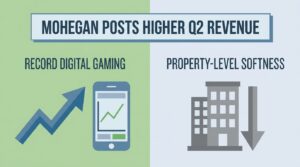
Mohegan, the tribal gaming authority operating one of the largest casino resort portfolios in North America, reported increased revenue for its fiscal second quarter, buoyed by record-breaking digital gaming performance. The gains helped cushion softer results at certain physical properties, painting a mixed but ultimately positive picture for the operator. While consolidated revenue climbed, the quarter also revealed margin pressures and shifting consumer behavior patterns that merit closer scrutiny from industry observers.
What Mohegan’s Q2 Numbers Signal for Tribal Gaming Operators
The results arrive at a moment when regional casino operators across the U.S. face an uneven demand environment. Consumer spending at brick-and-mortar venues has shown signs of cooling in several markets, yet digital channels continue to absorb that slack. For Mohegan, the interplay between these two dynamics defined the quarter.
- Record digital gaming revenue suggests Mohegan’s online strategy is gaining traction at a pace that now materially influences top-line performance
- Physical property results were mixed, with some locations experiencing softer visitation trends consistent with broader regional patterns
- The revenue increase, while welcome, came alongside cost pressures that operators across the sector have flagged throughout 2024 and into 2025
- Mohegan’s diversified model (spanning tribal operations, commercial management, and digital) gives it more levers to pull than single-property competitors
- Digital’s growing share of the revenue mix raises questions about long-term capital allocation between physical expansion and online investment
Digital Gaming: The Engine That Carried the Quarter
Mohegan’s digital segment delivered its strongest quarter on record. That’s not a minor footnote. For an operator historically defined by its flagship Mohegan Sun property in Uncasville, Connecticut, the digital pivot represents a structural shift in how the organization generates revenue and engages customers.
Online casino and sports betting operations, which Mohegan Sun’s integrated resort platform feeds into, have expanded their reach across multiple states. The digital segment benefits from lower marginal costs per customer compared to physical casino floors, which require significant labor, maintenance, and promotional spending to drive foot traffic. Still, competition in the iGaming space remains fierce, with larger operators like FanDuel and DraftKings commanding outsized market share in most jurisdictions.
What separates Mohegan’s approach is its hybrid model. The operator leverages its tribal gaming compacts and existing brand equity to cross-sell digital products to an established customer base. Whether that advantage proves durable as the digital market matures is a question the next several quarters will help answer.
Property-Level Performance Tells a More Complicated Story
Not every segment matched digital’s momentum. Mohegan’s physical properties delivered uneven results, reflecting a pattern visible across regional gaming markets in the northeastern United States and beyond. Visitation trends at some locations softened, and promotional spending remained elevated as operators competed for a consumer wallet that, arguably, has tightened since mid-2024.
Mohegan operates or manages properties across several states and international markets, including its Korean integrated resort. Each carries distinct demand drivers and cost structures, making consolidated figures somewhat deceptive at first glance.
| Segment | Q2 Performance Trend | Key Driver |
|---|---|---|
| Digital Gaming | Record revenue | iGaming expansion, customer acquisition |
| Mohegan Sun (CT) | Stable to slightly soft | Regional competition, consumer caution |
| Managed Properties | Mixed | Varies by jurisdiction and local economic conditions |
| International (Korea) | Under development pressure | Tourism recovery pace, regulatory environment |
How Strategic Framing Shapes Operator Resilience
Beyond the numbers, Mohegan’s quarter offers a case study in how gaming operators frame their strategic narratives during transitional periods. The language an organization uses internally and externally to describe its trajectory influences stakeholder confidence, employee alignment, and even regulatory relationships. This is where principles drawn from neuro-linguistic programming become relevant to corporate strategy, even in an industry as numbers-driven as gaming.
Consider the difference between an operator that describes softening property revenue as a “challenge” versus one that positions the same data as evidence of a “portfolio rebalancing toward higher-margin digital channels.” Both descriptions can be factually accurate. But the second reframes the narrative in a way that anchors stakeholders to growth rather than decline. Mohegan’s public communications have leaned into this reframing approach, consistently foregrounding digital milestones while contextualizing property-level softness within broader market trends.
This kind of strategic communication matters because perception shapes capital access. Tribal gaming authorities like Mohegan fund operations through bond markets rather than public equity, meaning bondholder confidence directly affects borrowing costs. An operator that projects coherence and forward momentum, even during mixed quarters, is better positioned to refinance debt or fund expansion at favorable terms. The framing isn’t spin; it reflects a genuine strategic choice about where to direct resources and attention. And when internal teams absorb that same narrative, operational decisions at the property level tend to align more naturally with corporate priorities. In practice, the organizations that master this alignment between data, narrative, and execution tend to outperform peers who treat communication as an afterthought.
What Comes Next for Mohegan?
Several threads will determine whether Mohegan’s Q2 trajectory holds. Digital gaming regulation continues to evolve state by state, and any expansion of legal iGaming markets would directly benefit operators with established platforms. At the same time, Mohegan faces refinancing decisions on its existing debt structure, a process that bondholder sentiment and credit agency assessments will heavily influence.
The operator’s international ambitions, particularly in South Korea, add another variable. Tourism flows into the Korean market have not fully recovered to pre-pandemic levels, and the competitive landscape for integrated resorts in Asia remains crowded. Yet Mohegan has committed significant capital to its Inspire Entertainment Resort project, betting that long-term demand will justify the investment.
Back in Connecticut, the competitive dynamics with neighboring Foxwoods and the broader New England gaming market will continue to shape property-level results. Whether Mohegan can sustain digital’s record pace while stabilizing its physical footprint will define the narrative heading into the second half of fiscal 2025.
Frequently Asked Questions
What drove Mohegan’s revenue increase in Q2?
Record digital gaming results were the primary driver, offsetting softer performance at some physical casino properties. The digital segment’s lower cost structure also contributed to the overall revenue lift.
Is Mohegan a publicly traded company?
No. Mohegan is a tribal gaming authority, which means it does not trade on public stock exchanges. It finances operations primarily through the bond market, making bondholder confidence a critical factor in its financial strategy.
Where does Mohegan operate?
Mohegan’s portfolio spans its flagship Mohegan Sun resort in Connecticut, managed properties in several U.S. states, and the Inspire Entertainment Resort in South Korea. Its digital gaming operations extend across multiple regulated U.S. markets.
How does Mohegan’s digital strategy compare to major iGaming operators?
Mohegan’s digital footprint is smaller than industry leaders like FanDuel or DraftKings, but its hybrid model, which cross-sells digital products to an existing physical casino customer base, gives it a differentiated path to growth that pure-play digital operators lack.



