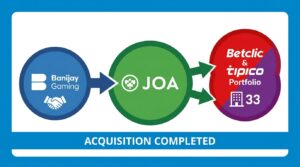
Banijay Gaming has struck a deal to acquire JOA, the French land-based casino operator running a network of 33 venues across the country. The move substantially broadens the footprint of the entertainment and gaming conglomerate, which already controls online betting brand Betclic and German sportsbook operator Tipico. While financial terms of the transaction have not been disclosed, the acquisition positions Banijay Gaming as a dual-channel force in European gambling, bridging digital wagering with physical casino operations at a scale few competitors can match.
What the JOA Deal Means for Banijay’s Strategic Ambitions
The acquisition arrives at a moment when convergence between online and land-based gambling is accelerating across regulated European markets. Banijay Gaming, a subsidiary of the Banijay Group known primarily for television production, has been quietly assembling a diversified gaming portfolio. Betclic operates as one of France’s leading licensed online sports betting and poker platforms, while Tipico dominates segments of the German market. Adding JOA’s brick-and-mortar casino estate fills a gap that pure-play digital operators cannot easily replicate.
- Omnichannel expansion: Banijay Gaming gains immediate physical presence across France through 33 casino properties, enabling cross-sell opportunities between online and retail channels
- Regulatory positioning: Owning licensed land-based venues strengthens Banijay’s standing with French regulators, who have historically favoured operators with tangible local economic contributions
- The deal consolidates Banijay’s position as a multi-vertical gaming group rather than a collection of separate betting brands
- Competitive pressure: Rival operators with online-only models in France now face a vertically integrated competitor capable of leveraging entertainment content, digital platforms, and physical venues simultaneously
- Revenue diversification: Land-based casino income tends to be more stable quarter-to-quarter than online betting, which is subject to sporting calendar fluctuations and regulatory shifts
JOA’s Casino Network: Scale and Geography
JOA operates 33 casinos spread across French municipalities, many of them in tourist-oriented or spa towns where casino licensing has deep historical roots. The company has built a reputation for mid-market casino experiences, distinct from the high-roller venues associated with groups like Barrière or Partouche. That positioning arguably makes JOA a better cultural fit for Banijay, whose entertainment DNA leans toward broad-audience engagement rather than luxury exclusivity.
France’s casino market remains tightly regulated under the Ministry of the Interior, with licences tied to specific municipal concessions. Acquiring JOA means inheriting not just physical assets but long-term concession agreements (a distinction regulators have been slow to make transparent to the public). Whether Banijay intends to modernise these venues with digital integrations or maintain their current operating model is something the company has not yet detailed.
How This Reshapes the French Gambling Landscape
France has long maintained a sharp regulatory divide between online gambling, overseen by the Autorité Nationale des Jeux (ANJ), and land-based casinos governed by municipal and interior ministry frameworks. Operators that straddle both worlds are rare. Groupe Barrière runs luxury hotels and casinos across France alongside limited digital offerings, but no French group has combined a dominant online betting platform with a national casino chain in quite this configuration.
Banijay’s play here is less about gambling volume and more about ecosystem control. Consider the parent company’s assets: Banijay Group produces over 100,000 hours of television content annually across 50 countries. Betclic sponsors major sporting events. Tipico holds a German sports betting licence. And now, 33 casinos.
Still, integration risk looms. Land-based casino operations demand fundamentally different management competencies than running a digital sportsbook. Staffing, property maintenance, municipal relations, food and beverage operations: none of these translate from an online playbook. Whether Banijay has the operational depth to run both verticals without diluting performance in either remains an open question.
The Broader Trend: Why Entertainment Groups Are Betting on Gambling
Banijay is not alone in recognising that entertainment and gambling share overlapping audiences and monetisation models. Across Europe, media companies have been edging into gaming, while gambling operators invest in content. The logic is straightforward: attention is the scarce resource, and whoever controls more touchpoints in a consumer’s leisure time captures more value.
But this logic has limits. Regulatory environments across EU member states remain fragmented, and what works in France may face entirely different constraints in Germany or Portugal. Banijay’s ability to create genuine synergies between Betclic’s online betting operations and JOA’s physical venues will depend heavily on how French regulators respond to cross-channel marketing and data-sharing practices. The ANJ has shown increasing willingness to scrutinise operator behaviour, particularly around responsible gambling obligations.
Key Variables to Watch
| Factor | Implication |
|---|---|
| Concession renewal timelines | JOA’s casino licences are tied to municipal agreements with varying expiry dates; renewal terms could shift under new ownership |
| ANJ regulatory posture | The regulator may impose additional conditions on cross-channel operations between Betclic and JOA |
| Integration costs | Modernising 33 physical venues while maintaining online growth could strain capital allocation |
| Competitive response | Partouche and Barrière may accelerate their own digital strategies in response to Banijay’s omnichannel model |
What Operators and Regulators Should Be Asking
For industry professionals tracking European market consolidation, this deal raises several practical questions worth monitoring.
- Will Banijay seek to unify loyalty programmes across Betclic and JOA? Cross-channel player tracking is technically feasible but regulatory approval is far from guaranteed under current French frameworks.
- Does this signal further M&A activity? Banijay’s appetite for acquisition suggests it may pursue additional land-based or digital assets in adjacent markets. Portugal and Poland, where Betclic already operates, are plausible targets.
- How will responsible gambling obligations scale? Operating both online and offline channels creates compounding exposure to problem gambling scrutiny. Regulators will expect a unified, demonstrably effective approach.
Frequently Asked Questions
What is JOA?
JOA is a French land-based casino operator managing 33 casino properties across the country, primarily in mid-market and tourist-oriented municipalities.
Who owns Betclic and Tipico?
Both brands fall under the Banijay Gaming umbrella, itself part of the broader Banijay Group, which is one of the world’s largest independent content production companies.
Does this deal require regulatory approval?
French casino licences are tied to municipal concessions and overseen by the Ministry of the Interior. Any change of ownership typically requires regulatory review, though Banijay has not publicly detailed the approval timeline.
Will JOA casinos be rebranded?
That remains unclear. Banijay has not announced branding plans, and given JOA’s established local presence, maintaining the existing name could prove more commercially sensible than a rebrand that risks alienating existing patrons.



