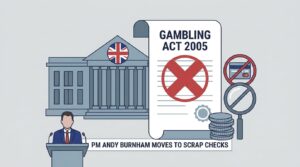
Prime Minister Andy Burnham has signalled a significant policy shift by announcing plans to remove the affordability check provisions embedded in the Gambling Act 2005. The proposal, which would eliminate requirements for gambling operators to verify customers’ financial standing before allowing large wagers, has drawn both praise from the betting industry and sharp criticism from harm-prevention advocates. If enacted, the change would represent one of the most consequential regulatory rollbacks in UK gambling policy in nearly two decades.
What the Affordability Check Removal Actually Means for Operators
Before diving into the strategic implications, it’s worth grounding what’s at stake. The affordability checks, introduced as part of the broader responsible gambling framework under the 2005 Act, require licensed operators to assess whether customers can sustain their gambling activity without financial harm. In practice, this has meant requesting bank statements, payslips, or other financial documentation from players who hit certain spending thresholds.
- Operators stand to recover significant revenue lost through customer friction at the point of verification, where drop-off rates have historically been steep
- The move could reshape the competitive landscape between UK-licensed operators and offshore platforms that face no such requirements
- Harm-prevention organisations face a policy reversal that undermines years of advocacy for tighter financial safeguards
- Regulatory bodies like the Gambling Commission may need to recalibrate their enforcement priorities and licence conditions
- Whether this triggers a broader deregulatory wave across other consumer protection measures remains an open question
Why This Shift Is Happening Now
The timing is not accidental. UK-licensed gambling operators have argued for years that affordability checks push customers toward unregulated, offshore betting sites where no protections exist at all. That argument gained traction as data from the Gambling Commission showed a measurable migration of betting activity to unlicensed platforms (a distinction regulators have been slow to quantify with precision).
Burnham’s announcement also arrives against a backdrop of broader economic pressures. The UK betting and gaming sector contributes billions in tax revenue annually, and operators have lobbied hard on the point that excessive regulatory burden erodes both their tax base and their ability to compete internationally. Several major operators, including those listed on the London Stock Exchange, have publicly cited affordability checks as a drag on customer acquisition and retention.
Still, the political calculus here is delicate.
Gambling harm remains a politically sensitive issue in Westminster. Campaigners have pointed to research linking unaffordable gambling to debt spirals, mental health crises, and in extreme cases, suicide. By removing the checks, the government risks being seen as prioritising industry revenue over vulnerable consumers. And while the Prime Minister has framed the move as pragmatic, not all stakeholders see it that way.
Industry Response and the Offshore Argument
The betting industry’s reaction has been largely positive, though measured in public statements. Trade bodies representing UK betting and gaming operators have long maintained that affordability checks, while well-intentioned, created a bureaucratic barrier that drove recreational gamblers underground. Their core argument: a regulated market with lighter-touch oversight is safer than pushing customers to platforms with no oversight at all.
There’s some evidence to support this. The Gambling Commission’s own enforcement data has shown a rise in reports of UK customers using VPNs and foreign-registered sites to bypass domestic restrictions. But critics counter that the solution to offshore migration shouldn’t be dismantling domestic protections. It should be better cross-border enforcement and international cooperation.
How Operators Currently Handle Affordability
| Spending Threshold | Current Requirement | Proposed Change |
|---|---|---|
| £100–£500 in 30 days | Light-touch monitoring, automated flags | Likely unchanged |
| £500–£2,000 in 30 days | Enhanced due diligence, possible document requests | Removal of mandatory document checks |
| Over £2,000 in 30 days | Full affordability assessment required, including income verification | Operators given discretion rather than obligation |
| High-value customers (VIP) | Ongoing monitoring and source-of-funds checks | Details remain under review; anti-money laundering rules still apply |
The Harm Prevention Perspective
Not everyone views this as progress. Organisations focused on gambling-related harm have warned that removing affordability checks strips away one of the few proactive tools available to identify at-risk gamblers before they reach crisis point. The checks, they argue, function as an early-warning system.
Research published by GambleAware has consistently shown that financial distress is both a cause and consequence of problem gambling. Removing the requirement for operators to assess financial capacity doesn’t eliminate the underlying risk. It just makes it less visible. And what becomes less visible to operators also becomes less visible to regulators.
One question that lingers: if affordability checks are removed, what replaces them as a harm-prevention mechanism? The government has gestured toward technology-driven solutions, including AI-based behavioural monitoring, but no concrete framework has been published. At least on paper, the replacement strategy remains thin.
Reframing the Debate: Regulation as Market Architecture
What often gets lost in this discussion is that gambling regulation doesn’t just protect consumers. It shapes markets. The affordability check regime, whatever its flaws, created a specific kind of market: one where operators competed partly on compliance capability, not just on odds and promotions. Removing that layer changes the competitive dynamics in ways that extend beyond customer experience.
Smaller operators, arguably, benefited from a level playing field where compliance standards were uniform. Larger firms with sophisticated data infrastructure could absorb the cost of affordability checks more easily, but the rules applied equally. Without them, scale advantages in customer acquisition become more pronounced. The market tilts further toward consolidation.
This isn’t just a consumer protection story. It’s a market structure story. And the two are harder to separate than the current debate acknowledges.
Frequently Asked Questions
What are gambling affordability checks?
They are assessments that licensed UK gambling operators must conduct to determine whether a customer’s level of gambling is financially sustainable. These checks can involve requesting documentation such as payslips or bank statements when spending exceeds certain thresholds.
Why does the government want to remove them?
The primary argument is that affordability checks drive customers to unregulated offshore platforms, reducing both consumer protection and tax revenue. The government has framed the removal as a pragmatic measure to keep gambling activity within the regulated UK market.
Will any consumer protections remain?
Anti-money laundering obligations and self-exclusion schemes like GAMSTOP would remain in place. The government has indicated interest in AI-driven behavioural monitoring as a potential alternative, though specifics have not been formalised.
When would this change take effect?
No legislative timeline has been confirmed. The proposal would require amendments to the Gambling Act 2005, which means parliamentary scrutiny and potential opposition could extend the process considerably.



