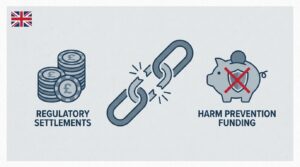
The UK Gambling Commission has quietly shifted its approach to how regulatory settlement payments are allocated, removing the longstanding assurance that funds collected from operators found in breach of licence conditions would be directed toward gambling harm research, prevention, and treatment. The change, which has drawn criticism from harm-reduction advocates and charity groups, raises pointed questions about accountability and the future funding pipeline for problem gambling support services. It also arrives at a moment when the broader UK gambling reform agenda remains in flux, with the government still working through commitments outlined in its 2023 White Paper.
What the Settlement Shift Actually Means for Harm Prevention
Before unpacking the implications, it helps to understand what changed and why it matters in practical terms. Regulatory settlements in the UK gambling sector have historically functioned as a mechanism through which operators pay sums (often substantial) to resolve compliance failures without formal prosecution. A significant portion of these payments was typically ring-fenced for organisations working on gambling harm.
- No binding commitment: Settlement payments from licensed operators will no longer carry a formal guarantee that proceeds fund gambling harm initiatives.
- Funding uncertainty: Charities and research bodies that relied on settlement-derived income now face a less predictable revenue stream.
- The Gambling Commission retains discretion over how settlement funds are used, but transparency around allocation criteria has not been expanded.
- Timing is significant: This policy shift coincides with ongoing debates about a statutory levy on gambling operators to fund harm reduction, a measure the industry has resisted.
- Operator accountability gap: Without earmarked harm-prevention spending, settlements risk becoming a cost of doing business rather than a corrective mechanism.
A Funding Model Built on Voluntary Goodwill
For years, the UK’s approach to funding gambling harm research and treatment has leaned heavily on voluntary contributions from operators. The system was never compulsory in the way a statutory levy would be. And while the Gambling Commission’s regulatory framework includes licence conditions and codes of practice, the actual flow of money toward harm prevention has always depended, at least in part, on a patchwork of goodwill, reputational pressure, and settlement agreements.
That patchwork is now thinner.
Removing the guarantee that settlement payments support harm work doesn’t mean the money vanishes. But it does mean the Commission can redirect funds without public explanation, and operators settling compliance cases no longer face the implicit expectation that their payments will visibly benefit those harmed by gambling. Whether this represents a deliberate policy choice or an administrative streamlining remains unclear (a distinction regulators have been slow to clarify).
Why the Statutory Levy Debate Gains New Urgency
The UK government’s 2023 gambling White Paper proposed a mandatory levy on operators to create a stable, independent funding source for harm research and treatment. Progress has been slow. Industry lobbying, definitional disputes over what counts as “harm,” and broader political distractions have all contributed to delays. Still, the removal of settlement guarantees arguably strengthens the case for a levy. If voluntary and semi-voluntary mechanisms keep eroding, the alternative is a compulsory one.
GambleAware, the charity that has historically received a large share of voluntary and settlement-linked funding, has repeatedly called for a statutory model. Its position is straightforward: relying on operator generosity creates a structural conflict of interest. Operators fund the very research that might lead to tighter regulation of their products. A levy, administered independently, would sever that link.
Yet not all market participants agree on the design. Smaller operators worry about disproportionate cost burdens. Larger firms, some of which already contribute significant voluntary sums, question whether a levy would simply replace existing commitments rather than add to them. The economics of who pays, how much, and who controls the resulting fund remain unresolved.
How Settlements Have Shaped Operator Behaviour
Regulatory settlements in the UK gambling sector have not been trivial sums. In recent years, several operators have agreed to payments exceeding £10 million to resolve failures related to anti-money laundering controls, social responsibility shortcomings, and customer interaction failures. These settlements served a dual purpose: they penalised non-compliance and channelled resources toward mitigating the harm caused by those same failures.
| Function | Previous Approach | Current Approach |
|---|---|---|
| Settlement allocation | Portion earmarked for harm prevention | No guaranteed allocation to harm prevention |
| Transparency | Public disclosure of recipient organisations common | Allocation criteria less clearly communicated |
| Operator expectation | Settlements framed as corrective and restorative | Settlements risk being perceived as purely financial penalties |
| Funding stability for charities | Semi-predictable income from major settlements | Greater uncertainty and reliance on other sources |
Without the restorative element, settlements become simpler transactions. An operator pays, the case closes, and the connection between the breach and its consequences fades. That shift in framing matters more than it might appear on the surface.
The Broader Regulatory Landscape and What Comes Next
Britain’s gambling regulatory environment is in a transitional phase. The White Paper promised sweeping reforms, from affordability checks to stake limits on online slots. Some measures have moved forward. Others remain stalled. The settlement funding question sits within this larger context of incomplete reform, where individual policy changes can look minor in isolation but collectively reshape the incentive structures operators navigate.
What remains less clear is whether the Gambling Commission views this change as permanent or interim. If a statutory levy materialises, the question of settlement allocation becomes less critical because a dedicated, compulsory funding stream would exist. But if the levy continues to stall, the gap left by removing settlement guarantees could widen considerably. Charities operating in this space have limited reserves and even less patience for ambiguity.
Frequently Asked Questions
What are regulatory settlement payments in UK gambling?
They are financial sums paid by licensed gambling operators to the Gambling Commission to resolve identified breaches of licence conditions or regulatory codes, typically without formal prosecution. These payments have historically been substantial, sometimes reaching tens of millions of pounds.
Will any settlement money still go toward gambling harm prevention?
Possibly, but there is no longer a formal guarantee. The Commission retains discretion over how funds are directed, which means some portion could still reach harm-related programmes. The difference is that this outcome is no longer assured or publicly committed.
What is the proposed statutory levy?
A compulsory charge on gambling operators, outlined in the UK government’s 2023 White Paper, intended to create a stable and independent funding source for gambling harm research, education, and treatment. It has not yet been implemented.
Why does this matter for people affected by gambling harm?
Organisations providing treatment, research, and support services depend on funding. When one source becomes unreliable, service delivery can be affected, particularly for smaller providers without diversified income. The people who use those services feel the impact most directly.



