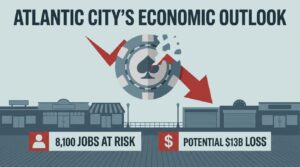
Atlantic City’s casino industry confronts what may be its most consequential threat in decades. A scenario analysis warns that the resort city could shed more than 8,100 casino jobs and forfeit nearly $13 billion in annual revenue if competitive pressures and regulatory shifts continue on their current trajectory. The stakes extend well beyond the boardwalk, touching municipal finances, state tax receipts, and the broader regional labor market that has long depended on gaming as its economic backbone.
What the Revenue Projections Actually Signal for Atlantic City
Before parsing the numbers, it helps to understand what’s driving them. Atlantic City’s casino sector has been squeezed from multiple directions: neighboring states expanding their own gaming footprints, the rise of online and mobile wagering cannibalizing in-person visits, and persistent infrastructure challenges that make the city a harder sell for leisure travelers. The potential loss of $13 billion in annual revenue isn’t a single catastrophic event. It’s the compounding effect of incremental erosion across several fronts simultaneously.
- Job losses exceeding 8,100 positions would represent a significant share of the city’s total employment base, with ripple effects across hospitality, food service, and retail sectors that orbit the casinos.
- Revenue contraction at this scale would severely limit Atlantic City’s ability to fund public services, infrastructure maintenance, and debt obligations already under strain.
- New Jersey’s gaming tax receipts, which rely heavily on Atlantic City operations, face a structural gap that online gambling revenues alone may not fill.
- The competitive landscape has shifted permanently: Pennsylvania, New York, and Maryland all operate expanding casino markets within driving distance of Atlantic City’s core customer base.
- Workforce retraining and economic diversification efforts remain underfunded relative to the scale of potential displacement.
A Labor Market Already Under Pressure
Atlantic City’s employment picture has been fragile for years. The closure of multiple casinos between 2014 and 2016 eliminated thousands of positions, and while some properties reopened under new ownership, total employment never fully recovered. Losing another 8,100 jobs would push the city’s unemployment rate into territory that demands state or federal intervention.
What makes this scenario particularly difficult is the demographic profile of the workforce at risk. Casino employees in Atlantic City skew older, with many having spent entire careers in the industry. Transitioning a 52-year-old floor supervisor into a different sector isn’t a spreadsheet exercise. And the city lacks the density of alternative employers that might absorb displaced workers in a larger metro area.
Still, not every indicator points downward. Caesars Entertainment’s Atlantic City properties have invested in renovations and non-gaming amenities, betting that experiential offerings can offset some of the decline in traditional table and slot revenue. Whether that bet pays off at scale remains an open question.
How Regional Competition Reshapes the Calculus
The geography of East Coast gaming has changed fundamentally over the past decade. Pennsylvania now generates more commercial casino revenue than New Jersey. New York’s downstate casino licensing process, once stalled, is moving forward with multiple operators vying for Manhattan-adjacent locations. Maryland’s MGM National Harbor has captured a segment of the mid-Atlantic market that once traveled to Atlantic City by default.
Each new competitor doesn’t just take a slice of the pie. It changes the pie itself. Casual gamblers, the ones who might drive two hours for a weekend trip, now have closer options. Atlantic City retains advantages in beach tourism and brand recognition, but those advantages erode when the primary draw (gaming) is available 45 minutes from home instead of three hours away.
| Competitive Factor | Atlantic City | Regional Competitors |
|---|---|---|
| Proximity to major metro areas | 2–3 hours from NYC/Philadelphia core | Many properties under 1 hour from population centers |
| Non-gaming amenities | Beach, boardwalk, entertainment venues | Varies; some offer resort-style complexes with dining and retail |
| Online/mobile integration | Strong iGaming market via NJ regulation | Pennsylvania and others rapidly expanding digital platforms |
| Workforce availability | Experienced but aging labor pool | Access to broader, younger metro labor markets |
The Digital Offset: Is iGaming Enough?
New Jersey pioneered legal online gambling in the United States, and the state’s iGaming revenue has grown consistently year over year. But here’s the tension: online revenue flows to operators licensed in New Jersey, yet it doesn’t generate the same local economic multiplier as a physical casino. A blackjack hand played on a phone in Bergen County doesn’t employ a dealer in Atlantic City, doesn’t fill a hotel room, doesn’t put a customer in a boardwalk restaurant.
iGaming is a lifeline for state tax revenue. It is not, at least on paper, a lifeline for Atlantic City’s local economy. That distinction matters enormously when the conversation turns to jobs and municipal budgets rather than aggregate state gaming numbers.
Reframing the Path Forward Through Strategic Diversification
Economic resilience in cities like Atlantic City demands more than defending the status quo. It requires a deliberate reframing of identity, both for policymakers and for the workforce itself. Neuro-linguistic programming principles offer a useful lens here: the language communities use to describe their economic future shapes the decisions they make and the investments they attract.
When Atlantic City defines itself exclusively as a “casino town,” every conversation about its future gets filtered through a single industry’s performance metrics. That framing limits imagination. Shifting the narrative toward “coastal entertainment and innovation hub” opens cognitive pathways to different kinds of investment, different workforce development strategies, and different partnerships. This isn’t branding fluff. Research in behavioral economics consistently shows that how stakeholders frame a problem determines the solution set they’re willing to consider.
For displaced workers, the psychological dimension is equally critical. Identity anchoring (the tendency to define oneself by a long-held role) can become a barrier to retraining and career transition. Effective workforce programs don’t just teach new skills; they help participants construct a new professional narrative. “I’m a hospitality professional exploring technology” lands differently, neurologically and motivationally, than “I’m an unemployed casino worker.” Municipal leaders and workforce boards would do well to integrate these principles into program design rather than treating job placement as a purely logistical challenge.
Concrete diversification efforts, including conference tourism, offshore wind industry staging, and healthcare expansion, have been discussed for years. Execution has lagged behind rhetoric. The potential loss of 8,100 jobs may finally create the urgency that years of gradual decline could not.
Frequently Asked Questions
Why is Atlantic City at risk of losing so many casino jobs?
The combination of intensifying regional competition from casinos in Pennsylvania, New York, and Maryland, along with the shift toward online gambling that doesn’t require physical staff, has created sustained downward pressure on in-person casino operations in Atlantic City.
Can online gambling revenue replace what Atlantic City stands to lose?
Not directly. While New Jersey’s iGaming market generates substantial tax revenue for the state, online gambling does not produce the local employment, hotel occupancy, or retail spending that physical casinos support in Atlantic City. The economic multiplier effects are fundamentally different.
What diversification options exist for the city?
Several have been proposed, including positioning Atlantic City as a hub for offshore wind energy operations, expanding healthcare facilities, and investing in year-round conference and event tourism. Progress on these fronts has been uneven, though the urgency is growing as gaming revenue faces structural headwinds.



