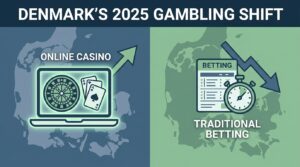
Online casino has displaced sports betting as the single largest gambling segment in Denmark, marking a structural shift in the country’s regulated market. The change, confirmed by data from the Danish Gambling Authority (Spillemyndigheden), reflects years of steady growth in digital casino products and a plateau in traditional wagering revenue. Denmark’s regulated online gambling market has long been dominated by sports betting operators, making this crossover a notable milestone for European iGaming.
What the Revenue Shift Tells Us About Danish Gambling
The transition didn’t happen overnight. Online casino’s share of gross gaming revenue has been climbing for several consecutive quarters, driven by expanding game libraries, mobile-first player behaviour, and increasingly sophisticated retention strategies from licensed operators. Sports betting, while still generating substantial revenue, has seen its growth flatten in a market where customer acquisition costs continue to rise and margins remain under pressure from regulatory requirements.
This is more than a statistical curiosity. For operators licensed under Denmark’s gambling framework, the rebalancing of revenue streams carries implications for product investment, marketing allocation, and compliance resourcing. Casino products tend to generate higher per-session revenue but also attract more intense regulatory scrutiny around responsible gambling measures (a distinction regulators have been slow to enforce uniformly across Europe).
- Online casino now generates more gross gaming revenue than sports betting in Denmark’s regulated market, ending a period of betting dominance that stretched back to the market’s liberalisation in 2012.
- Mobile play and live dealer formats have arguably been the primary accelerants behind casino’s growth trajectory.
- Sports betting revenue has not declined sharply but has plateaued, suggesting market saturation rather than product failure.
- Operators will likely redirect marketing budgets toward casino verticals, reshaping competitive dynamics among Denmark’s licensed brands.
- The Danish Gambling Authority may intensify its focus on casino-specific player protection tools as the segment’s dominance grows.
Why Denmark’s Market Structure Made This Inevitable
Denmark operates a partially liberalised gambling model. Online casino and sports betting are open to licensed private operators, while land-based casino and lottery products remain under state control. The Danish Gambling Authority’s licensing framework has created a competitive environment where international operators invest heavily in localised content and compliance infrastructure.
That competitive pressure has, in practice, benefited the casino vertical disproportionately. Slot suppliers and live casino providers have flooded the Danish market with localised titles, Danish-language dealers, and gamification features designed to extend session times. Betting products, by contrast, are more commoditised. Odds margins are thin. And the product itself is constrained by the sporting calendar in ways that casino simply isn’t.
Still, one factor deserves closer scrutiny: the role of bonus structures. Casino bonuses in Denmark remain a powerful acquisition tool, even within the regulatory guardrails that Spillemyndigheden enforces. Whether the current bonus framework adequately protects players in a market now dominated by higher-volatility casino products is a question regulators will need to revisit.
How Operators Are Repositioning
Major operators active in Denmark have already begun shifting resources. Product teams are prioritising casino content partnerships, and some brands have restructured their front-end experiences to surface casino offerings more prominently than sportsbook pages. The economics are straightforward: casino products carry better margins and are less dependent on external event schedules.
But not every operator views this the same way. Some sportsbook-first brands see the betting plateau as cyclical rather than structural, pointing to upcoming major sporting events as potential catalysts for renewed wagering growth. Whether that optimism holds will depend partly on how effectively these operators can cross-sell casino products to their existing betting customer base.
| Segment | Trend (2023–2025) | Key Driver |
|---|---|---|
| Online Casino | Consistent growth, now market leader | Mobile adoption, live dealer expansion, localised content |
| Sports Betting | Plateauing revenue | Market saturation, margin compression, regulatory costs |
| Land-based Casino | Stable but limited | State-controlled, fewer competitive dynamics at play |
Regulatory Implications and Player Protection
When a market’s centre of gravity shifts toward casino products, regulators typically follow with tighter controls. Denmark has already implemented deposit limits, self-exclusion registers, and mandatory responsible gambling messaging. Yet the adequacy of these measures was calibrated during a period when betting was the dominant product.
Casino gameplay presents different risk profiles. Session lengths tend to be longer. Loss velocity can be higher, particularly with slots. And the psychological mechanisms that drive problematic play differ from those in sports betting, where the illusion of skill plays a larger role. Spillemyndigheden will likely need to recalibrate its supervisory approach, potentially introducing casino-specific affordability checks or enhanced session-time interventions.
At least on paper, Denmark’s regulatory infrastructure is well-equipped for this. The country’s data-sharing requirements give the regulator granular visibility into operator activity. Translating that data into proactive intervention is the harder part.
What This Means for the Broader Nordic Market
Denmark’s shift mirrors trends visible in Sweden and, to a lesser extent, Finland’s re-regulation discussions. Across the Nordics, online casino is gaining ground against betting in regulated markets. The pattern suggests that as digital gambling markets mature, casino products naturally capture a larger share of player spend.
For operators evaluating Nordic expansion or rebalancing their portfolio strategies, Denmark’s data provides a useful benchmark. The market is well-regulated, transparent in its reporting, and large enough to be commercially meaningful without the scale distortions seen in larger European jurisdictions.
Frequently Asked Questions
When did online casino overtake sports betting in Denmark?
The crossover occurred in 2025, based on gross gaming revenue data published by the Danish Gambling Authority. The shift had been building for several quarters prior.
Is sports betting declining in Denmark?
Not exactly. Revenue has plateaued rather than dropped significantly. The segment remains commercially viable, but growth has stalled relative to online casino’s upward trajectory.
What does this mean for Danish gambling regulation?
Spillemyndigheden may need to adapt its player protection framework to account for the different risk profile of casino products, including potentially stricter session-time limits and affordability checks. How quickly that happens remains an open question.



