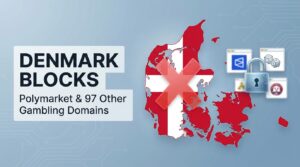
Denmark’s gambling regulator, Spillemyndigheden, has secured a court order to block access to Polymarket and 97 other unlicensed gambling platforms operating within the country. The decision marks one of the most sweeping domain-blocking actions in recent European regulatory history, targeting prediction markets and traditional gambling sites alike. It also raises fresh questions about how regulators across the EU classify blockchain-based prediction platforms — and whether the current patchwork of national frameworks can keep pace with their growth.
What Denmark’s Domain Block Means for Prediction Markets
Before diving into the specifics, the strategic implications of this move deserve attention. Denmark’s action is not an isolated enforcement event; it fits a broader pattern of European regulators drawing harder lines around unlicensed digital gambling operations. Here are the key takeaways:
- Polymarket now faces its second major regulatory setback after previously being fined by the U.S. Commodity Futures Trading Commission (CFTC) in 2022, signalling that jurisdictional risk is compounding for the platform.
- Danish authorities classified prediction markets as gambling under existing law, a framing that could influence how other EU member states approach similar platforms.
- The court order covers 98 domains in total, suggesting Spillemyndigheden pursued a batch enforcement strategy rather than singling out any one operator.
- ISPs in Denmark are now required to block access to the listed domains, though users with VPNs can still circumvent the restriction (a distinction regulators have been slow to enforce).
- The move arrives at a moment when prediction markets are gaining mainstream traction, particularly around political events and elections.
How Spillemyndigheden Built Its Case
Denmark’s gambling authority operates under the Danish Gambling Act, which requires all operators offering gambling services to Danish residents to hold a valid licence. Spillemyndigheden maintains a public blacklist of unauthorised domains and periodically seeks court orders to compel Danish internet service providers to restrict access.
This latest batch of 98 domains represents a significant escalation. Previous rounds typically targeted a handful of offshore casinos or sports betting sites. Including Polymarket’s blockchain-based prediction platform in the same sweep as conventional gambling operators sends a clear signal: in Denmark’s regulatory view, wagering on real-world outcomes — whether an election result or a sports match — falls under the same legal umbrella.
Still, the enforcement mechanism has limits. Domain blocking is a blunt instrument. Sophisticated users route around it easily, and the platforms themselves remain operational for users in jurisdictions where they are not restricted. What the order does accomplish is symbolic and precedential: it puts the classification question on the record.
Polymarket’s Growing Jurisdictional Problem
For Polymarket, Denmark is the latest in a string of regulatory headaches. The platform settled with the CFTC in January 2022, paying a $1.4 million penalty and agreeing to wind down certain markets that the commission deemed unregistered swaps. That settlement forced Polymarket to geo-block U.S. users, pushing its user base further toward international markets.
And while the platform has since grown substantially — reportedly processing hundreds of millions of dollars in trading volume around the 2024 U.S. presidential election — that growth has drawn exactly the kind of regulatory scrutiny that early-stage crypto projects often avoid. Denmark’s move suggests European regulators are no longer content to watch from the sidelines.
The harder question: does Polymarket have a viable path to licensed operation in any major European market? The EU’s Markets in Crypto-Assets Regulation (MiCA) framework, which began phased implementation in 2024, does not explicitly address prediction markets. That regulatory gap leaves individual member states to apply existing gambling or financial services law as they see fit.
A Fragmented European Landscape
Denmark’s approach contrasts with how other jurisdictions have handled prediction markets. France’s ANJ has taken a cautious but less aggressive stance. The UK’s Gambling Commission has not publicly moved against Polymarket. And in some smaller EU states, the platforms operate in a grey zone — not explicitly licensed, but not actively blocked either.
This fragmentation creates an uneven playing field. Operators face a patchwork of national rules with no harmonised EU-level framework governing prediction markets specifically. For institutional participants and liquidity providers, the uncertainty arguably matters more than any single enforcement action.
| Jurisdiction | Regulatory Status of Prediction Markets | Key Authority |
|---|---|---|
| Denmark | Blocked — classified as unlicensed gambling | Spillemyndigheden |
| United States | Restricted — CFTC settlement; geo-blocked for U.S. users | CFTC |
| United Kingdom | No public enforcement action to date | Gambling Commission |
| France | Under review; cautious regulatory posture | ANJ |
| EU-wide (MiCA) | Not explicitly covered by current framework | ESMA / national regulators |
Why the Timing Matters
Prediction markets have surged in visibility. Polymarket’s trading volumes spiked dramatically during the 2024 U.S. election cycle, drawing coverage from mainstream financial media and prompting debates about whether prediction markets produce more accurate forecasts than traditional polling. That visibility cuts both ways: it attracts users and capital, but it also attracts regulators who might previously have ignored a niche crypto product.
Denmark’s decision lands at precisely this inflection point. The platform is no longer small enough to fly under the radar, yet it operates without licences in most of the jurisdictions where its users reside. Whether other European regulators follow Denmark’s lead in the coming months will depend partly on political appetite and partly on whether Polymarket’s growth continues to generate headlines that make inaction politically uncomfortable.
Frequently Asked Questions
Is Polymarket illegal in Denmark?
Polymarket has been classified as an unauthorised gambling service under Danish law. The platform itself is not “illegal” globally, but Danish ISPs are now required to block access to it following the court order obtained by Spillemyndigheden.
Can Danish users still access Polymarket?
Technically, yes — VPNs and other circumvention tools can bypass domain-level blocks. But doing so may expose users to legal risk, and the platform’s terms of service may also restrict access from certain jurisdictions.
Does this affect Polymarket’s operations elsewhere?
Not directly. The Danish order applies only to ISPs within Denmark’s jurisdiction. Polymarket continues to operate for users in markets where it has not been blocked or restricted, though the precedent could embolden regulators in other countries.
Will the EU regulate prediction markets under MiCA?
MiCA, at least on paper, does not explicitly address prediction markets. Whether future amendments or supplementary guidance will bring them into scope remains an open question — one that Denmark’s action may accelerate.