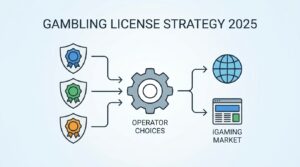
Selecting a gambling license ranks among the most consequential decisions any iGaming operator will face. The jurisdiction an operator chooses shapes everything from market access and tax obligations to player trust and banking relationships. Yet the licensing landscape has grown more fragmented and complex over the past two years, with regulatory bodies tightening requirements while new jurisdictions compete aggressively for applicants. For operators weighing their options in 2025, the calculus involves far more than cost and speed of approval.
What Operators Need to Weigh Before Applying
Before diving into specific jurisdictions, it helps to frame the decision in terms of strategic outcomes rather than administrative convenience. A license is not just a compliance checkbox. It determines which payment processors will work with you, which affiliates will promote you, and which markets you can realistically serve without running afoul of local enforcement. The following takeaways capture the core trade-offs operators should internalize:
- Jurisdictions with stricter regulatory frameworks (such as the UK, Malta, and Sweden) carry higher compliance costs but unlock access to mature, high-value player markets
- Offshore licenses from Curaçao or Anjouan remain cheaper and faster to obtain, though banking and payment processing partnerships are increasingly difficult to secure under these regimes
- Tax structures vary dramatically: Malta’s effective gaming tax sits well below the UK’s 21% remote gaming duty, a gap that compounds at scale
- Dual-licensing strategies are becoming standard among mid-size operators seeking both credibility in regulated markets and flexibility in grey-market territories
- Regulatory momentum is moving toward convergence, with the EU exploring harmonized frameworks that could reshape the value of individual national licenses within the decade
Tier-One Jurisdictions: The Cost of Credibility
The UK Gambling Commission, Malta Gaming Authority, and Gibraltar Regulatory Authority occupy the top tier for a reason. Operators licensed by these bodies gain immediate legitimacy with players, affiliates, and financial institutions. But that legitimacy comes at a price (and not just the application fee).
In the UK, the UKGC has steadily expanded its enforcement posture. Licence holders face ongoing obligations around responsible gambling, anti-money laundering controls, and advertising standards that require dedicated compliance teams. The UK Gambling Commission’s regulatory framework now includes affordability checks that have drawn criticism from parts of the industry but show no signs of being rolled back. Annual fees scale with gross gambling yield, and penalties for non-compliance have reached eight-figure sums in recent cases.
Malta remains arguably the most popular single jurisdiction for operators targeting multiple European markets. The MGA’s B2C and B2B license categories offer flexibility, and the island’s tax regime is notably more favorable than the UK’s. Still, processing times have lengthened. What once took three to four months can now stretch past six, reflecting both increased application volumes and more granular due diligence.
Offshore Options Are Losing Ground
Curaçao has long served as the default entry point for operators seeking a low-barrier license. That calculus is shifting. The jurisdiction’s 2023 regulatory overhaul introduced new compliance requirements, higher fees, and a supervisory body with actual enforcement teeth. Operators who chose Curaçao precisely because oversight was minimal now face a regime that looks more like a mid-tier European framework, without the market access benefits.
And the banking problem has only worsened. Major payment processors and acquiring banks have grown increasingly reluctant to onboard Curaçao-licensed operators, particularly those serving players in jurisdictions where local licensing exists. The result: a license that costs less on paper but creates friction at every downstream touchpoint.
Comparative Licensing Overview
| Jurisdiction | Approx. Setup Cost | Processing Time | Tax on GGR | Banking Access |
|---|---|---|---|---|
| UK (UKGC) | £50,000–£150,000+ | 4–8 months | 21% | Strong |
| Malta (MGA) | €30,000–€100,000 | 4–6 months | 5% (capped) | Strong |
| Gibraltar | £30,000–£100,000 | 3–6 months | 1% of turnover (capped at £425k) | Strong |
| Curaçao | $15,000–$40,000 | 6–12 weeks | 2% on net profit | Increasingly limited |
| Isle of Man | £35,000–£80,000 | 3–5 months | 1.5% of net profits | Good |
The Dual-License Strategy and Why It’s Gaining Traction
A growing number of operators are pursuing two or more licenses simultaneously. The logic is straightforward: hold a tier-one license for credibility and regulated market access, then pair it with a more permissive jurisdiction to serve players in markets where no local licensing regime exists. This approach carries its own risks. Regulators in stricter jurisdictions have begun scrutinizing whether dual-licensed operators maintain consistent standards across all their licensed entities, or whether the offshore arm operates under looser controls.
Whether this strategy remains viable depends heavily on how quickly regulatory convergence advances. The European Commission has signaled interest in a more unified approach to online gambling regulation, though concrete legislative proposals remain distant. In the meantime, operators with dual licenses walk a tightrope between flexibility and regulatory exposure.
How Licensing Choices Shape Player Psychology and Brand Perception
Beyond the regulatory mechanics, licensing decisions carry a psychological dimension that operators frequently underestimate. Players may not read the fine print of a license, but they register trust signals. A visible UKGC or MGA badge on a casino’s footer functions as a cognitive shortcut, reducing the perceived risk of depositing funds. This is anchoring at work: the first piece of credibility information a player encounters frames their entire evaluation of the brand.
Operators can leverage this by positioning licensing information prominently rather than burying it in terms and conditions. The framing matters. Stating “licensed and regulated by the Malta Gaming Authority” activates a different mental model than simply listing a license number. Players process authority cues rapidly, and in a market saturated with options, the operator whose trust signals are clearest wins the deposit. Conversely, operators holding only offshore licenses often find themselves compensating with aggressive bonuses, which attract price-sensitive players but erode margins and increase churn. The long-term brand equity of a tier-one license, while harder to quantify on a balance sheet, compounds over time through higher player lifetime values and lower acquisition costs. Smart operators treat the license not as a regulatory burden but as a positioning asset, one that shapes how players feel before they ever place a bet.
Frequently Asked Questions
Can an operator hold multiple gambling licenses at once?
Yes. Many operators maintain licenses in two or more jurisdictions to balance market access with operational flexibility. The key challenge is ensuring compliance standards remain consistent across all licensed entities, as regulators increasingly share information and cross-reference enforcement actions.
Which gambling license is cheapest to obtain?
Curaçao and Anjouan remain among the least expensive options in terms of upfront costs. But “cheapest” is misleading here. Lower licensing fees often correlate with restricted banking access and reduced player trust, costs that surface downstream rather than at application.
How long does it take to get a UK gambling license?
The UKGC typically processes applications within four to eight months, though complex corporate structures or incomplete submissions can extend timelines considerably. Operators should budget for at least six months from initial submission to approval.
Is a Malta gaming license valid across the EU?
Not automatically. While Malta’s EU membership provides certain passporting advantages, most EU member states maintain their own national licensing regimes. An MGA license does not grant automatic right to operate in, say, France or the Netherlands. Each market requires separate assessment.