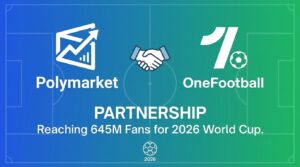
Polymarket, the blockchain-based prediction market platform, has struck an exclusive partnership with OneFootball, a Berlin-headquartered digital football platform claiming more than 645 million fans globally and 200 million monthly active users. The deal lands roughly two weeks before the 2026 FIFA World Cup kicks off across the United States, Canada, and Mexico. It marks one of the most ambitious distribution plays yet by a prediction market operator targeting mainstream sports audiences, and it signals a broader strategic shift in how crypto-native platforms are pursuing growth beyond their core user base.
What the OneFootball Deal Means for Prediction Markets in Sport
Before diving into the specifics, it helps to frame what this partnership represents at a strategic level. Prediction markets have long operated at the margins of sports engagement, attracting crypto-literate users but struggling to break through to casual fans. This deal changes the calculus. By embedding directly into a platform where hundreds of millions already consume football content, Polymarket is bypassing the traditional funnel problem entirely.
- Polymarket gains direct access to OneFootball’s 200 million monthly active users, a distribution channel that dwarfs most crypto-native platforms’ entire addressable markets
- The exclusive nature of the partnership locks out competing prediction market operators from OneFootball’s ecosystem during a peak-attention sporting event
- Timing is deliberate: the 2026 FIFA World Cup, expanded to 48 teams for the first time, is projected to be the most-watched sporting event in history
- For OneFootball, the deal adds an interactive engagement layer that could boost session times and user retention during tournament coverage
- The partnership tests whether mainstream sports audiences will engage with blockchain-based prediction markets when friction is reduced and context is familiar
Why the World Cup Window Matters
The 2026 FIFA World Cup is not just another tournament. With 48 teams, 104 matches, and host cities spanning three countries, the event represents a once-in-a-cycle opportunity for platforms seeking mass engagement. Polymarket’s decision to time this partnership around the tournament is strategic in a way that goes beyond marketing convenience.
Sports prediction markets historically see their sharpest usage spikes during major international tournaments, when even casual viewers develop opinions worth backing. And while regulated sportsbooks have long capitalized on these windows, prediction markets operate in a different register (a distinction regulators have been slow to enforce consistently across jurisdictions). They offer event-based contracts rather than traditional betting lines, which creates a subtly different user experience.
Still, the question of regulatory treatment hangs over the entire sector. Whether Polymarket’s contracts are classified as derivatives, gambling products, or something else entirely varies by market. The partnership with OneFootball’s global football content platform could accelerate regulatory scrutiny in jurisdictions where prediction markets exist in legal grey zones.
OneFootball’s Strategic Calculus
For OneFootball, this is about more than adding a widget. The Berlin-based company has spent years building one of the largest independent football media platforms in the world, competing for attention against broadcasters, social media, and official league apps. Adding prediction market functionality gives users a reason to stay on the platform longer and engage more actively with match content.
That engagement layer matters commercially. Platforms that can demonstrate higher session times and deeper interaction command better advertising rates and stronger positions in content licensing negotiations. Whether prediction markets deliver that engagement at scale remains unproven in this context, but the logic is sound on paper.
How This Compares to Traditional Sports Partnerships
| Factor | Traditional Sportsbook Deal | Polymarket–OneFootball Partnership |
|---|---|---|
| Regulatory clarity | Generally licensed and regulated | Varies by jurisdiction; prediction markets face evolving oversight |
| User experience | Odds-based betting with established formats | Event-based contracts on blockchain infrastructure |
| Distribution model | Standalone apps, broadcast integrations | Embedded within an existing content platform reaching 645M+ fans |
| Revenue structure | Commission on wagers, sponsorship fees | Terms of this specific deal have not been publicly disclosed |
The Broader Shift: Crypto Platforms Chasing Sports Audiences
Polymarket is not operating in isolation. Across the crypto sector, sports have become the preferred gateway to mainstream adoption. Fan tokens, NFT ticketing experiments, and now prediction market integrations all reflect the same underlying thesis: sports audiences are large, passionate, and willing to engage with new formats if the experience is intuitive enough.
But most of those earlier experiments stumbled. Fan tokens lost value. NFT projects faded. What makes prediction markets potentially different is that they offer genuine utility during live events. A user watching a World Cup match has an immediate, contextual reason to engage with a prediction contract in a way that buying a digital collectible never quite delivered.
Even so, execution risk is real. Polymarket’s blockchain-based prediction contracts require some degree of onboarding that traditional apps do not. How much of that friction OneFootball can absorb through its integration will likely determine whether this partnership produces meaningful conversion numbers or remains a high-profile experiment.
Frequently Asked Questions
What is Polymarket?
Polymarket is a prediction market platform built on blockchain technology where users can trade on the outcomes of real-world events, including political elections, economic indicators, and sporting events. It operates using event-based contracts rather than traditional betting odds.
How large is OneFootball’s audience?
OneFootball reports reaching more than 645 million fans worldwide, with approximately 200 million monthly active users engaging with football content across its platform. Those figures position it as one of the largest independent football media properties globally.
Is this partnership limited to the 2026 World Cup?
The partnership has been announced in the context of the upcoming 2026 FIFA World Cup, though the full duration and scope of the exclusivity agreement have not been publicly detailed. The World Cup timing is clearly a catalyst, but whether the integration extends beyond the tournament remains to be confirmed by either party.
Are prediction markets legal?
The legal status of prediction markets varies significantly across jurisdictions. In some markets they operate under existing regulatory frameworks, while in others their classification remains unsettled. Users should verify the regulatory status in their own jurisdiction before participating.