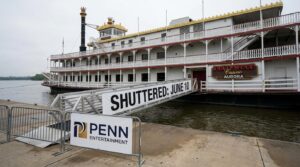
Penn Entertainment has confirmed it will permanently close the Hollywood Casino Aurora riverboat at 5:59 am CDT on 10 June, ending decades of gaming operations on the Fox River in Aurora, Illinois. The closure marks the final chapter for one of the state’s original riverboat casinos, a format that once defined Illinois gambling but has steadily lost ground to land-based competitors and shifting regulatory frameworks. The decision carries consequences for hundreds of employees, local tax revenues, and the broader competitive landscape across the Chicago metropolitan gaming market.
What the Aurora Closure Signals for Illinois Gaming
Before unpacking the details, it’s worth framing what this shutdown actually represents for stakeholders across the region. This isn’t merely a single property going dark. It reflects a structural realignment in how Illinois distributes gaming capacity, particularly as newer, larger venues continue to absorb market share.
- Revenue pressure from land-based expansion: The proliferation of land-based casinos and video gaming terminals across Illinois has eroded the riverboat model’s viability, squeezing margins at legacy venues like Aurora.
- Workforce displacement: Hundreds of casino employees face job losses, with ripple effects likely felt across Aurora’s hospitality and service sectors.
- Local government budgets that have long depended on gaming tax receipts from the riverboat will need to identify alternative revenue streams or absorb the shortfall.
- Penn Entertainment’s portfolio strategy: The closure allows Penn to concentrate resources on higher-performing properties, a pattern consistent with the company’s broader capital allocation approach.
- Illinois regulators face renewed questions about market saturation, a topic that has simmered since the state expanded gaming licenses in 2019.
A Riverboat Era Winds Down
When Illinois first authorized riverboat gambling in the early 1990s, the concept was novel, even glamorous. Floating casinos along the state’s rivers attracted visitors who might never have set foot in a traditional gaming hall. Aurora’s riverboat was among the earliest, and for years it generated substantial revenue for both its operator and the city.
But the market changed around it. Land-based casinos opened. Video gaming terminals spread to bars and restaurants statewide, numbering in the tens of thousands. And then came the biggest shift: Chicago itself entered the casino race, with a massive new venue under development that promises to reshape regional competition entirely. Against that backdrop, a riverboat docked on the Fox River was always going to struggle for relevance.
Penn Entertainment, which operates gaming and racing properties across North America through its Hollywood Casino and related brands, had been evaluating the Aurora property’s performance for some time. The 10 June date gives the company a clean operational exit before the summer season fully ramps up.
Impact on Aurora’s Economy and Workforce
The city of Aurora, Illinois’s second-largest municipality, has relied on gaming revenue as a meaningful component of its fiscal picture. Casino tax receipts have historically funded public services, infrastructure, and community programs. Losing that stream won’t be catastrophic on its own, but it compounds other fiscal pressures municipalities across Illinois already face.
For workers, the timeline is tight. Employees at the Hollywood Casino Aurora include dealers, floor staff, food service workers, security personnel, and administrative teams. Whether Penn Entertainment offers transfer opportunities to other properties remains an open question (and one the company has not publicly detailed). Some displaced workers may find positions at competing Illinois casinos, though the regional market’s absorption capacity is uncertain at best.
How Market Saturation Reshapes Operator Decisions
Illinois now hosts more gaming positions than at any point in its history. That expansion has been deliberate, driven by legislative action designed to boost state revenues. Yet the math doesn’t always work in every operator’s favor. When supply grows faster than demand, the weakest venues close. Simple as that.
Penn Entertainment’s decision fits a pattern visible across U.S. regional gaming markets. Operators are consolidating around their strongest assets, investing in digital platforms and sports betting, and exiting properties where the return no longer justifies the overhead. The company’s broader pivot toward its ESPN Bet partnership and interactive gaming suggests where management sees future growth, and it isn’t on a riverboat in suburban Chicago.
Still, the closure raises a harder question for regulators: at what point does market saturation begin to undermine the tax revenue gains that expansion was supposed to deliver?
Frequently Asked Questions
When exactly does Hollywood Casino Aurora close?
The casino will cease operations at 5:59 am CDT on 10 June.
Why is Penn Entertainment closing this location?
The company has not issued a granular public explanation, but the closure aligns with declining competitiveness of the riverboat format amid Illinois’s expanded land-based and video gaming landscape. Concentrating capital on higher-performing assets appears to be the driving logic.
Will employees be relocated to other Penn properties?
That hasn’t been confirmed publicly. Affected workers may have opportunities at other Penn Entertainment venues, though specifics remain undisclosed.
What does this mean for Aurora’s tax revenue?
The city will lose a recurring source of gaming tax income. How significant that gap proves depends on whether alternative revenue sources or development projects fill the void, something local officials will need to address in upcoming budget cycles.
Reading the Broader Competitive Landscape
Understanding this closure requires looking beyond a single property’s P&L statement. The psychology of market positioning matters here. Operators like Penn Entertainment don’t just react to current losses; they anticipate where competitive gravity is shifting. When a major new casino opens in downtown Chicago, the gravitational pull on discretionary gaming dollars across the metro area intensifies. Properties that were already marginal become untenable.
For communities that host legacy gaming venues, the lesson is uncomfortable but clear: the presence of a casino is not a permanent economic anchor. Regulatory environments evolve, consumer preferences migrate, and operators reallocate. Aurora isn’t the first Illinois city to lose a gaming property, and it arguably won’t be the last. The municipalities best positioned to weather these transitions are those that diversified their economic base while gaming revenues were still flowing, rather than treating them as a structural given.
What happens to the physical riverboat itself, and whether the gaming license attached to it carries any residual value in Illinois’s current framework, are questions that will play out in the months ahead. Penn Entertainment has given no indication of plans for the site beyond the closure date.