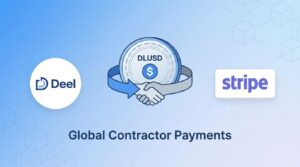
Deel, the global payroll and compliance platform that serves roughly 40,000 businesses and 1.5 million workers spread across more than 150 countries, has integrated Stripe’s full crypto-infrastructure stack to roll out DLUSD. The USD-denominated stablecoin balance lets contractors hold funds, earn rewards, and spend directly within Deel’s ecosystem. It marks one of the more concrete attempts by a major HR-tech platform to embed digital currency into everyday cross-border payroll workflows.
What the Deel-Stripe Stablecoin Integration Signals for Global Payroll
This isn’t simply another crypto announcement dressed up in fintech language. The partnership between Deel and Stripe represents a deliberate convergence of two infrastructure layers that have, until now, operated in largely separate orbits: workforce compliance platforms and crypto payment rails. A brief look at what matters most:
- Direct stablecoin access for contractors: DLUSD gives Deel’s 1.5 million-strong contractor base a dollar-denominated balance that sidesteps traditional banking friction, particularly relevant in markets where USD access is limited or costly
- Stripe’s crypto stack as backbone: Rather than building proprietary blockchain infrastructure, Deel chose to leverage Stripe’s existing crypto capabilities, reducing development risk and accelerating time to market
- The integration positions Deel ahead of most competitors in the global payroll space, few of whom have moved beyond fiat-only settlement
- Rewards layer embedded: Contractors can earn on their DLUSD holdings, adding a retention incentive that traditional payroll wallets simply don’t offer
- For businesses paying international contractors, this could compress settlement times and reduce FX conversion costs at scale
Why Stablecoins Are Gaining Ground in B2B Payroll
The timing here is not accidental. Stablecoin transaction volumes surpassed $10 trillion in 2024 according to multiple industry trackers, and regulatory frameworks in the US and EU are beginning to crystallize around their use in commercial payments. Deel’s move reflects a broader pattern: enterprise platforms are no longer treating stablecoins as experimental. They’re treating them as plumbing.
For contractors in emerging markets (a distinction that matters enormously in Deel’s user base), holding a USD-pegged balance offers a hedge against local currency volatility. In countries like Argentina, Nigeria, or Turkey, where inflation has eroded purchasing power dramatically, a stablecoin wallet inside a payroll platform is arguably more useful than a local bank account. Whether regulators in those jurisdictions will view it the same way remains an open question.
And while stablecoins have drawn scrutiny from financial regulators globally, the involvement of Stripe’s regulated crypto infrastructure lends a layer of institutional credibility that standalone crypto projects often lack.
How DLUSD Fits Into Deel’s Broader Platform Strategy
Deel has been on an aggressive expansion trajectory. The company has built out capabilities spanning employer-of-record services, global payroll processing, immigration support, and now crypto-native payments. DLUSD slots into this stack as a retention and differentiation tool, not just a payment mechanism.
Consider the competitive landscape. Rivals like Remote, Papaya Global, and Oyster HR have focused primarily on compliance and payroll automation. None have introduced a stablecoin product. By moving first, Deel creates switching costs: contractors who accumulate DLUSD balances and earn rewards have a tangible reason to stay on the platform, even if a competing employer uses a different payroll provider.
That stickiness matters.
Contractor Experience and Spending Utility
What separates DLUSD from a typical crypto wallet is the spending layer. Contractors aren’t just holding a token; they can use it within Deel’s ecosystem without converting back to fiat first. This closed-loop design mirrors what fintech super-apps in Asia and Latin America have done with local currencies, but applies the model to a global, dollar-denominated workforce. The practical question is how quickly merchants and service providers outside Deel’s platform will accept or integrate with DLUSD, if at all.
Regulatory and Market Considerations Worth Watching
| Factor | Current Status | Potential Impact |
|---|---|---|
| US stablecoin legislation | Multiple bills under congressional review | Could formalize or restrict how platforms like Deel offer stablecoin balances to US-based contractors |
| EU MiCA regulation | Enforcement began in phases from mid-2024 | Sets compliance requirements for stablecoin issuers operating in European markets |
| Emerging market FX controls | Varies widely by jurisdiction | Some countries may restrict or tax USD-denominated digital balances held by residents |
| Stripe’s crypto licensing | Operational across multiple regulated jurisdictions | Provides Deel with a compliance shield, at least on paper, for crypto-related services |
The Behavioral Economics Behind Stablecoin Payroll Adoption
Beyond the technical architecture, there’s a psychological dimension to why DLUSD could gain traction faster than traditional crypto payroll experiments. Contractors operating across borders often experience what behavioral economists call “loss aversion” around currency conversion. Every time earnings move from one currency to another, fees erode the total. That erosion feels disproportionately painful, even when the absolute amounts are small. A USD-pegged stablecoin that eliminates or reduces those conversion moments addresses this friction directly.
There’s also the anchoring effect at play. When contractors see their balance denominated in US dollars rather than a volatile local currency, their perception of earnings stability shifts. This isn’t just about actual purchasing power; it’s about perceived financial security, which influences contractor satisfaction, platform loyalty, and willingness to accept new contracts through Deel’s global hiring and payroll platform. The rewards mechanism layered on top of DLUSD holdings introduces a compounding incentive structure. Contractors aren’t merely storing value. They’re watching it grow, however modestly, which triggers the endowment effect: people value what they already possess more highly than equivalent alternatives. In practical terms, a contractor with an earning DLUSD balance is less likely to withdraw immediately and more likely to remain engaged with the platform over time.
Still, adoption will hinge on trust. Contractors unfamiliar with stablecoins will need clear, jargon-free communication about what DLUSD is, how it maintains its peg, and what protections exist if something goes wrong. Deel’s onboarding design for this product may matter as much as the product itself.
Frequently Asked Questions
What is DLUSD?
DLUSD is a USD-denominated stablecoin balance available to contractors on Deel’s platform. It allows them to hold, earn rewards on, and spend their earnings without converting to local fiat currency first.
How does Stripe’s involvement affect the product?
Stripe provides the underlying crypto infrastructure, including payment processing and regulatory compliance layers. This means Deel didn’t need to build blockchain capabilities from scratch, and it benefits from Stripe’s existing licenses and security frameworks. The partnership also signals institutional-grade backing, which could ease adoption among risk-averse contractors and enterprise clients alike.
Is DLUSD available to all Deel users?
Availability details have not been fully disclosed. Given the regulatory complexity of offering stablecoin products across 150-plus jurisdictions, rollout will likely be phased.
Can contractors convert DLUSD back to fiat?
The product is designed to function within Deel’s ecosystem, though specific off-ramp details and any associated fees have yet to be confirmed publicly.