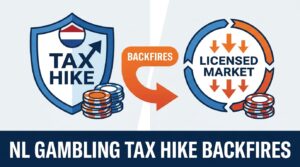
The Dutch government raised its gambling tax rate in an effort to bolster state coffers, but the policy appears to have produced the opposite of its intended effect. Rather than generating more revenue from a growing regulated sector, the licensed online gambling market in the Netherlands has contracted. Operators licensed by the Kansspelautoriteit (KSA) are reporting declining gross gaming revenue, while unlicensed platforms — operating beyond the reach of Dutch tax authorities — have absorbed displaced demand. It is a case study in how fiscal policy, when calibrated without regard for competitive dynamics, can undermine the regulatory framework it depends on.
What the Dutch Tax Increase Actually Did to the Market
Before diving into the strategic implications, it helps to understand the mechanics. The Netherlands increased its gambling tax rate from 29.5% to 30.5% in October 2023, with a further rise to 37.8% taking effect in January 2025. The stated rationale was straightforward: a larger tax take from a sector generating substantial consumer spending. But the arithmetic of regulated gambling markets rarely works that way.
Licensed operators, squeezed by higher tax obligations, have fewer resources to compete on promotional offers, odds, and product quality. Unlicensed operators, paying no Dutch tax at all, face no such constraint. The result: a market caught between two frameworks, one taxed and one invisible to the treasury.
- Tax rate trajectory: 29.5% → 30.5% (Oct 2023) → 37.8% (Jan 2025)
- Licensed market response: Contraction in gross gaming revenue among KSA-licensed operators
- Unlicensed market response: Growth, as players migrate toward platforms offering better value propositions
- Several licensed operators have reportedly scaled back Dutch marketing spend, further reducing their visibility against unlicensed competitors
- State revenue outcome: Still uncertain, but early indicators suggest the tax base is shrinking faster than the rate increase can compensate
Why Channelisation Rates Tell the Real Story
The concept of channelisation — the share of total gambling activity that flows through licensed, regulated operators — is arguably the single most important metric for any regulated gambling jurisdiction. A high channelisation rate means the regulatory system is working: consumers are choosing licensed platforms, tax revenue is flowing, and player protections are being enforced. A declining rate signals structural failure.
In the Netherlands, channelisation was already a concern before the tax hike. The KSA has acknowledged the persistent challenge of unlicensed operators targeting Dutch consumers, often through offshore platforms that accept Dutch payment methods and advertise in Dutch. Raising the tax burden on licensed operators without simultaneously intensifying enforcement against unlicensed ones has, in practice, widened the competitive gap.
That gap matters because it compounds. Every player who migrates to an unlicensed platform is a player the state can no longer protect — and can no longer tax.
How Operators Are Responding
Licensed operators in the Netherlands face a difficult strategic calculus. Some have absorbed the higher tax costs, accepting thinner margins to maintain market share. Others have passed costs to consumers through less generous bonus structures and reduced promotional activity. And a few have begun questioning whether the Dutch market justifies continued investment at all.
The Dutch gambling authority’s licensing framework was designed to attract reputable international operators. Yet the economics of operating under a near-38% tax rate, combined with strict advertising restrictions introduced in 2023, have made the Netherlands one of the more challenging regulated markets in Europe. By comparison, the UK charges 21% on gross gaming revenue, and Malta’s effective rates for B2C operators sit considerably lower (a distinction regulators have been slow to acknowledge publicly).
| Jurisdiction | Approximate GGR Tax Rate | Market Maturity |
|---|---|---|
| Netherlands | 37.8% (2025) | Relatively new regulated market (licensed since Oct 2021) |
| United Kingdom | 21% | Mature, established since 2005 |
| Malta | Variable (lower effective rate) | Mature hub for B2C and B2B operators |
| Denmark | 28% | Established, moderate channelisation |
The Behavioural Economics Behind Player Migration
Understanding why players shift to unlicensed platforms requires more than a spreadsheet. Behavioural science and decision-making psychology offer a sharper lens. When licensed operators reduce bonuses or tighten wagering conditions to offset tax costs, players perceive a decline in value — even if the absolute difference is modest. This perception triggers what behavioural economists call loss aversion: the tendency to weigh losses more heavily than equivalent gains.
Unlicensed platforms exploit this cognitive bias aggressively. They offer sign-up bonuses, higher payout percentages, and fewer friction points during registration. For a player comparing two experiences side by side, the unlicensed option often feels more rewarding, even though it carries real risks around data security, fair play, and dispute resolution. The framing effect plays a role here too. When an unlicensed site presents itself with professional branding and Dutch-language support, the perceived risk drops dramatically in the player’s mind.
Still, the deeper issue is trust calibration. Players who have never experienced a dispute with an operator — licensed or otherwise — tend to underweight the value of regulatory protection. They anchor their expectations on recent experience, not on worst-case scenarios. This anchoring bias makes it exceptionally difficult for regulators to communicate the value of channelisation to consumers who have never needed it. Policymakers who assume rational cost-benefit analysis drives player behaviour are, at least on paper, solving the wrong problem.
What Comes Next for Dutch Gambling Policy?
The Dutch government faces a policy feedback loop. Higher taxes reduce the competitiveness of licensed operators. Reduced competitiveness drives players to unlicensed platforms. Fewer players in the licensed market shrink the tax base. A shrinking tax base creates pressure for — yes — higher taxes.
Breaking that cycle requires either a reduction in the tax rate (politically difficult), a dramatic escalation in enforcement against unlicensed operators (resource-intensive), or both. The KSA has signalled interest in stronger enforcement tools, including ISP blocking and payment processing restrictions, but implementation has been uneven.
Whether the Dutch parliament revisits the 37.8% rate before its effects fully materialise remains an open question. What is less ambiguous is the direction of travel: without intervention, the licensed market’s share of total Dutch gambling activity will continue to erode, taking both tax revenue and player protection standards with it.
Frequently Asked Questions
Why did the Netherlands raise its gambling tax?
The government sought to increase state revenue from the regulated gambling sector. The tax was raised incrementally, reaching 37.8% of gross gaming revenue in January 2025.
Has the tax increase generated more revenue?
Early indications suggest not. The licensed market has contracted, meaning the higher rate applies to a smaller revenue base. Whether net tax receipts have increased, decreased, or remained flat has not been officially confirmed.
What is channelisation and why does it matter?
Channelisation measures the percentage of total gambling activity that occurs through licensed, regulated operators. High channelisation means the regulatory system is functioning — players are protected, and the state collects tax. The Netherlands is seeing this metric decline, which undermines both objectives simultaneously.
Are other European countries facing similar issues?
Several jurisdictions with higher-than-average tax rates have reported channelisation challenges. The dynamic is not unique to the Netherlands, but the speed and scale of the Dutch tax increase have made the effects particularly visible there.



