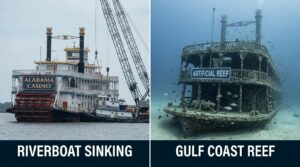
Alabama has deployed a decommissioned riverboat casino to the floor of the Gulf of Mexico, repurposing the vessel known as Argosy VI as the foundation for a new artificial reef. The project, coordinated by the Alabama Department of Conservation and Natural Resources, transforms a relic of the state’s gambling history into marine habitat infrastructure. It marks one of the more unusual reef-building efforts along the Gulf Coast, where states have increasingly turned to unconventional materials to bolster underwater ecosystems.
What the Argosy VI’s Second Life Means for Gulf Reef Strategy
Artificial reef programs across the Gulf states have gained momentum in recent years, driven by a combination of environmental goals and fishing industry economics. Alabama’s decision to sink a former casino vessel fits within that broader push, but carries a few distinctive implications worth isolating.
- Cost efficiency through repurposing: Decommissioned vessels that would otherwise require expensive dismantling can be cleaned, prepared, and deployed at a fraction of the cost of purpose-built reef structures.
- Marine habitat expansion: Large steel-hulled vessels provide complex three-dimensional structures that attract fish, invertebrates, and coral growth far more effectively than flat seabed.
- Alabama’s artificial reef program already manages over 17,000 reef sites in the Gulf, one of the most extensive networks of any U.S. state.
- Tourism and recreational fishing: New reef sites generate economic activity for charter boat operators and dive outfitters along the Alabama coast, particularly around Orange Beach and Dauphin Island.
- The symbolic weight of converting a gambling vessel into public marine infrastructure has not gone unnoticed by local officials or environmental advocates.
From Floating Casino to Fish Habitat
The Argosy VI operated as a riverboat casino before being decommissioned. Riverboat gambling once represented a significant slice of the gaming industry across several southern and midwestern states, but shifting regulations and the rise of land-based casinos rendered many of these vessels obsolete. What happens to a 200-foot steel hull when the slot machines come out? In Alabama’s case, it becomes infrastructure.
Before any vessel can be deployed as an artificial reef, it must undergo extensive environmental preparation. That means stripping all hazardous materials, including fuels, lubricants, asbestos, PCBs, and any coatings that could leach toxins into the water. The Alabama Department of Conservation and Natural Resources oversees this process in coordination with the U.S. Environmental Protection Agency and the Army Corps of Engineers, both of which must sign off before a vessel is cleared for sinking.
Once cleaned, the vessel is towed to a designated reef zone and sunk in a controlled manner. The Argosy VI now sits on the Gulf floor where, over the coming months and years, it will accumulate marine growth and begin functioning as a living reef ecosystem. Within the first year, barnacles, algae, and small invertebrates typically colonize the structure. Larger species follow.
Alabama’s Reef Program in Numbers
| Metric | Detail |
|---|---|
| Total reef sites managed | Over 17,000 |
| Reef zone coverage | Approximately 1,260 square miles of permitted reef zones in the Gulf |
| Types of materials deployed | Ships, concrete, steel, limestone, purpose-built modules |
| Primary economic beneficiaries | Charter fishing, recreational diving, coastal tourism |
| Oversight agency | Alabama Marine Resources Division |
The sheer scale of Alabama’s program arguably makes it the most aggressive artificial reef initiative on the U.S. Gulf Coast. And while Florida and Texas also maintain substantial reef networks, Alabama’s density of deployments per mile of coastline stands apart.
Why Repurposed Vessels Keep Showing Up on the Seabed
Sinking ships to create reefs is not new. The practice dates back decades, with military vessels, barges, and even decommissioned subway cars finding second lives underwater. But the economics have shifted. Scrap steel prices fluctuate, and when they dip, vessel owners face a harder calculus: pay for demolition, or donate the hull to a reef program and claim a tax benefit. States like Alabama have structured their programs to make the second option attractive.
Still, not every vessel qualifies. The environmental preparation process can itself be costly, and vessels with extensive contamination may not be worth the effort. The Argosy VI, built for inland waterway use, was a relatively clean candidate compared to, say, an aging cargo freighter with decades of heavy fuel oil residue in its tanks.
There is also a question of long-term structural integrity. Steel vessels corrode in saltwater (a distinction that separates Gulf deployments from freshwater reef projects in the Great Lakes region). Over decades, the hull will deteriorate, eventually collapsing into a lower-profile rubble field that still functions as habitat but loses the vertical relief that initially attracts pelagic species. Reef managers plan for this degradation cycle.
The Broader Shift: Industrial Waste as Ecological Asset
What makes projects like the Argosy VI deployment worth watching extends beyond marine biology. At a policy level, these programs represent a quiet but meaningful shift in how states think about end-of-life industrial assets. Rather than treating decommissioned infrastructure purely as a disposal problem, reef programs reframe it as a resource allocation question. The vessel has already been built, already consumed its raw materials. Sinking it in a controlled location extracts additional public value from that embedded investment.
This logic has begun influencing other domains as well. Concrete from demolished bridges and highway overpasses routinely enters reef programs. Oil and gas platforms in the Gulf are sometimes converted in place through “rigs-to-reefs” initiatives, avoiding the cost and emissions of full removal. The underlying principle is the same: match the material properties of industrial waste to ecological needs, and the disposal problem becomes a habitat solution.
Whether this approach scales beyond opportunistic deployments into something more systematic remains an open question. Permitting timelines can stretch for years. Environmental review adds cost. And not every coastal community welcomes new reef sites, particularly when they alter established fishing grounds or navigation patterns.
Frequently Asked Questions
What was the Argosy VI before it became a reef?
The Argosy VI operated as a riverboat casino. After being decommissioned from gambling operations, it was cleaned of hazardous materials and prepared for deployment as an artificial reef in the Gulf of Mexico off Alabama’s coast.
How does an artificial reef benefit marine life?
Large structures on the seabed provide surfaces for coral, algae, and invertebrates to colonize. These organisms attract small fish, which in turn draw larger predatory species. The three-dimensional complexity of a vessel hull creates shelter, feeding zones, and breeding habitat that flat sand bottom simply cannot offer.
Is sinking a ship environmentally safe?
Only after rigorous preparation. All fuels, oils, asbestos, PCBs, and toxic coatings must be removed before deployment. Federal agencies including the EPA and Army Corps of Engineers review and approve each vessel before it can be sunk. The process is heavily regulated, at least on paper, though enforcement rigor varies by state.
How long does an artificial reef last?
Steel vessels in saltwater environments corrode over time. Most provide peak habitat value for 20 to 50 years before structural collapse reduces their vertical profile. Even after collapsing, the rubble continues to function as reef habitat, though it attracts different species than a tall, intact structure would.