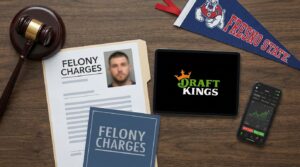
Samuel Silverman, a former trader at DraftKings, has been charged with felony counts in connection with an alleged scheme involving Fresno State athletics. The charges mark a rare instance of a sportsbook insider facing criminal prosecution tied to college sports betting irregularities. While details of the full indictment remain partially sealed, the case has already sent ripples through the regulated sports wagering industry, raising pointed questions about internal controls at licensed operators and the vulnerability of college athletics to manipulation.
What the Felony Charges Against Silverman Signal for the Industry
The prosecution of a former employee from one of the largest U.S. sportsbook operators carries implications that extend well beyond a single courtroom. Here’s what matters most for stakeholders across the betting ecosystem:
- Integrity risk at the operator level: The case suggests that individuals with inside access to trading desks and line-setting tools may exploit their positions, a scenario regulators have long warned about but rarely seen prosecuted.
- College sports exposure: Fresno State’s involvement underscores the particular susceptibility of mid-major and lower-profile programs, where less public scrutiny and smaller athletic budgets can create openings for bad actors.
- Regulatory bodies across multiple states will likely use this case as a reference point when evaluating operator compliance frameworks and employee vetting procedures.
- Reputational fallout for DraftKings: Even if the company cooperated with investigators (a distinction regulators have been slow to publicly clarify), the association with a felony case creates a communications challenge during a period of aggressive market expansion.
Inside the Alleged Scheme
According to available court filings, Silverman allegedly leveraged his role at DraftKings’ sportsbook trading operations to place or facilitate bets connected to Fresno State sporting events under circumstances that prosecutors characterize as fraudulent. The precise mechanics of the scheme have not been fully disclosed, though the felony classification indicates authorities believe the conduct involved significant financial harm or a deliberate pattern of deception.
Traders at major sportsbooks occupy a uniquely sensitive position. They set odds, adjust lines in real time, and have visibility into betting volume and market movement that the public simply does not. That access, in the wrong hands, becomes a tool.
What remains less clear is whether Silverman allegedly acted alone or coordinated with individuals connected to Fresno State’s athletic programs. College sports integrity investigations frequently involve multiple parties, and prosecutors in similar cases have historically unsealed additional charges as cooperation agreements develop.
Why Fresno State? The Mid-Major Vulnerability
Fresno State competes in the Mountain West Conference, a tier of college athletics that generates meaningful betting handle but attracts far less monitoring infrastructure than Power Five programs. That gap matters. Integrity monitoring firms and sportsbook compliance teams allocate resources proportionally to risk exposure and revenue, which means games involving smaller programs often receive lighter scrutiny.
This isn’t a new observation. But it is one the industry has been slow to address structurally. The NCAA’s own integrity monitoring arm has flagged the disparity in coverage between high-profile and mid-major programs in previous reports, yet funding for expanded surveillance remains inconsistent.
How Sportsbook Operators Screen and Monitor Employees
The Silverman case inevitably raises questions about what DraftKings knew, when it knew it, and whether existing employee monitoring protocols were sufficient to detect the alleged conduct. Licensed operators are required by state regulators to maintain internal controls that include:
| Control Area | Typical Requirement | Enforcement Reality |
|---|---|---|
| Background checks | Pre-employment criminal and financial screening | Generally enforced, though depth varies by jurisdiction |
| Trading activity monitoring | Automated alerts for unusual line movements or bet patterns | Effectiveness depends heavily on calibration thresholds set by each operator |
| Personal betting restrictions | Employees prohibited from wagering on platforms they operate | Difficult to enforce across third-party accounts or intermediaries |
| Whistleblower mechanisms | Internal reporting channels for suspicious activity | Adoption and trust in these systems remains uneven across the sector |
Even so, no compliance framework eliminates insider risk entirely. The question regulators will press is whether DraftKings’ systems were designed to catch the specific type of conduct alleged here, or whether the scheme exploited a known blind spot.
Broader Regulatory and Market Consequences
State gaming commissions in jurisdictions where DraftKings holds licenses are almost certainly reviewing the matter. In practice, a felony charge against a former employee does not automatically trigger license sanctions against the operator. But it does invite enhanced scrutiny during renewal cycles and can influence pending applications in new markets.
The timing is notable. Several states are actively debating expanded sports betting legislation in 2025, and opponents of legalization have consistently pointed to integrity risks as a reason to slow or block market growth. A high-profile criminal case involving a major operator hands those critics a concrete example rather than a hypothetical.
And while DraftKings has not been charged with any wrongdoing, the company’s response to the situation will be closely watched by competitors, regulators, and institutional investors alike.
Frequently Asked Questions
What specific charges does Samuel Silverman face?
Silverman faces felony charges related to an alleged betting scheme connected to Fresno State athletics. The full scope of the charges has not been entirely disclosed, as portions of the case filings remain sealed.
Has DraftKings been charged or sanctioned?
No. DraftKings itself has not been charged with any criminal wrongdoing in connection with the case. Whether the company faces any regulatory consequences will depend on the findings of state gaming commission reviews.
Could this case affect sports betting legislation in other states?
It could influence the debate. Legislators weighing sports betting expansion often cite integrity concerns, and a felony prosecution involving a major operator provides tangible ammunition for skeptics, even if the case ultimately reflects individual misconduct rather than systemic failure.
What protections exist for college athletes in these situations?
The NCAA maintains an integrity monitoring program, and several states require sportsbooks to report suspicious activity on college events. Still, coverage gaps persist, particularly for programs outside the Power Five conferences.