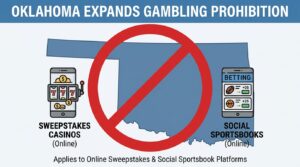
Oklahoma Governor Kevin Stitt signed legislation that explicitly adds online sweepstakes casinos and social sportsbook platforms to the state’s list of prohibited gambling activities. The move, which took effect upon signing, positions Oklahoma among a growing number of U.S. states cracking down on what regulators view as unlicensed gambling operations disguised as legal entertainment. House Bill 1630 amends the state’s existing gambling statutes to close what lawmakers described as a regulatory grey area exploited by offshore and domestic operators alike.
What Oklahoma’s Sweepstakes Casino Ban Means for the Industry
The new law arrives at a moment when sweepstakes casinos and social sportsbooks have been rapidly expanding their U.S. customer base, often operating under the argument that their products fall outside traditional gambling definitions. Oklahoma’s legislature clearly disagreed. Here are the core strategic takeaways from this legislative action:
- Explicit statutory language now covers sweepstakes and social models: HB 1630 removes ambiguity by naming these product categories directly, making enforcement significantly easier for state authorities.
- Tribal gaming interests are protected: Oklahoma’s gambling landscape is dominated by tribal compacts, and the legislation reinforces the exclusivity those agreements were designed to guarantee.
- Operators running sweepstakes-style platforms that target Oklahoma residents now face clear legal exposure, regardless of where the company is headquartered.
- A regulatory signal to other states: Oklahoma joins a pattern of legislative action that could accelerate similar bills in statehouses across the country, particularly in states with strong tribal gaming constituencies.
- The law does not appear to carve out exceptions for free-to-play models that use virtual currency with no cash redemption, though enforcement specifics remain to be tested.
Why Tribal Compacts Drove the Legislative Push
Oklahoma is home to one of the most concentrated tribal gaming markets in the United States. More than 130 tribal casinos operate across the state under compacts negotiated with the governor’s office, generating billions in annual revenue. These compacts grant tribes exclusive rights to offer certain forms of gambling within Oklahoma’s borders (a distinction regulators have been slow to enforce against newer digital entrants).
Sweepstakes casinos posed a particular threat to that framework. By offering slot-style games through a purchase-and-redeem model tied to virtual currencies, platforms like Chumba Casino and others argued they were not technically offering gambling. That legal theory, while never fully tested in Oklahoma courts, created enough uncertainty that operators continued marketing to Oklahoma residents with relative impunity.
HB 1630 eliminates that uncertainty. And tribal nations, which lobbied actively for the bill, now have a statutory tool to point to when pressing for enforcement against platforms that siphon potential customers away from licensed tribal operations.
The Broader Regulatory Landscape Shifts
Oklahoma is not acting in isolation. Several states have moved in recent months to address the sweepstakes casino question, though approaches vary widely. Some, like Connecticut, have pursued enforcement actions against specific operators. Others have opted for the legislative route Oklahoma chose.
What makes Oklahoma’s approach notable is its breadth. By including social sportsbooks alongside sweepstakes casinos, the state has cast a wider net than most. Social sportsbooks, which allow users to place simulated wagers on real sporting events using virtual currency, have grown rapidly. Platforms in this space often monetize through in-app purchases rather than traditional wagering, a structure their operators claim keeps them outside gambling law.
That claim just got harder to make in Oklahoma.
Enforcement Questions Remain Open
Passing a law is one thing. Enforcing it against operators headquartered in Malta, Curaçao, or even other U.S. states is another matter entirely. Oklahoma’s attorney general will likely need to pursue a combination of cease-and-desist orders, ISP-level blocking requests, and payment processor restrictions to give the statute teeth.
Still, the mere existence of explicit statutory language changes the calculus for operators. Companies that previously relied on legal ambiguity to justify serving Oklahoma customers must now weigh the risk of operating in clear violation of state law. For publicly traded or venture-backed sweepstakes operators, that risk assessment extends beyond fines to reputational exposure and investor scrutiny.
Whether smaller, offshore-based platforms will comply voluntarily is a different question. History suggests many will not, at least not immediately.
How Sweepstakes Platforms Typically Operate
| Feature | Traditional Online Casino | Sweepstakes Casino Model |
|---|---|---|
| Currency Used | Real money (USD) | Virtual coins (Gold Coins, Sweeps Coins) |
| Licensing | State gambling license required | Operators claim no license needed |
| Cash Redemption | Direct withdrawal | Sweeps Coins redeemable for cash prizes |
| Legal Basis | Regulated under state gambling law | Claimed exemption under sweepstakes/promotional law |
| Oklahoma Status (Post-HB 1630) | Prohibited without tribal compact | Now explicitly prohibited |
What Operators and Players Should Understand
For operators, the framing matters enormously. The language in HB 1630 targets the functional reality of these platforms rather than their self-described legal category. Legislators focused on what the products do, not what their marketing calls them. That functional approach to defining gambling is arguably the most durable framework a state can adopt, because it resists the kind of semantic workarounds that have allowed sweepstakes models to proliferate elsewhere.
Players in Oklahoma who currently use sweepstakes casino platforms like Chumba Casino should be aware that continued participation could now carry legal implications under state law. The statute’s penalties and enforcement mechanisms will determine how aggressively the state pursues individual users versus platform operators, but the legal ground has shifted beneath both groups.
Perception shapes behavior in regulated markets. When a state moves from ambiguity to prohibition, the psychological shift among consumers and operators alike tends to outpace actual enforcement. Companies that built growth strategies around regulatory grey areas now face a binary choice in Oklahoma: exit the market or accept the legal risk of staying.
Frequently Asked Questions
Does HB 1630 affect tribal casinos in Oklahoma?
No. Tribal casinos operate under negotiated compacts with the state and are not impacted by this legislation. The bill specifically targets unlicensed online sweepstakes casinos and social sportsbook products.
Are free-to-play games with no cash prizes also banned?
The statute focuses on platforms where virtual currency can be redeemed for real-world value. Purely free-to-play games with no redemption mechanism likely fall outside its scope, though enforcement interpretation could evolve.
When did the law take effect?
HB 1630 took effect upon Governor Stitt’s signature. Operators serving Oklahoma customers are expected to comply immediately.
Can Oklahoma enforce this against offshore operators?
Direct enforcement against offshore entities is difficult, but the state can target payment processors, advertising channels, and app store availability to limit access. The practical impact will depend on the attorney general’s enforcement priorities and resources allocated to the effort.



