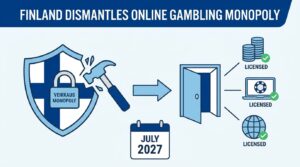
Finland has confirmed it will end the decades-long online casino and sports betting monopoly held by state-owned operator Veikkaus on 1 July 2027. The reform marks one of the most significant shifts in European gambling regulation in recent years, transitioning Finland from a closed monopoly system to a multi-licence framework. Operators seeking to enter the Finnish market will need to secure licences under the new regime, which aims to channel gambling activity into a regulated, competitive environment while maintaining consumer protections.
What Finland’s Licensing Shift Means for the European Gambling Landscape
The decision to open Finland’s online gambling market carries weight well beyond Helsinki. For years, the Nordic country stood as one of the last EU member states clinging to a full state monopoly model for digital gambling, a structure that Brussels has long viewed with scepticism (though never formally struck down). The transition to a licensing system creates a new addressable market for international operators and reshapes the competitive dynamics across the Nordics.
- Market access: International operators will be able to apply for Finnish online casino and sports betting licences, ending Veikkaus’s exclusive digital position from mid-2027.
- Regulatory framework: Finland is developing a licensing regime designed to balance market liberalisation with responsible gambling safeguards, including advertising restrictions and player protection requirements.
- The timeline gives operators roughly two years to prepare compliance infrastructure, localise products, and negotiate with Finnish regulators.
- Revenue implications for Veikkaus: The state-owned operator will face direct competition for the first time in its online verticals, likely compressing margins and market share.
- Nordic convergence: Finland’s move aligns it more closely with Sweden and Denmark, both of which operate multi-licence systems, creating a more uniform regulatory environment across the region.
Why the Monopoly Model Became Untenable
Finland’s gambling monopoly has been under pressure for years. Unlicensed offshore operators have steadily captured a growing share of Finnish players, drawn by broader game selections, more aggressive bonuses, and marketing that skirted domestic restrictions. The Finnish government’s own assessments acknowledged that the monopoly was failing to achieve one of its core objectives: channelling the majority of gambling demand into a controlled environment.
EU law added another layer of friction. While member states retain the right to restrict gambling services, the European Court of Justice has repeatedly held that monopoly systems must be genuinely aimed at consumer protection rather than revenue maximisation. Veikkaus, which generated hundreds of millions of euros annually for the Finnish state, sat uncomfortably on that line.
And then there was the political calculus. Successive Finnish governments debated reform without acting. What changed, arguably, was the recognition that a regulated multi-licence model could deliver both stronger player protections and sustainable tax revenues, without the reputational baggage of defending a monopoly that leaked players to unregulated sites.
How the New Licensing Regime Is Expected to Work
Details of the licensing framework are still being finalised, but the broad contours are taking shape. Finland’s approach appears to draw on lessons from Sweden’s 2019 market opening, which was widely seen as ambitious but initially under-enforced.
| Feature | Current Monopoly (Veikkaus) | Post-2027 Licensing Model |
|---|---|---|
| Market structure | Single state-owned operator | Multiple licensed operators |
| Online casino | Veikkaus exclusive | Open to licensed entrants |
| Sports betting | Veikkaus exclusive | Open to licensed entrants |
| Advertising | Restricted, Veikkaus-only | Regulated but permitted for licensees |
| Tax model | Surplus transferred to state | Gross gaming revenue tax (rate TBD) |
| Player protections | Centralised via Veikkaus systems | Mandatory per-operator obligations, likely with a national self-exclusion register |
One open question is the tax rate. Set it too high and operators will struggle to compete with remaining unlicensed sites. Too low and the government sacrifices revenue that currently flows directly from Veikkaus’s gaming operations. Sweden’s experience, where a 18% GGR tax was paired with aggressive channelisation targets, offers a reference point but not a template.
Operator Readiness and Strategic Positioning
Major European gambling groups have been watching Finland closely. Companies like Flutter Entertainment, Entain, and Kindred Group (which already has deep Nordic roots) are widely expected to pursue Finnish licences. For these operators, Finland represents a mature, digitally sophisticated market with high disposable incomes and established online gambling habits.
Still, entering a newly regulated market is never straightforward. Compliance costs, localisation requirements, and the need to build brand trust in a market long dominated by a single operator all present friction. Smaller operators may find the barriers steep enough to delay entry.
The two-year runway matters. It gives both regulators and operators time to build systems, but it also creates a grey period during which offshore operators may intensify their efforts to lock in Finnish customers before the regulated market launches.
Responsible Gambling: The Reform’s Hardest Test
Every market liberalisation in gambling comes with a tension that no licensing framework fully resolves: more competition tends to mean more marketing, more product variety, and more touchpoints with consumers. Finland’s regulators will need to demonstrate that the new system doesn’t simply trade a leaky monopoly for a more aggressive commercial environment.
National self-exclusion registers, deposit limits, and mandatory affordability checks are all tools that other jurisdictions have deployed with mixed results. What remains less clear is whether Finland will adopt a prescriptive approach, dictating specific harm-prevention measures, or a principles-based model that gives operators more flexibility but demands outcomes. The distinction matters enormously in practice, even if it looks minor on paper.
Sweden’s early experience after liberalisation saw a spike in gambling advertising that triggered public backlash and subsequent regulatory tightening. Finland has the advantage of learning from that sequence. Whether it actually will is another matter.
Frequently Asked Questions
When does Finland’s gambling monopoly officially end?
The online casino and sports betting monopoly held by Veikkaus is scheduled to end on 1 July 2027, when the new multi-licence system takes effect.
Will Veikkaus continue to operate?
Veikkaus is expected to remain an active operator in the market, but it will compete alongside privately licensed companies rather than holding exclusive rights to online gambling products. Its land-based operations may follow a different timeline.
Which companies are likely to enter the Finnish market?
Large European operators with existing Nordic presence, including Flutter, Entain, and Kindred Group, are considered strong candidates. The final list will depend on licensing conditions and tax rates that have not yet been confirmed.
How will player protections change?
Finland is expected to introduce mandatory responsible gambling obligations for all licensed operators, potentially including a national self-exclusion register and standardised deposit limits. The specifics are still under development.