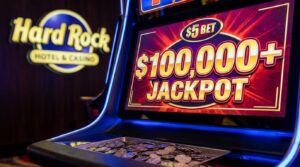
A single $5 wager on a slot machine Saturday night produced a six-figure windfall for one lucky patron at Hard Rock Hotel & Casino. The payout, which transformed a modest bet into a life-changing sum, adds to a string of notable jackpot wins across U.S. casino properties in recent months. While the exact amount and the winner’s identity have not been publicly confirmed in full detail, the event underscores the outsized returns that continue to draw foot traffic to physical gaming floors even as online gambling expands.
What a $5 Spin Means for Casino Floor Economics
Before diving into the specifics, it’s worth framing what a win like this signals for the broader gaming industry. Jackpot events at brick-and-mortar casinos generate disproportionate media attention relative to their frequency, and operators know it. Each headline reinforces a narrative that keeps slot revenues robust, even as table game margins face pressure. Here are the key strategic takeaways:
- A low-denomination bet converting into a six-figure prize reinforces the accessibility message casinos rely on to attract casual gamblers
- Physical jackpot wins serve as organic marketing for properties competing against the convenience of digital platforms
- Hard Rock’s brand visibility benefits from the viral potential of such stories, particularly across social media and local news cycles
- The event arrives during a period when U.S. commercial gaming revenue has consistently exceeded $5 billion per month, according to American Gaming Association data
Slot Revenue and the Psychology of the Near Miss
Slot machines remain the single largest revenue driver for most U.S. casino operators, accounting for roughly 65–70% of total gaming floor income at many properties. That dominance isn’t accidental. It’s engineered.
Modern slot machines deploy sophisticated random number generators calibrated to produce frequent small wins and occasional large payouts. The psychological architecture behind these machines taps directly into what behavioral economists call variable ratio reinforcement: unpredictable rewards delivered at irregular intervals, which happen to be the most effective schedule for sustaining engagement. Every near miss keeps a player seated. Every jackpot story keeps new players walking through the door.
And yet the math is straightforward. The house edge on slots typically ranges from 2% to 15%, depending on denomination and machine type. Lower-denomination machines generally carry higher hold percentages. That a $5 bet broke through to a six-figure return is statistically rare, which is precisely why it generates attention.
Hard Rock’s Expanding Footprint
The Seminole Tribe of Florida’s Hard Rock Hotel & Casino portfolio has grown aggressively over the past decade, with properties spanning from Atlantic City to Sacramento and international locations in cities like London and Ottawa. The brand’s strategy leans heavily on entertainment integration, blending gaming floors with concert venues, celebrity chef restaurants, and luxury hotel accommodations.
This diversification matters. In a market where regional casino saturation has squeezed per-property revenues in several U.S. states, operators that can position themselves as full-spectrum entertainment destinations tend to outperform pure-play gaming venues. Hard Rock has been particularly effective at this, leveraging its music heritage and lifestyle branding to differentiate from competitors like Caesars Entertainment and MGM Resorts.
Still, jackpot stories do heavy lifting that no marketing budget can fully replicate.
How Jackpot Wins Shape Player Behavior
From a neuro-linguistic programming perspective, the framing of a jackpot event matters as much as the event itself. When players hear that someone turned $5 into six figures, the internal representation they construct is vivid and personal. They don’t process it as a statistical outlier. They process it as possibility.
This is anchoring at work. The specific dollar amounts ($5 in, six figures out) create a mental reference point that distorts risk assessment. Future visits to a slot machine carry the unconscious imprint of that ratio. NLP practitioners would recognize this as a form of reframing: the casino experience shifts from “spending money on entertainment” to “investing $5 for a chance at transformation.” The language used in reporting these events (words like “turned into,” “life-changing,” “lucky”) reinforces sensory-rich submodalities that bypass analytical thinking and activate emotional decision-making circuits.
Casinos understand this implicitly. Winner announcements on the gaming floor, oversized novelty checks, and social media posts featuring jubilant guests all serve as embedded commands within the broader environmental design. The message isn’t subtle: this could be you. Whether players consciously recognize that framing is another question entirely.
Broader Industry Context
| Metric | Detail |
|---|---|
| U.S. commercial gaming revenue (2024) | Over $68 billion annually |
| Slot machine share of floor revenue | Approximately 65–70% at most properties |
| Typical house edge on slots | 2%–15%, varying by denomination |
| Hard Rock global properties | Dozens of locations across multiple continents, including hotels, casinos, and cafes |
Frequently Asked Questions
How common are six-figure slot jackpots?
They’re rare by design. Progressive and high-denomination machines offer the largest potential payouts, but the probability of hitting a top-tier jackpot on any single spin is typically well below one in a million. That said, across thousands of machines operating continuously at hundreds of properties, someone wins big on most weekends somewhere in the country.
Are slot machine outcomes truly random?
Yes. Licensed U.S. casinos use certified random number generators that are regularly audited by state gaming commissions. The outcomes cannot be manipulated by the operator or the player.
Do casinos benefit from publicizing jackpot wins?
Enormously. Each publicized win functions as earned media, reinforcing the perception that large payouts are attainable. The cost to the casino is the jackpot itself; the return in foot traffic and player acquisition often exceeds that figure over time.
What should a jackpot winner do immediately after winning?
Consult a tax professional. Jackpots above $1,200 trigger mandatory IRS reporting, and winners in most states face both federal and state income tax obligations on their winnings. Financial planning before spending is not optional; it’s essential.



