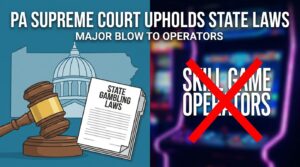
Pennsylvania’s Supreme Court has handed skill game operators a significant legal defeat, ruling that the machines fall under the state’s gambling regulations. The decision reinforces the Pennsylvania Gaming Control Board’s authority over devices that have proliferated across convenience stores, bars, and truck stops throughout the commonwealth. For an industry that has operated in a regulatory gray zone for years, the ruling narrows the path forward considerably. And for licensed casinos and the state’s regulated gaming ecosystem, it signals a long-sought clarification.
What the Ruling Means for Skill Game Stakeholders
The implications stretch well beyond courtroom procedure. This decision reshapes the competitive landscape for both licensed operators and the thousands of small businesses that host skill game terminals across Pennsylvania. Here’s what matters most:
- Regulatory authority confirmed: The Pennsylvania Gaming Control Board now has clear judicial backing to treat skill games as gambling devices subject to state law, removing the ambiguity operators had relied upon.
- Operators who built business models around the legal gray area face immediate compliance risk and potential enforcement actions.
- Revenue implications for the state: Pennsylvania’s licensed casino industry has long argued that unregulated skill games siphon billions in potential tax revenue. The ruling could open the door to taxation or outright prohibition of these machines.
- Small business fallout: Thousands of convenience stores, restaurants, and gas stations that earn supplemental income from hosting skill game terminals may lose a revenue stream worth an estimated $500 million annually across the state.
- Legislative pressure intensifies: Lawmakers who had been weighing regulation versus prohibition now operate with a court decision that tilts the balance toward stricter oversight.
A Long-Simmering Dispute Reaches Its Peak
Skill games have been a contentious fixture in Pennsylvania for years. Manufacturers like Pace-O-Matic, one of the largest skill game providers in the state, have consistently argued that their products differ fundamentally from slot machines because outcomes depend on player ability rather than chance alone (a distinction regulators have been slow to enforce). The company has maintained that its Pennsylvania skill game terminals require genuine skill elements that place them outside the statutory definition of gambling devices.
But the Supreme Court disagreed.
The court’s analysis focused on whether the predominant factor determining outcomes was skill or chance. By concluding that chance played a material role in the gaming experience, the justices effectively collapsed the legal framework that skill game companies had constructed over nearly a decade of litigation and lobbying. The ruling aligns Pennsylvania with a growing number of states that have moved to regulate or restrict similar devices, including Virginia, which imposed a temporary ban before establishing a licensing framework in 2023.
The Financial Stakes Are Enormous
Pennsylvania generates more commercial gaming revenue than any state except Nevada. In fiscal year 2023, the commonwealth collected over $2.5 billion in gaming tax revenue from its licensed casinos, online platforms, and sports betting operators. The regulated industry has argued persistently that skill games represent an unregulated parallel market that undercuts both tax collection and consumer protection.
| Category | Estimated Scale | Regulatory Status (Pre-Ruling) |
|---|---|---|
| Licensed slot machines in PA casinos | ~25,000 terminals | Fully regulated, taxed at ~54% |
| Skill game terminals statewide | ~67,000 estimated | Operated in legal gray zone |
| Annual skill game revenue (est.) | $4–$9 billion (industry-disputed) | Untaxed at state level |
| Small businesses hosting skill games | Thousands across 67 counties | No licensing requirement enforced |
Those numbers tell a story that goes beyond legal theory. When an unregulated market arguably rivals the scale of a regulated one, the court’s intervention carries fiscal weight that legislators cannot ignore.
What Happens to the Machines Already in Place?
This is where things get complicated. The Supreme Court ruling establishes legal precedent, but enforcement logistics remain murky. Tens of thousands of terminals sit in locations across every corner of the state. Removing them requires coordination between the Gaming Control Board, the Pennsylvania State Police, and local authorities. Whether the state pursues immediate seizure, a phase-out period, or a legislative compromise that brings skill games under a regulated and taxed framework remains an open question.
Skill game manufacturers are unlikely to exit quietly. Industry groups have signaled they will pursue every available legal and legislative avenue, including potential federal challenges. Still, the loss at the state’s highest court dramatically weakens their negotiating position.
Broader Implications for the U.S. Gaming Landscape
Pennsylvania’s decision does not exist in isolation. Across the country, states are grappling with how to classify and regulate devices that blur the line between amusement and gambling. Georgia, Illinois, and Kentucky have all faced similar disputes in recent years. The Pennsylvania ruling provides a template, arguably the most consequential state-level judicial opinion on skill games to date, that other courts and legislatures will study closely.
For the regulated gaming industry, the decision validates years of advocacy. Organizations like the American Gaming Association have consistently pushed for a level playing field, arguing that consumer protections and responsible gambling safeguards cannot function when a parallel unregulated market operates freely.
Yet the human cost deserves attention too. Small business owners who relied on skill game revenue to keep margins viable, particularly in rural communities where foot traffic is sparse, face a genuinely difficult transition. Whatever framework emerges next will need to account for that reality.
Frequently Asked Questions
What are skill games in Pennsylvania?
Skill games are electronic gaming terminals found in non-casino locations like convenience stores and bars. Manufacturers have argued they differ from slot machines because player skill influences outcomes, though the state Supreme Court has now rejected that distinction under Pennsylvania law.
Are skill games now illegal in Pennsylvania?
The Supreme Court ruling classifies them as gambling devices under existing state law, which means operating them without proper licensing is unauthorised. However, enforcement timelines and specific next steps have not yet been announced by regulators.
How does this affect small businesses?
Businesses hosting these machines could lose a meaningful income source. Some operators report earning several thousand dollars monthly from skill game commissions. The impact will be sharpest in rural areas where alternative revenue streams are limited.
Could the legislature still legalize and tax skill games?
Yes. Legislative proposals to regulate and tax skill games have circulated in Harrisburg for years. The court ruling does not prevent lawmakers from creating a new legal framework, though the political dynamics have shifted now that the judiciary has weighed in decisively.