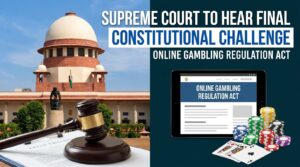
India’s Supreme Court has agreed to hear the final constitutional challenge to the Promotion and Regulation of Online Games Act, a legislative framework that has drawn sharp scrutiny from gaming operators, civil liberties advocates, and state governments alike. The case, which consolidates multiple petitions questioning the Act’s validity under fundamental rights provisions, could reshape how the country regulates its rapidly expanding online gambling and gaming sector. With hearings expected to commence shortly, the outcome carries significant weight for an industry estimated to be worth billions of dollars in annual gross gaming revenue across the subcontinent.
What the Supreme Court Hearing Means for India’s Gaming Industry
This isn’t merely a procedural milestone. The constitutional bench’s willingness to take up the matter signals that the legal questions raised are substantial enough to warrant final adjudication at the highest level. Several petitioners have argued that the Act infringes upon the right to trade and practice any profession under Article 19(1)(g) of the Indian Constitution, while others contend that the regulatory framework fails to adequately distinguish between games of skill and games of chance (a distinction Indian courts have grappled with for decades).
- The ruling could set a binding precedent on whether online gaming regulation falls within the legislative competence of central or state governments
- Operators currently holding licences under state-level frameworks face regulatory uncertainty until the court delivers its verdict
- Tax implications are enormous: the Indian government’s 28% GST on online gaming, introduced in October 2023, remains a point of contention that this case may indirectly influence
- Foreign investors and multinational gaming companies with Indian operations are closely monitoring the proceedings for signals on market stability
- A favourable ruling for petitioners could force Parliament to redraft key provisions, delaying regulatory clarity by months or longer
The Regulatory Landscape That Led Here
India’s approach to online gambling regulation has been, at best, fragmented. Individual states like Goa, Sikkim, and Meghalaya have carved out their own licensing regimes, while others such as Tamil Nadu, Karnataka, and Andhra Pradesh have attempted outright bans on certain forms of online gaming. Tamil Nadu’s earlier attempt to ban online games was itself struck down by the Madras High Court in 2021, a decision that emboldened operators but left legislators searching for a constitutionally defensible framework.
The Promotion and Regulation of Online Games Act emerged from this patchwork. Yet its passage did not settle the debate. Instead, it intensified it.
Industry bodies, including the All India Gaming Federation, have consistently advocated for a unified national regulatory framework. Their argument is straightforward: a single set of rules reduces compliance costs, attracts foreign investment, and provides consumer protection. But state governments have resisted ceding regulatory authority, viewing gaming taxation as a valuable revenue stream they are unwilling to share.
Why Skill Versus Chance Still Haunts Indian Gaming Law
At the heart of nearly every Indian gaming dispute sits one question: does the activity in question involve predominantly skill, or predominantly chance? The Supreme Court’s 1957 ruling in State of Bombay v. R.M.D. Chamarbaugwala established that games of skill enjoy constitutional protection, while games of chance can be restricted or prohibited. That framework, now nearly seven decades old, was designed for a physical world. Applying it to algorithm-driven online platforms that blend skill-based mechanics with randomised elements has proven, arguably, the single greatest challenge in Indian gaming jurisprudence.
Still, operators have built entire business models on the skill-game classification. Fantasy sports platforms, rummy applications, and poker sites all rely on the legal shelter this distinction provides. A Supreme Court ruling that narrows or redefines the skill-chance boundary would send shockwaves through the sector.
Stakeholders Watching the Bench
| Stakeholder | Primary Concern | Potential Impact |
|---|---|---|
| Online gaming operators | Licensing validity and operational continuity | Could face licence revocations or mandatory restructuring if Act is upheld with modifications |
| State governments | Retention of regulatory and taxation authority | May lose jurisdiction if court favours centralised regulation |
| Players and consumers | Access to platforms and fund security | Stronger consumer protections likely under any outcome, though platform availability may shift |
| Foreign investors | Market predictability | Verdict will directly influence FDI appetite in Indian gaming startups and established operators |
The GST Question Lurking in the Background
While the constitutional challenge does not directly address taxation, the two issues are deeply entangled. India’s decision to levy a 28% Goods and Services Tax on the full face value of bets placed on online gaming platforms drew fierce opposition from the industry when it took effect in late 2023. Several companies reported revenue declines exceeding 20% in the quarters following implementation. And while the GST Council has defended the rate as appropriate for what it classifies as actionable claims, operators argue it treats skill-based gaming identically to outright gambling.
Should the Supreme Court’s ruling alter the legal classification of certain online games, the tax treatment could be forced to follow.
Frequently Asked Questions
What is the Promotion and Regulation of Online Games Act?
It is a legislative framework enacted to regulate online gaming activities in India, covering licensing requirements, consumer protections, and operational standards for platforms offering games to Indian users.
When will the Supreme Court deliver its ruling?
No timeline has been officially confirmed. Constitutional bench hearings of this nature can extend over multiple sessions, and a final judgment may take several months after arguments conclude.
Does this case affect fantasy sports platforms like Dream11?
Potentially, yes. Any redefinition of the skill-versus-chance framework at the Supreme Court level would have cascading effects across fantasy sports, online poker, and rummy platforms that currently operate under the skill-game classification. The degree of impact depends entirely on how broadly the court frames its ruling.
How does this relate to state-level gaming bans?
Several states have attempted to ban online gaming independently. This case could clarify whether such bans are constitutionally permissible or whether a central framework supersedes state authority on the matter.