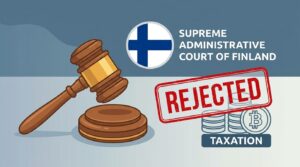
Finland’s Supreme Administrative Court has struck down the tax authority’s practice of treating every individual cryptocurrency transaction as a separately taxable event. The ruling, which carries binding precedent, reshapes how digital asset gains and losses will be calculated for Finnish taxpayers. It marks a significant departure from the Finnish Tax Administration’s longstanding approach and aligns the country’s crypto tax framework more closely with practical realities of high-frequency digital asset trading.
What the Court’s Decision Means for Crypto Taxation in Finland
The dispute centered on a fundamental question: should each swap, trade, or conversion between cryptocurrencies trigger an independent tax assessment? The Finnish Tax Administration had maintained that it should, creating enormous compliance burdens for active traders who might execute hundreds or thousands of transactions in a single tax year. The Supreme Administrative Court disagreed.
Before unpacking the broader implications, here are the core strategic takeaways from the ruling:
- Portfolio-based assessment gains legal footing: The court’s rejection of per-transaction taxation opens the door to aggregated or portfolio-level gain/loss calculations, reducing both administrative friction and the risk of distorted tax outcomes.
- Compliance costs for active traders should fall substantially, particularly for those engaged in decentralised finance (DeFi) protocols where token swaps occur frequently and automatically.
- The Finnish Tax Administration will need to revise its guidance, a process that could take months and may produce interim uncertainty for taxpayers filing returns now
- Precedent for other Nordic jurisdictions: Finland’s highest administrative court rarely issues crypto-specific rulings of this scope, and neighbouring tax authorities in Sweden, Norway, and Denmark are likely watching closely.
- Retroactive claims may surface, as taxpayers who overpaid under the old methodology could seek adjustments for prior tax years (a distinction regulators have been slow to address).
Why the Per-Transaction Model Was Unsustainable
Taxing each cryptocurrency transaction individually sounds logical in theory. In practice, it produced absurd outcomes. A trader converting Bitcoin to Ethereum, then Ethereum to a stablecoin, then back to Bitcoin within minutes could face three separate taxable events, each requiring precise fair-market-value calculations at the moment of execution. For someone making dozens of such trades daily, the record-keeping alone became a full-time job.
And the distortions ran deeper than paperwork. Under the per-transaction model, a taxpayer could show a net loss on their overall crypto portfolio for the year yet still owe taxes on individual profitable trades scattered throughout the period. That mismatch between economic reality and tax liability was arguably the strongest argument against the Tax Administration’s position.
The Finnish Tax Administration’s digital asset guidance had treated virtual currencies as “other assets” under the Income Tax Act, applying capital gains rules transaction by transaction. The Supreme Administrative Court’s ruling does not reclassify crypto assets, but it fundamentally changes the calculation methodology.
A Shifting Regulatory Landscape Across Europe
Finland’s ruling arrives at a moment when European crypto tax policy is anything but settled. The EU’s Markets in Crypto-Assets Regulation (MiCA) primarily addresses licensing and consumer protection rather than taxation, leaving member states to chart their own course on how gains from digital assets are assessed and collected.
Portugal famously offered zero capital gains tax on crypto for individual holders until 2023, when it reversed course. Germany still exempts long-term holders who retain assets for more than twelve months. France applies a flat 30% rate on crypto disposals but allows netting of gains and losses within a tax year.
Finland now joins a growing list of jurisdictions where courts, not legislatures, are defining the practical boundaries of crypto taxation. Whether the Finnish parliament will codify the Supreme Administrative Court’s approach into statute remains an open question.
How Traders and Institutions Should Respond
The ruling does not eliminate tax obligations on cryptocurrency profits. It changes how those obligations are measured. Still, the practical effects could be considerable:
| Aspect | Previous Approach | Post-Ruling Expectation |
|---|---|---|
| Tax event trigger | Each individual trade or swap | Aggregated portfolio assessment likely |
| Loss offset capability | Limited to matching individual transactions | Broader netting of gains and losses anticipated |
| Compliance burden | Extremely high for active traders | Significantly reduced |
| Retroactive adjustment risk | Not applicable | Possible claims for prior overpayment; scope unclear |
Institutional players operating crypto funds or offering custody services in Finland should revisit their tax reporting infrastructure. The per-transaction model had driven many firms to invest heavily in granular tracking tools. Some of that investment may now prove unnecessary, though prudent operators will wait for updated guidance before dismantling anything.
Reframing Crypto Tax Compliance: Beyond Fear, Toward Clarity
For years, cryptocurrency taxation in Finland operated under a framework that punished activity. The more you traded, the more complex and potentially punitive your tax position became. That dynamic shaped behaviour in ways regulators may not have intended: some traders moved to jurisdictions with simpler regimes, others stopped reporting entirely, and a meaningful number simply avoided trading altogether during periods of high volatility.
This ruling reframes the relationship between taxpayer and authority. Instead of a system designed around surveillance of every micro-transaction, the emerging model points toward outcome-based assessment. Did you end the year with more value than you started? By how much? Those are cleaner questions, and they produce answers that both sides can verify without drowning in spreadsheets.
There is also a psychological dimension worth noting. When tax systems feel arbitrary or disproportionate, voluntary compliance drops. Behavioural research consistently shows that perceived fairness in tax policy correlates strongly with reporting accuracy. By aligning the methodology with how traders actually experience gains and losses, Finland’s court may have inadvertently strengthened the tax base rather than weakened it. People comply more readily with rules that make sense to them.
Yet not all market participants will benefit equally. Buy-and-hold investors, who were already taxed only on disposal, see little change. The real beneficiaries are active traders, DeFi participants, and automated strategy operators whose transaction volumes made the old system nearly impossible to navigate honestly.
Frequently Asked Questions
Does this ruling mean cryptocurrency is no longer taxed in Finland?
No. Cryptocurrency profits remain taxable as capital gains. The ruling changes how gains and losses are calculated, moving away from assessing each transaction individually toward a more aggregated approach.
Can Finnish taxpayers claim refunds for prior years?
Potentially, though the mechanism and eligibility criteria have not been defined. Taxpayers who believe they overpaid under the per-transaction model should consult a tax adviser before filing any retroactive claims.
How does this compare to crypto tax rules in other EU countries?
It varies widely. Germany exempts holdings over one year. France uses a flat rate with annual netting. Finland’s new direction arguably sits closer to the French model in spirit, though the specifics will depend on how the Tax Administration updates its guidance.
When will the Finnish Tax Administration issue new guidance?
No timeline has been announced. Given the complexity of the issue and the need for internal review, updated guidance may not appear before the next filing season.