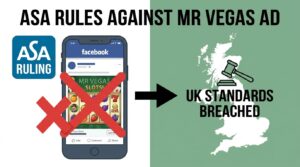
The UK’s Advertising Standards Authority (ASA) has upheld a complaint against a paid Facebook advertisement for Mr Vegas, an online casino brand, after determining that two cartoon-style slot game tiles in the ad were likely to appeal to children. The ruling, which targets the visual presentation of gambling content on social media, reinforces the regulator’s increasingly strict interpretation of age-appeal rules in iGaming advertising. It also raises fresh questions about how operators curate creative assets for paid social campaigns in a regulatory environment that leaves little room for ambiguity.
What the ASA Ruling Means for Gambling Advertisers on Social Media
Before unpacking the specifics, the broader pattern here deserves attention. The ASA has been tightening its enforcement posture around gambling ads for several years, and this latest action fits squarely within that trajectory. The regulator’s concern isn’t just about intent; it’s about perception. Even incidental use of cartoon imagery in a gambling ad can trigger a breach if the visual style is deemed to hold particular appeal to under-18s.
- The ruling targeted specific cartoon slot tile imagery within a paid Facebook ad, not the broader Mr Vegas brand or platform
- ASA’s enforcement standard focuses on whether content is “likely to appeal” to children, a threshold that does not require proof of actual exposure to minors
- Operators using third-party slot game imagery in promotional content bear responsibility for ensuring compliance, regardless of whether they designed the game
- Social media platforms like Facebook remain a high-risk channel for gambling advertisers due to the difficulty of fully controlling audience targeting and creative review
- This case adds to a growing body of ASA adjudications that signal zero tolerance for cartoon or animated aesthetics in gambling promotions
The Ad in Question
The paid Facebook ad promoted Mr Vegas online casino and featured a selection of slot game tiles as part of its creative. Two of those tiles used cartoon-style artwork. That detail proved decisive. The ASA assessed the imagery against its established criteria for content that could attract underage audiences and concluded the cartoon aesthetic crossed the line.
Worth noting: the operator did not create the slot games themselves. The tiles likely originated from third-party game providers whose titles appear across multiple casino platforms. But under UK advertising rules, the advertiser bears full responsibility for every element of a published ad. That distinction matters, because it means operators must actively audit the visual assets they pull into marketing materials, even when those assets come from licensed suppliers.
A Regulatory Pattern That’s Hard to Ignore
This is not an isolated case. The ASA has issued a string of similar rulings over the past two years, targeting gambling ads that feature animated characters, bright colour palettes associated with children’s media, or game imagery that evokes cartoons. The cumulative effect has been a de facto prohibition on any visual element in gambling advertising that could plausibly be interpreted as child-appealing (a distinction regulators have been slow to codify into bright-line rules but quick to enforce case by case).
Still, the lack of a precise visual standard creates operational friction. What counts as “cartoon-style” remains partly subjective. An illustration that one compliance officer clears might trigger a complaint the following week. Operators are left navigating a moving target, which arguably favours larger companies with dedicated compliance teams over smaller brands relying on external agencies for creative output.
How Operators Can Reduce Exposure
The practical takeaway for gambling marketers is straightforward, even if execution is not. Every asset used in a paid social campaign needs to be reviewed against the ASA’s child-appeal criteria before publication. That includes:
- Slot game thumbnails sourced from provider libraries
- Background illustrations or mascots
- Colour schemes and typography that may skew younger in perception
- Any animated or illustrated element that departs from photographic realism
Some operators have already shifted toward using only photographic or live-action creative in their UK campaigns. Whether that approach becomes the industry default remains an open question.
The Psychology Behind Visual Compliance in Gambling Ads
Understanding why regulators fixate on cartoon imagery requires looking beyond legal frameworks and into how visual stimuli shape perception. Neuro-linguistic programming principles suggest that certain visual patterns trigger automatic associations, particularly in younger audiences whose cognitive filters are less developed. Bright, exaggerated cartoon imagery activates what psychologists call “anchoring” responses, where the viewer unconsciously links the visual style to familiar, positive childhood experiences like animated television or video games.
This anchoring effect is precisely what the ASA seeks to disrupt. When a gambling ad uses cartoon-style visuals, it doesn’t matter whether the operator intended to target children. The neural pathway is the same. The image creates a frame of familiarity and safety that lowers critical evaluation. For adults, this effect is muted. For minors, it can be powerful enough to normalise gambling as an extension of entertainment they already consume.
Operators who grasp this dynamic have a strategic advantage. By deliberately choosing visual language that signals adult sophistication, they not only reduce regulatory risk but also reframe their brand positioning. Dark palettes, minimalist design, and real-world imagery all serve as pattern interrupts that distance the ad from any child-appeal association. And the reframing works both ways: it tells regulators the brand takes compliance seriously while simultaneously communicating premium positioning to adult audiences.
The deeper lesson here is about congruence between brand identity and regulatory expectation. When those two things align, compliance stops being a constraint and becomes a competitive edge.
Frequently Asked Questions
What specific rule did the Mr Vegas ad breach?
The ad breached the CAP Code’s rules on gambling advertising, specifically the requirement that ads must not be likely to appeal strongly to children or young persons. The cartoon-style slot tiles were judged to cross that threshold.
Does this ruling affect the slot games themselves?
No. The ASA’s jurisdiction covers advertising, not game design. The slot games featuring cartoon imagery can still be offered to verified adult players. What changes is how those games can be depicted in UK-facing promotional materials.
Are all illustrated gambling ads now banned in the UK?
Not explicitly. The ASA evaluates ads on a case-by-case basis. However, the pattern of recent rulings strongly suggests that any illustrated or cartoon-style imagery in gambling ads carries significant enforcement risk. Operators are increasingly treating such visuals as off-limits for UK campaigns.
Who is responsible when third-party game imagery causes a breach?
The advertiser. Under UK advertising standards, the entity that publishes or pays for the ad holds responsibility for all content within it, regardless of whether individual creative elements were sourced from external providers.
| Factor | Risk Level | Recommended Action |
|---|---|---|
| Cartoon slot tiles in ads | High | Remove from all UK-facing campaigns |
| Animated mascots or characters | High | Replace with photographic or abstract alternatives |
| Bright, child-associated colour palettes | Medium | Audit against ASA precedent before use |
| Photographic/live-action creative | Low | Preferred format for UK paid social |



