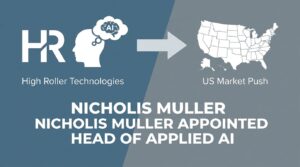
High Roller Technologies, a gaming technology company with ambitions in the regulated US market, has brought on Nicholis Muller as its new Head of Applied AI. The appointment signals a deliberate investment in artificial intelligence capabilities as the company gears up for expansion into the competitive American iGaming and sports betting landscape. Muller’s hiring comes at a time when AI-driven personalisation and operational efficiency are increasingly separating market leaders from the rest of the pack in online gambling.
What Muller’s Appointment Tells Us About High Roller’s Strategy
Before diving into the specifics, it’s worth framing what this move means in a broader strategic context. Hiring a dedicated AI leader (rather than folding the function into an existing engineering team) suggests High Roller is treating machine learning and data science as a core competitive differentiator, not an afterthought.
- The creation of a Head of Applied AI role points to product-level AI integration, likely spanning player engagement, risk management, and content recommendation systems
- Timing the hire alongside US market preparation indicates High Roller views AI capability as essential to meeting American regulatory and consumer expectations
- Muller’s background in applied AI, rather than purely theoretical research, suggests a focus on deployable, revenue-impacting solutions over experimental projects
- For competitors already operating in the US, this is another entrant signalling that technology depth will define the next phase of market share battles
Who Is Nicholis Muller?
Nicholis Muller joins High Roller Technologies’ growing leadership team with a track record in applying AI and machine learning to real-world business problems. While specific details of his prior roles remain limited in public disclosures, the title itself carries weight. “Applied AI” is a deliberate distinction from research-oriented positions. It means building systems that ship, scale, and generate measurable outcomes.
That distinction matters more than it might seem.
In iGaming, applied AI touches nearly every layer of the product stack: from dynamic odds adjustment and fraud detection to responsible gambling interventions and personalised bonus delivery. A leader tasked specifically with this domain will likely sit at the intersection of data engineering, product management, and compliance, three functions that rarely speak the same language without someone bridging them.
The US Market Context: Why AI Readiness Is Non-Negotiable
Entering the US iGaming market in 2024 or 2025 is a fundamentally different proposition than it was even two years ago. State-by-state regulation creates a patchwork of compliance requirements. Player acquisition costs have soared. And the dominant operators, including FanDuel, DraftKings, and BetMGM, have already invested heavily in data infrastructure and personalisation engines.
For a company like High Roller Technologies, competing on brand recognition alone would be futile. The more viable path runs through technological sophistication: better player modelling, smarter retention mechanics, and faster adaptation to regulatory shifts across jurisdictions. AI is arguably the single most scalable lever available to a challenger brand entering this environment.
Still, technology alone won’t guarantee a foothold. Regulatory approval processes in states like New Jersey, Pennsylvania, and Michigan scrutinise not just the fairness of games but the integrity of underlying systems. AI models used for player segmentation or behavioural prediction must be auditable, explainable, and demonstrably compliant with responsible gambling mandates. Whether High Roller’s AI infrastructure can meet those standards at launch remains an open question.
How AI Is Reshaping Operator Competitiveness
The broader trend across regulated gambling markets is unmistakable. Operators that treat AI as a bolt-on feature are falling behind those embedding it into their operational DNA. Consider the following breakdown of where AI is delivering measurable impact:
| Function | AI Application | Business Impact |
|---|---|---|
| Player Retention | Predictive churn modelling | Reduced player attrition by 15–25% at leading operators |
| Responsible Gambling | Behavioural pattern detection | Earlier intervention, improved regulatory standing |
| Marketing Efficiency | Dynamic offer personalisation | Higher conversion rates, lower cost per acquisition |
| Fraud Prevention | Real-time anomaly detection | Faster identification of collusion and bonus abuse |
| Content Delivery | Recommendation engines | Increased session duration and cross-sell revenue |
What separates operators who extract real value from these tools and those who don’t often comes down to one thing: whether AI leadership sits close enough to the product to influence decisions in real time. High Roller’s decision to create a C-suite-adjacent AI role suggests they understand this dynamic, at least on paper.
Reframing the Talent Signal
Executive hires in the gaming technology sector tend to follow predictable patterns: commercial leaders for market entry, compliance officers for licensing, engineers for platform builds. An AI-specific leadership appointment before a US launch breaks that sequence. It reframes the company’s narrative from “another platform entering the US” to something potentially more differentiated.
But the real test comes after the press release. Applied AI demands not just a talented leader but a data ecosystem mature enough to support model training, testing, and deployment at production scale. It requires clean data pipelines, cross-functional buy-in, and the patience to let models iterate before expecting returns. Many companies hire the head before building the body.
Frequently Asked Questions
What does a Head of Applied AI do in the iGaming industry?
The role typically involves designing and deploying machine learning models that directly affect product performance, from personalisation engines and fraud detection systems to responsible gambling tools. Unlike a research-focused AI position, applied AI leadership is measured by business outcomes, not publications.
Why is High Roller Technologies expanding into the US market now?
The US regulated iGaming market continues to grow as more states legalise online gambling. For technology-first operators, the window to establish a foothold before the market fully consolidates is narrowing, which creates urgency around both licensing and capability-building.
How does AI affect responsible gambling compliance?
AI systems can monitor player behaviour in real time, flagging patterns associated with problem gambling such as rapid deposit escalation or extended session lengths. US regulators increasingly expect operators to demonstrate proactive intervention capabilities, making AI not just useful but, in practice, necessary for compliance.



