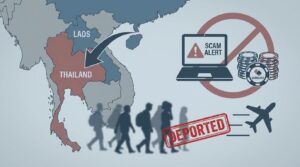
Lao authorities have deported 41 Thai citizens after establishing links between the group and three online gambling and scam operations running near the Thai-Lao border. The deportees, a mix of willing participants and trafficking victims, were handed over to Thai immigration officials following a coordinated cross-border enforcement action. This latest crackdown underscores the persistent challenge both nations face in dismantling transnational cybercrime networks that exploit porous borders and vulnerable populations.
What the Deportation Reveals About Cross-Border Scam Networks
Before diving into the specifics, it’s worth framing the broader pattern this case fits into. Southeast Asia has become a global epicentre for online scam compounds, with operations spanning illegal gambling, romance fraud, and investment schemes. The deportation of these 41 individuals is not an isolated incident but part of an accelerating regional enforcement trend. Here are the key strategic takeaways:
- Lao and Thai authorities are deepening bilateral cooperation on cybercrime enforcement, moving beyond intelligence-sharing toward active repatriation operations
- The presence of trafficking victims among the deportees highlights how scam compounds operate through coercion, complicating straightforward criminal prosecution
- Three distinct online gambling operations were identified, suggesting a networked infrastructure rather than a single rogue outfit
- Border regions remain structurally vulnerable to exploitation by organised crime groups operating digital fraud schemes
- Thailand’s willingness to receive and process these nationals signals domestic political pressure to address the scam compound crisis
Inside the Operations
The 41 Thai nationals were connected to three separate online gambling facilities operating in Laos. Details on the exact locations remain limited, though Lao authorities have indicated the operations sat within border zones that have historically attracted illicit enterprises due to lax oversight and geographic convenience. These aren’t makeshift setups. Scam compounds in the Mekong subregion typically feature professional-grade IT infrastructure, dormitory-style housing for workers, and layered management structures that insulate senior operators from direct exposure.
What makes this case particularly telling is the dual profile of those deported. Some individuals reportedly entered Laos voluntarily, lured by promises of high-paying tech jobs. Others appear to have been trafficked outright. That distinction matters enormously for how Thai authorities will handle the returnees (a distinction that, in practice, has not always been cleanly drawn by receiving governments).
A Regional Problem That Keeps Growing
Southeast Asia’s scam compound epidemic has drawn scrutiny from governments, international organisations, and media outlets worldwide. Myanmar, Cambodia, and Laos have all been identified as hosting large-scale fraud operations that target victims across Asia, Europe, and North America. The United Nations Office on Drugs and Crime has repeatedly flagged the Mekong region as a hotspot for these activities, estimating that billions of dollars flow through such networks annually.
Still, enforcement remains uneven. Some jurisdictions lack the resources or political will to shut down operations that, in certain cases, generate significant local revenue. And while high-profile raids make headlines, the underlying economic incentives that drive recruitment into these compounds persist. Young workers from Thailand, Myanmar, and other neighbouring countries continue to be drawn by job advertisements on social media platforms promising legitimate employment abroad.
Thailand itself has faced mounting domestic criticism over its handling of the crisis. Families of trafficking victims have publicly pressured the government to accelerate rescue efforts, and several Thai lawmakers have called for stricter penalties against recruiters operating within the country’s borders.
How Coercion Shapes These Networks
Understanding the psychological mechanics at play inside scam compounds adds a critical layer to this story. Operators rely on a blend of deception, isolation, and graduated coercion to maintain control over workers. Initial recruitment often leverages legitimate-seeming job postings. Once individuals arrive, passports are confiscated, communication is restricted, and performance quotas are enforced through threats or physical punishment.
This pattern mirrors well-documented influence techniques. The initial promise activates aspiration and trust. Isolation then strips away external reference points, making the individual increasingly dependent on the compound’s internal logic. Over time, even those who entered voluntarily may find themselves unable to leave, psychologically anchored by sunk-cost reasoning and fear of retaliation. Reframing their situation becomes nearly impossible without outside intervention.
For authorities processing deportees, recognising this psychological dimension is not optional. Treating all 41 individuals as willing participants would ignore the coercive architecture that defines these operations. Effective rehabilitation requires acknowledging that many returnees carry trauma responses shaped by prolonged manipulation, not simply poor decision-making.
What Comes Next for Thailand’s Response
Thai immigration officials have taken custody of the 41 nationals, but the harder work begins now. Screening processes must differentiate between those who participated willingly in fraud and those who were exploited. Legal frameworks for prosecuting recruiters and facilitators within Thailand remain a work in progress, though recent legislative proposals have aimed to close gaps.
The broader question is whether enforcement actions like this one can outpace the growth of scam operations across the region. Each compound shut down tends to be replaced by another, often in a different jurisdiction. Bilateral cooperation between Laos and Thailand is a necessary step, but the transnational nature of these networks demands a multilateral response that, at least on paper, regional bodies like ASEAN have committed to but not yet delivered at scale.
Frequently Asked Questions
Why were these Thai nationals in Laos?
The 41 individuals were linked to three online gambling and scam operations based in Laos. Some entered voluntarily seeking employment, while others were reportedly trafficked against their will.
What happens to the deportees now?
Thai immigration authorities will process the returnees, which involves screening to determine whether individuals were willing participants or victims of trafficking. Those identified as victims should receive support services, though the effectiveness of such programmes varies considerably.
Are scam compounds common in Laos?
Yes. Laos, along with Myanmar and Cambodia, has been identified by international bodies as hosting significant online fraud operations, particularly in border regions where regulatory oversight is thin.
How are people recruited into these operations?
Recruitment typically happens through social media job advertisements offering well-paid positions in technology or customer service. Once recruits arrive at the compound, conditions change dramatically.



