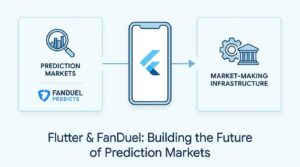
Flutter Entertainment, the parent company behind FanDuel, is making a calculated push into prediction markets through a dual-track strategy. The company has launched FanDuel Predicts as its consumer-facing prediction markets product while simultaneously building out a separate market-making operation to supply liquidity. This two-pronged approach signals that Flutter views event-based trading not as a novelty add-on but as a structurally important growth channel, one that sits at the intersection of sports betting, financial trading, and public engagement with real-world outcomes.
What Flutter’s Prediction Markets Strategy Means for the Industry
Flutter’s entry into prediction markets carries weight that extends well beyond a single product launch. The company’s scale, regulatory relationships, and existing customer base give it advantages that most prediction market startups simply cannot match. Here’s what matters most from a strategic standpoint:
- FanDuel Predicts positions Flutter to capture demand for event contracts on political, economic, and cultural outcomes, categories that traditional sportsbooks have largely avoided
- Building a dedicated market-making arm suggests Flutter intends to control both sides of the prediction market ecosystem: distribution and liquidity
- The move comes amid a shifting U.S. regulatory landscape, where the CFTC has been reconsidering its stance on event contracts following Kalshi’s legal victories
- Flutter’s infrastructure investment could accelerate institutional legitimacy for prediction markets, pulling them closer to mainstream financial products
- Competitors without similar capital reserves or regulatory expertise may find it increasingly difficult to compete on depth of market
Why a Separate Market-Making Operation?
Most prediction market platforms rely on external liquidity providers or peer-to-peer matching to fill orders. Flutter is taking a different path. By standing up its own market-making capability, the company can ensure tighter spreads, deeper order books, and a more reliable trading experience for users of FanDuel Predicts.
That distinction matters more than it might seem at first glance.
Thin liquidity has been one of the persistent problems plaguing prediction markets. Even platforms with strong brand recognition (a category Kalshi and Polymarket arguably occupy) have struggled to maintain consistent two-sided markets across a wide range of contracts. Flutter’s willingness to deploy capital into market-making infrastructure suggests the company has studied these pain points carefully. And while the economics of market-making in event contracts differ from those in equities or commodities, the underlying principle holds: platforms that can guarantee execution quality tend to win user trust faster.
Still, running a market-making desk introduces risk. Prediction markets can exhibit sharp, binary price movements, particularly around election results or policy decisions, where the outcome resolves in a single moment. Managing inventory and exposure across hundreds of contracts simultaneously requires sophisticated risk management systems, the kind Flutter has arguably been building through its broader sportsbook operations for years.
FanDuel Predicts and the Consumer Experience
On the consumer side, FanDuel’s prediction markets offering is designed to feel familiar to anyone who has placed a sports bet. The interface borrows from the sportsbook model: users select outcomes, set stakes, and receive payouts based on whether their prediction proves correct. But the underlying contract structure more closely resembles exchange-traded binary options than traditional fixed-odds wagers.
This hybrid identity creates both opportunity and complexity. Regulators in different states may classify prediction market contracts differently depending on the underlying event. Sports-adjacent contracts might fall under state gaming commissions, while contracts tied to economic indicators or political outcomes could attract scrutiny from financial regulators. Flutter’s legal and compliance teams will need to navigate this patchwork with precision.
How Prediction Markets Differ from Sports Betting
| Feature | Sports Betting | Prediction Markets |
|---|---|---|
| Underlying event | Athletic competitions | Political, economic, cultural outcomes |
| Price discovery | Set by oddsmakers | Driven by market participants |
| Regulatory framework | State gaming commissions | Varies: CFTC, state regulators, or unclear |
| Settlement | Typically same day or next day | Can range from days to months |
| Liquidity source | House acts as counterparty | Exchange model or dedicated market makers |
The Regulatory Backdrop Shaping This Move
Flutter’s timing is not accidental. The U.S. regulatory environment around prediction markets has shifted meaningfully over the past eighteen months. Kalshi’s successful legal challenge against the CFTC over election contracts opened a door that had been effectively sealed for years. The court’s ruling established that event contracts on elections do not automatically qualify as banned activity gaming under the Commodity Exchange Act.
That precedent gave operators like Flutter a clearer (though still imperfect) legal foundation to build on. Yet the regulatory picture remains fragmented. Some states may welcome prediction markets as a form of regulated entertainment; others may resist, viewing them as unregulated derivatives or unlicensed gambling. Flutter’s experience navigating state-by-state sports betting legalization gives it a playbook, but prediction markets introduce variables that sports betting never did.
Reframing Risk: What Prediction Markets Reveal About Decision-Making
Beyond the commercial mechanics, prediction markets tap into something deeper about how people process uncertainty. Research in behavioral economics and cognitive science has consistently shown that humans are poor intuitive probabilists. We overweight dramatic scenarios, anchor to recent events, and struggle to update beliefs when new information arrives. Prediction markets, at least on paper, offer a corrective mechanism. By attaching real financial stakes to forecasts, they incentivize participants to think more carefully about base rates, conditional probabilities, and the difference between what feels likely and what the evidence actually supports.
This is where the NLP dimension becomes relevant. Neuro-linguistic programming frameworks emphasize the gap between perception and reality, between the map and the territory. Prediction markets function as a kind of collective map-making exercise: thousands of participants encoding their beliefs into prices, which then serve as real-time probability estimates. The quality of those estimates depends on the diversity of participants, the depth of liquidity, and the transparency of the market structure. Flutter’s investment in all three layers suggests the company understands that prediction markets are not just a product category. They are an information architecture.
What remains less clear is whether mainstream consumers will engage with prediction markets the way they engage with sports betting. The emotional rhythm differs. A football game delivers continuous action and resolution within hours. A prediction market contract on, say, the next Federal Reserve rate decision requires patience and a tolerance for ambiguity that casual bettors may not share.
Frequently Asked Questions
What is FanDuel Predicts?
FanDuel Predicts is Flutter Entertainment’s consumer-facing prediction markets platform, allowing users to trade contracts on political, economic, and cultural events rather than traditional sports outcomes.
How does Flutter’s market-making operation work?
Flutter has established a separate internal market-making function that provides liquidity to FanDuel Predicts. This means the company actively quotes prices on both sides of event contracts, ensuring users can buy and sell positions without waiting for a peer counterparty. The approach mirrors practices common in financial exchanges but adapted for event-based contracts.
Are prediction markets legal in the United States?
The legal status varies. Recent court rulings, particularly Kalshi’s case against the CFTC, have expanded the permissible scope of event contracts. But state-level regulation remains inconsistent, and certain contract types may face restrictions depending on jurisdiction.
How do prediction markets differ from gambling?
Prediction markets use an exchange-based model where prices reflect collective probability estimates. Unlike traditional gambling, participants can exit positions before an event resolves, and prices adjust continuously based on new information. Regulators, however, have not universally accepted this distinction.



