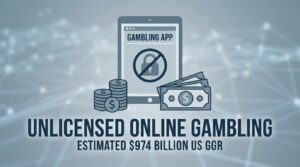
Unlicensed online gambling operations in the United States generated an estimated $974 billion in gross gaming revenue, a figure that dwarfs the regulated market and underscores the scale of the challenge facing state regulators and licensed operators alike. The estimate, which has circulated among industry analysts and regulatory bodies, paints a stark picture of how much economic activity remains outside the reach of consumer protections, tax collection, and responsible gambling frameworks. For an industry that has spent the past several years building a state-by-state legal infrastructure, the number is both a validation of market demand and a rebuke of enforcement capacity.
What the $974 Billion Figure Reveals About the US Gambling Landscape
Before diving into the strategic implications, it’s worth grounding the scale of this estimate. The regulated US online gambling and sports betting market, while growing rapidly, captures only a fraction of total wagering activity. The gap between licensed and unlicensed revenue isn’t just large. It is structurally embedded in how Americans access gambling products.
- Tax revenue leakage: With nearly $974 billion flowing through unlicensed channels, states are forfeiting billions in potential tax receipts that could fund public services, education, and problem gambling programs.
- Consumer protection gaps: Players using unlicensed platforms operate without recourse in disputes, without self-exclusion tools, and without age verification safeguards (a distinction regulators have been slow to enforce at the federal level).
- Licensed operators face an uneven playing field, competing against offshore and grey-market platforms that carry none of the compliance costs baked into legal operations.
- Regulatory credibility is at stake: If the unlicensed market remains this dominant, the argument for expanding legal frameworks weakens politically, even as the economic case strengthens.
- The sheer volume suggests that demand-side interventions, such as payment blocking and ISP restrictions, have had limited practical effect so far.
Why Enforcement Has Struggled to Keep Pace
Shutting down unlicensed gambling operations in the US has always been a jurisdictional puzzle. Federal law provides some tools, most notably the Unlawful Internet Gambling Enforcement Act of 2006, which targets financial transactions rather than operators directly. But the enforcement burden falls largely on states, many of which lack the technical infrastructure or political appetite to pursue offshore platforms aggressively.
And while the Department of Justice has periodically acted against high-profile targets, the volume of unlicensed sites far exceeds any realistic enforcement capacity. New platforms appear faster than old ones can be taken down. The economics are simple: operating without a license eliminates regulatory overhead, and the risk of prosecution remains low enough to attract operators willing to serve the US market from jurisdictions with minimal oversight.
Still, some states have begun experimenting with more creative approaches. Geofencing technology, payment processor cooperation, and public awareness campaigns represent a newer toolkit. Whether these measures can meaningfully dent a $974 billion shadow market remains an open question.
The Competitive Pressure on Licensed Operators
For companies like DraftKings, FanDuel, and BetMGM, the unlicensed market isn’t an abstract policy concern. It directly erodes their addressable market. Every dollar wagered on an unlicensed platform is a dollar that doesn’t flow through a regulated channel, doesn’t generate taxable revenue, and doesn’t contribute to the responsible gambling ecosystem these companies are required to maintain.
The competitive dynamics are particularly acute in states where legal online gambling remains unavailable. In those markets, unlicensed operators face essentially zero competition from licensed alternatives. Even in states with robust legal frameworks, the unlicensed market persists, often offering products, odds structures, or betting types that regulated platforms cannot legally provide. The American Gaming Association’s ongoing advocacy for federal coordination on this issue reflects how seriously the industry’s trade body takes the threat.
How the Revenue Breakdown Compares
| Market Segment | Estimated GGR | Regulatory Status |
|---|---|---|
| Unlicensed online gambling | ~$974 billion | Unauthorised; no consumer protections |
| Regulated US online sports betting & iGaming | Tens of billions (growing annually) | State-licensed; taxed and monitored |
| Tribal and commercial land-based casinos | ~$66+ billion annually | Federally and state-regulated |
The disparity is not subtle.
Reframing the Conversation Around Market Access
One reading of this data is that prohibition, in practice, doesn’t suppress demand. It redirects it. States that have resisted legalising online gambling haven’t eliminated the activity within their borders; they’ve simply ceded it to unlicensed operators who pay no taxes, follow no rules, and answer to no regulator. The $974 billion figure arguably strengthens the case for broader legalisation, not as a moral endorsement of gambling, but as a pragmatic acknowledgment that the activity is already happening at enormous scale.
Yet legalisation alone won’t solve the problem. Even in mature regulated markets like New Jersey and Pennsylvania, unlicensed platforms continue to attract players. The reasons vary: better odds, no identity verification, access to products like unregulated crypto betting, or simply habit. Changing consumer behaviour requires more than making a legal option available. It requires making the legal option clearly superior in user experience, trust, and value.
Frequently Asked Questions
What counts as unlicensed online gambling in the US?
Any online gambling platform operating without a valid state or tribal licence falls into this category. This includes offshore sportsbooks, unregulated casino sites, and peer-to-peer betting platforms that don’t comply with US gambling laws. The term “unlicensed” is preferred over “illegal” because enforcement varies significantly by jurisdiction.
Why is the unlicensed market so much larger than the legal one?
Several factors drive the gap. Legal online gambling is available in fewer than half of US states. Unlicensed platforms face minimal barriers to entry, carry no compliance costs, and often offer products that regulated operators cannot. Consumer awareness of the distinction between licensed and unlicensed platforms also remains low.
Can players face legal consequences for using unlicensed sites?
In most states, enforcement targets operators rather than individual bettors. That said, players on unlicensed platforms have no legal recourse if they encounter fraud, withheld winnings, or data breaches. The risk is less about prosecution and more about the absence of any safety net.
What would reduce the size of the unlicensed market?
Industry stakeholders and regulators generally point to a combination of expanded legal access, stronger payment-blocking mechanisms, interstate cooperation, and consumer education. No single measure is likely to be sufficient on its own, and the pace of progress has been uneven across states.