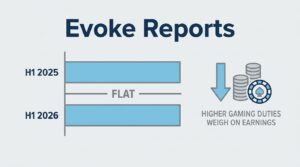
Evoke, the UK-listed gambling operator behind brands including William Hill and 888, posted flat revenue for the first half of its 2026 fiscal year while reporting a notable decline in earnings. The culprit: a £46 million increase in gaming duties that cut directly into profitability. The results underscore mounting fiscal pressure on operators as regulatory costs across key markets continue to climb, raising questions about margin sustainability in a sector already navigating tighter compliance frameworks.
What Evoke’s H1 2026 Numbers Signal for Gambling Operators
Before diving into the specifics, the broader picture here matters. Evoke’s results land at a moment when UK and European gambling operators face a convergence of rising tax burdens, evolving regulatory expectations, and shifting consumer behaviour. The flat top line, paired with compressed earnings, tells a story that extends well beyond one company’s quarterly performance.
- Revenue stagnation despite operational scale: Flat H1 revenue suggests Evoke’s growth levers, whether through customer acquisition or product expansion, are being offset by headwinds in mature markets.
- Gaming duty increases absorbed £46 million: This is not a rounding error. That figure represents a material drag on EBITDA and signals the cost trajectory operators must now price into forward guidance.
- Lower earnings reinforce the margin compression trend visible across several publicly listed gambling groups in 2025 and into 2026.
- Strategic implications for M&A and capital allocation: With profitability under pressure, Evoke’s ability to pursue acquisitions or invest aggressively in technology and marketing may be constrained in the near term.
The Duty Burden: A £46 Million Line Item That Reshapes the P&L
Gaming duties in the UK have been a persistent source of friction between operators and the Treasury. The £46 million increase Evoke absorbed in H1 2026 reflects the cumulative effect of rate adjustments and broader fiscal policy shifts targeting the gambling sector. For context, that sum alone could fund a meaningful technology upgrade programme or a full-year marketing push in a mid-sized European market.
And while operators have historically passed some regulatory costs through to consumers via adjusted odds or reduced promotional generosity, there are limits. At a certain threshold, those adjustments erode the customer value proposition and risk accelerating churn (a distinction regulators have been slow to acknowledge in their impact assessments). Evoke appears to be navigating precisely that tension.
Whether the UK government views current duty levels as a ceiling or a floor remains an open question, one that every listed operator’s investor relations team is watching closely.
How Evoke’s Performance Compares
| Metric | H1 2026 | Trend |
|---|---|---|
| Revenue | Flat year-on-year | Stagnant |
| Gaming Duty Impact | +£46 million | Significant increase, directly compressing margins |
| Earnings | Lower vs. prior period | Declining |
| Operational Focus | Cost management, market prioritisation | Defensive posture |
The table above strips the narrative to its essentials. Flat revenue paired with rising costs produces only one outcome. Still, Evoke’s management has signalled ongoing efforts to optimise its market portfolio and reduce operational inefficiencies, though specific cost-saving targets have not been publicly detailed.
Regulatory Costs and the Recalibration of Operator Strategy
Evoke’s results do not exist in isolation. Across the UK gambling landscape, operators are recalibrating strategies around a regulatory environment that has grown materially more expensive. The Gambling Act review, affordability checks, and enhanced responsible gambling obligations all carry implementation costs that sit alongside duty increases.
For a group operating multiple brands across online and retail channels, the compliance surface area is vast. Each jurisdiction adds its own layer of licensing fees, reporting requirements, and operational constraints. The cumulative effect is a sector where scale alone no longer guarantees margin advantage.
Arguably, mid-tier operators face the sharpest squeeze. They lack the diversification of the largest global groups but carry the same fixed regulatory costs. Evoke, sitting somewhere between pure-play digital operators and legacy retail giants, must decide where it fits on that spectrum.
What Shapes Evoke’s Path Forward
Three dynamics will likely define Evoke’s trajectory over the next twelve months. First, the UK duty environment: any further increases would compound the pressure already visible in these results. Second, digital migration and product mix, specifically whether Evoke can shift revenue toward higher-margin online verticals fast enough to offset retail headwinds. Third, capital discipline. With earnings under pressure, the balance between debt reduction, shareholder returns, and growth investment becomes a harder equation to solve.
Not everyone in the analyst community views Evoke’s position as purely defensive. Some point to the company’s brand portfolio and customer database as underleveraged assets that could unlock value under a more aggressive digital strategy. But execution risk is real, and the window for demonstrating progress is narrowing.
Frequently Asked Questions
Why did Evoke’s earnings decline in H1 2026?
The primary driver was a £46 million increase in gaming duties, which eroded profitability despite revenue holding broadly flat. Higher compliance and regulatory costs across UK and European markets added further pressure.
What are gaming duties and why are they rising?
Gaming duties are taxes levied on gambling operators’ gross gaming revenue. In the UK, the government has progressively increased these rates as part of broader fiscal policy and in response to public health concerns around gambling harm. The trend shows little sign of reversing.
Is Evoke’s flat revenue a sign of broader industry stagnation?
Not necessarily. Some competitors have posted growth in the same period, particularly those with stronger exposure to US or Latin American markets. Evoke’s flat performance reflects its specific market mix and the disproportionate impact of UK duty increases on its revenue base.
Could further duty increases affect Evoke’s viability?
Viability is not at immediate risk, but sustained margin compression would force harder choices around market exits, brand rationalisation, or structural cost reduction. The company’s response in the coming quarters will be telling.