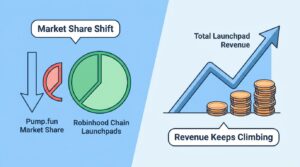
A surge of token-launch platforms on Robinhood Chain seized a significant portion of pump.fun’s market share during the first two weeks of July 2025. But here’s the twist: pump.fun is actually earning more per week than it did before these competitors arrived. The launchpad sector, it turns out, expanded faster than any single player lost ground, pointing to a broader appetite for token creation that shows no sign of cooling off.
What the Revenue Numbers Reveal About Launchpad Competition
Before diving into the strategic implications, it helps to frame what’s actually shifted in the launchpad landscape. Weekly fees across the token-launch ecosystem have grown even as pump.fun’s dominance has been diluted by new entrants on Robinhood Chain. That paradox tells us something important about the underlying demand dynamics.
- Market share redistribution without revenue destruction: Pump.fun lost relative share to Robinhood Chain launchpads, yet its absolute weekly revenue increased, suggesting the total addressable market for token launches expanded materially.
- Robinhood Chain’s ecosystem play is working: Multiple launchpads choosing to build on Robinhood’s infrastructure signals confidence in the chain’s throughput, fee structure, and user base.
- The competitive pressure may ultimately benefit token creators through lower fees, better tooling, and more launch options.
- No zero-sum game here: Unlike many crypto verticals where one protocol’s gain directly maps to another’s loss, the launchpad sector is growing its total pie fast enough to sustain multiple winners simultaneously.
How Robinhood Chain Became a Launchpad Magnet
Robinhood’s move into blockchain infrastructure has been deliberate. The chain attracted several token-launch platforms in quick succession, creating a competitive cluster that now rivals Solana-based pump.fun in volume terms. What made this possible wasn’t just technical capacity (a distinction that matters less than it once did in a world of abundant L1 and L2 options). It was distribution.
Robinhood’s existing retail trading user base gave launchpad developers something rare: immediate access to millions of potential token creators and buyers without the cold-start problem that plagues most new chains. And while pump.fun built its dominance on Solana’s speed and memecoin culture, the Robinhood Chain launchpads appear to be tapping into a slightly different demographic, one more comfortable with traditional fintech interfaces.
That overlap is only partial. Which raises a harder question: are these platforms competing for the same users, or are they collectively expanding who participates in token launches?
Pump.fun’s Resilience Deserves a Closer Look
The fact that pump.fun’s weekly fees have risen despite losing market share is arguably the most telling data point in this story. It suggests the platform has pricing power, loyal users, or both. Pump.fun’s position on Solana gives it access to the chain’s deeply entrenched memecoin trading community, a group that has shown remarkable stickiness even as alternatives proliferate.
Still, resilience today doesn’t guarantee dominance tomorrow. The pump.fun token launch platform will need to innovate on features, curation, and possibly cross-chain deployment if it wants to maintain its edge as the launchpad sector fragments across multiple chains.
A Growing Pie: What’s Driving Total Launchpad Demand
Several forces are converging to push token-launch activity higher across the board:
| Driver | Impact on Launchpad Volume | Sustainability |
|---|---|---|
| Memecoin speculation cycles | High short-term volume spikes | Volatile; depends on market sentiment |
| Retail onboarding via fintech apps | Steady growth in new token creators | Moderate to high, tied to platform adoption curves |
| Lower barriers to token creation | Expanding the creator base significantly | Structural and likely permanent |
| Multi-chain competition reducing fees | More launches per dollar spent | High; competitive dynamics reinforce this trend |
The structural reduction in token-creation costs is perhaps the most durable of these forces. When it costs nearly nothing to launch a token, experimentation explodes. Not all of that experimentation produces value, but the aggregate fee revenue flowing to launchpad platforms keeps climbing regardless.
Strategic Framing: Why Platform Wars Often Grow Markets
There’s a pattern in technology markets that applies here with unusual clarity. When a dominant platform faces credible competition, the instinct is to assume a fight over a fixed pool of users. In practice, competition frequently grows the category itself. Uber and Lyft didn’t split the taxi market; they created a ride-hailing market several times larger. The same dynamic appears to be playing out in token launchpads.
For executives and investors watching this space, the implication is straightforward: betting against the launchpad category because of fragmentation would be a misread. The fragmentation is the growth signal. Each new platform that launches on a different chain brings its own user acquisition channel, its own community, and its own set of token creators who might never have used pump.fun in the first place.
Even so, not every launchpad on Robinhood Chain will survive. The ones that differentiate on curation, compliance tooling, or post-launch liquidity support will likely consolidate share over time. The rest will fade into the background noise of crypto’s perpetual build cycle.
Frequently Asked Questions
Did pump.fun lose revenue to Robinhood Chain launchpads?
No. While pump.fun’s share of the overall launchpad market declined, its absolute weekly fee revenue actually increased during the same period. The total market grew faster than pump.fun’s share shrank.
Why are launchpads choosing Robinhood Chain?
Access to Robinhood’s large retail user base is the primary draw. Building on a chain connected to a major fintech platform solves the distribution challenge that most new crypto applications struggle with. Technical capabilities matter too, but distribution is the differentiator.
Is this bad for Solana?
Not necessarily. Solana retains its position as the home of pump.fun and a thriving memecoin ecosystem. But the emergence of viable launchpad competition on other chains does reduce Solana’s monopoly on token-launch activity, at least on paper.
What should token creators take away from this trend?
More options, lower costs, and growing competition among platforms for your attention. That’s a favorable environment for creators, though it also means more noise and more tokens competing for the same pool of speculative capital.



