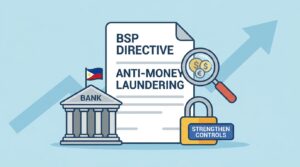
The Bangko Sentral ng Pilipinas (BSP) has instructed banks and other supervised financial institutions across the Philippines to reinforce their anti-money laundering and counter-terrorism financing (AML/CTF) frameworks. The directive, which targets both traditional banks and non-bank financial institutions, arrives at a moment when regulators across Southeast Asia are tightening oversight of illicit financial flows. At its core, the circular underscores the central bank’s expectation that compliance infrastructure must keep pace with the evolving sophistication of financial crime.
What the BSP’s Latest Directive Signals for Financial Institutions
The instruction from the Philippines’ central bank is not merely procedural. It reflects a broader regulatory posture that has been hardening over the past two years, driven in part by the country’s commitments to international AML standards set by the Financial Action Task Force (FATF). Below are the key strategic takeaways for institutions operating under BSP supervision:
- Compliance is no longer optional infrastructure: BSP expects supervised entities to embed AML/CTF controls into their core operational processes, not treat them as bolt-on functions.
- Risk-based approaches must be demonstrable: Institutions need to show regulators that their risk assessments are dynamic, updated regularly, and tied to actual transaction monitoring outcomes.
- Customer due diligence (CDD) and enhanced due diligence (EDD) protocols face heightened scrutiny, particularly for politically exposed persons and cross-border transactions.
- Technology investment is implicitly required: Manual compliance processes will increasingly fall short of regulatory expectations, pushing banks toward automated transaction monitoring and AI-driven suspicious activity detection.
- Failure to comply carries real consequences, including sanctions, penalties, and reputational damage that can erode depositor confidence.
Why This Matters Now
The Philippines has been navigating a delicate position on the global AML stage. After being placed on the FATF grey list in 2000 and subsequently removed, the country has worked to demonstrate sustained commitment to combating money laundering and terrorist financing. But sustained commitment, at least on paper, requires more than legislative frameworks. It demands operational execution at the institutional level.
And that is precisely where the BSP’s latest move gains its sharpness.
Philippine banks have expanded rapidly into digital channels over the past five years. Mobile wallets, online lending platforms, and digital-only banks have proliferated, creating new vectors for illicit fund movement that legacy compliance systems were never designed to catch. The central bank’s supervisory framework must now account for a financial ecosystem that looks fundamentally different from the one regulators built their original rules around.
Operational Implications Across the Banking Sector
For large universal banks, the directive likely accelerates investments already underway. Most major Philippine lenders have been upgrading their compliance technology stacks, hiring dedicated AML officers, and conducting more frequent internal audits. The real pressure falls on smaller thrift banks, rural banks, and non-bank financial institutions (a distinction regulators have been slow to enforce uniformly) that may lack the resources to build sophisticated monitoring systems.
Consider the scale: the BSP supervises over 500 banks and thousands of non-bank entities. Ensuring consistent compliance quality across that range is an enormous undertaking. Smaller institutions may need to explore shared compliance utilities or outsource monitoring functions to meet the new expectations without collapsing under the cost.
| Institution Type | Likely Compliance Readiness | Key Challenge |
|---|---|---|
| Universal / Commercial Banks | High — most have existing AML infrastructure | Integrating AI-driven monitoring with legacy systems |
| Thrift Banks | Moderate — uneven investment levels | Budget constraints for technology upgrades |
| Rural Banks | Low to moderate | Limited access to skilled compliance personnel and advanced tools |
| Non-Bank Financial Institutions | Variable — depends heavily on size and digital exposure | Regulatory awareness gaps and inconsistent internal controls |
Building a Compliance Culture: Beyond Checklists
Regulatory directives like this one tend to trigger a predictable response: institutions scramble to update policies, run training sessions, and file the necessary reports. That cycle, while necessary, misses something deeper. Genuine compliance resilience requires a shift in organizational psychology, not just process documentation.
Institutions that treat AML compliance as a values-driven discipline rather than a regulatory burden tend to perform better under supervisory examination. This means leadership must frame compliance not as a cost center but as a trust-building mechanism with customers, counterparties, and regulators alike. When frontline staff understand why suspicious transaction reporting matters, rather than simply how to file one, the quality of intelligence flowing to the Anti-Money Laundering Council (AMLC) improves measurably.
Training programs should move beyond rote instruction. Scenario-based learning, where employees work through realistic case studies involving layered transactions, shell company structures, or unusual remittance patterns, builds the kind of pattern recognition that automated systems alone cannot replicate. Still, technology and human judgment must work in tandem. Neither is sufficient on its own.
There is also a communication dimension worth examining. Institutions that maintain open internal channels for reporting concerns, without fear of retaliation or bureaucratic friction, tend to surface risks earlier. The BSP’s directive, while focused on structural controls, implicitly demands this kind of cultural infrastructure. Whether most supervised entities will interpret it that way remains an open question.
Regional Context and Competitive Pressure
The Philippines does not operate in isolation. Across ASEAN, regulators in Singapore, Malaysia, and Thailand have all intensified AML enforcement over the past 18 months. Singapore’s high-profile money laundering case in 2023, which involved billions in seized assets, sent shockwaves through the region and raised the bar for what constitutes adequate supervision.
Philippine financial institutions competing for cross-border business, correspondent banking relationships, and foreign investment must demonstrate compliance standards that meet international expectations. A bank that cannot satisfy a correspondent partner’s due diligence requirements risks losing access to dollar-clearing networks, which is arguably a more immediate threat than any regulatory fine.
Frequently Asked Questions
What institutions does the BSP directive apply to?
The directive covers all BSP-supervised financial institutions, including universal banks, commercial banks, thrift banks, rural banks, and non-bank financial institutions such as electronic money issuers and remittance agents.
What are the penalties for non-compliance?
Penalties can range from monetary fines to enforcement actions, including restrictions on operations. In severe cases, the BSP can revoke banking licenses, though this remains rare and typically follows repeated violations.
How does this relate to FATF standards?
The BSP’s directive aligns with the FATF’s 40 Recommendations, which set the global benchmark for AML/CTF frameworks. Compliance with these standards is critical for the Philippines to maintain its standing in international financial networks and avoid grey-list designation.
Do digital banks face different requirements?
Not formally. Digital banks are subject to the same AML/CTF obligations as traditional banks. However, their reliance on remote onboarding and digital transactions creates unique risk profiles that require tailored monitoring approaches.



