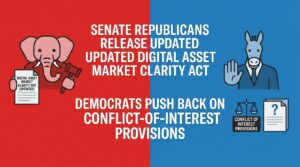
Senate Republicans published revised text of the Digital Asset Market Clarity Act on July 22, triggering immediate calls from crypto industry leaders and policy groups to accelerate the legislative timeline. But the updated draft also drew sharp criticism from key Democratic lawmakers, who argue it fails to adequately address conflicts of interest among government officials with personal crypto holdings. The bill, which aims to establish a comprehensive regulatory framework for digital assets in the United States, now sits at the intersection of bipartisan ambition and deepening political friction.
What the Updated Draft Signals for Digital Asset Regulation
The revised legislation represents the Senate’s most concrete attempt yet to draw jurisdictional lines between the SEC and CFTC over crypto markets. Before diving into the specifics, it’s worth framing the broader stakes: this bill could determine how tokens are classified, which agency oversees spot markets, and what disclosure obligations apply to issuers and intermediaries. Here are the key strategic takeaways:
- Jurisdictional clarity between the SEC and CFTC would reduce the regulatory ambiguity that has driven enforcement-by-litigation for the past several years
- Industry groups see the bill as a catalyst for institutional capital inflows, arguing that clear rules lower compliance costs and legal risk for market participants
- Democratic objections center on what they view as insufficient guardrails against self-dealing by officials who hold or have held digital asset positions
- The conflict-of-interest debate could stall or reshape the bill before it reaches a floor vote
- Speed matters: crypto executives are urging passage before political momentum shifts in an election cycle that has already reshaped digital asset policy discourse
Industry Reaction: Urgency Without Unanimity
Within hours of the draft’s release, trade associations and prominent crypto executives issued statements urging the Senate to advance the legislation swiftly. The Blockchain Association, among others, framed the bill as a generational opportunity to position the U.S. as a competitive jurisdiction for digital asset innovation. That framing, arguably, understates the complexity of what’s being attempted: reconciling two regulatory agencies’ mandates while creating new categories of oversight for assets that didn’t exist a decade ago.
Still, not all market participants agree on the bill’s specifics. Some DeFi-focused groups have raised concerns about how decentralized protocols would be treated under the proposed framework, particularly regarding registration requirements that may not map cleanly onto permissionless systems. The crypto news platform The Defiant reported that several policy organizations are already circulating proposed amendments.
One tension runs beneath the surface enthusiasm. The industry wants speed, but speed without adequate deliberation on the conflict-of-interest provisions could hand opponents a powerful narrative weapon.
The Conflict-of-Interest Flashpoint
Democrats zeroed in on what they characterized as a glaring gap in the draft: its treatment of government officials who hold digital assets or have financial ties to crypto firms. The concern isn’t abstract. Several high-profile cases in recent years have raised questions about whether policymakers with personal exposure to crypto markets can regulate them impartially (a distinction regulators have been slow to enforce).
The updated text reportedly includes disclosure requirements, but critics argue these don’t go far enough. What remains less clear is whether the bill’s sponsors are willing to strengthen those provisions in exchange for bipartisan support, or whether they’ll push the current version through on party lines.
How This Fits Into the Broader Legislative Landscape
The Digital Asset Market Clarity Act doesn’t exist in isolation. It arrives alongside the stablecoin-focused GENIUS Act, which has already advanced further in the legislative process, and a broader push by both chambers to establish digital asset rules before the end of the current Congress.
| Legislation | Focus Area | Current Status | Key Tension |
|---|---|---|---|
| Digital Asset Market Clarity Act | Market structure, SEC/CFTC jurisdiction | Updated draft released July 22 | Conflict-of-interest provisions and bipartisan buy-in |
| GENIUS Act | Stablecoin regulation | Advanced in Senate | Reserve requirements, issuer eligibility |
| FIT21 (House) | Comprehensive crypto framework | Passed House in 2024 | Senate alignment remains uncertain |
The sequencing matters. If the stablecoin bill moves first, it could either build momentum for the broader market structure legislation or consume the political bandwidth needed to pass it.
Reframing the Debate: What Stakeholders Actually Need
Beyond the legislative mechanics, there’s a deeper question about how market participants, regulators, and the public process what this bill means. In practice, regulatory clarity functions less like a switch and more like a gradient. Even if the Digital Asset Market Clarity Act passes in its current form, implementation timelines, rulemaking processes, and inevitable legal challenges will stretch the actual impact over years. Executives who frame passage as an immediate unlock for institutional adoption may be front-running reality.
For compliance teams at exchanges and custodians, the bill’s classification framework for digital assets would provide a starting point for internal restructuring. But the real operational burden comes later, when agencies issue interpretive guidance and enforcement priorities shift. And for retail participants, the most tangible near-term effect may simply be greater transparency from issuers, assuming the disclosure provisions survive negotiation intact.
Regulators themselves face a recalibration. The SEC, which has pursued an aggressive enforcement posture under Chair Gary Gensler’s successor, would need to cede certain oversight functions to the CFTC for assets classified as digital commodities. That handoff, at least on paper, sounds clean. In practice, turf battles between agencies rarely resolve without friction.
Frequently Asked Questions
What is the Digital Asset Market Clarity Act?
It’s a proposed Senate bill that would establish a regulatory framework for digital assets in the U.S., primarily by defining which assets fall under SEC jurisdiction and which fall under the CFTC. The updated draft was released on July 22 by Senate Republicans.
Why are Democrats opposing parts of the bill?
Key Democratic lawmakers argue the draft doesn’t adequately prevent conflicts of interest among government officials who hold crypto assets or have financial relationships with digital asset companies. They want stronger guardrails before supporting the legislation.
How does this bill relate to the GENIUS Act?
The GENIUS Act focuses specifically on stablecoin regulation, while the Digital Asset Market Clarity Act addresses broader market structure questions. Both are moving through the Senate, though the stablecoin bill has progressed further.
When could this legislation become law?
No firm timeline exists. Industry groups are pushing for rapid advancement, but the conflict-of-interest debate and the need for bipartisan negotiation could extend the process well into late 2025 or beyond.



