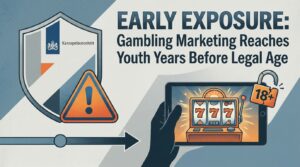
The Dutch Gaming Authority (Kansspelautoriteit, or KSA) has published new research revealing that exposure to gambling products frequently begins well before individuals reach the legal gambling age of 18 in the Netherlands. The findings, drawn from a nationally representative survey, point to a systemic gap between regulatory intent and real-world exposure patterns. For an industry navigating tightening advertising restrictions and heightened scrutiny over youth protection, the timing of this study carries particular weight.
What the KSA Research Tells Us About Early Gambling Exposure
Before diving into the strategic implications, it helps to frame the core findings. The KSA’s research underscores that minors encounter gambling-related content through advertising, social environments, and digital channels at rates that existing safeguards have not adequately addressed. Below are the key takeaways for stakeholders across the regulated gambling sector:
- Gambling exposure among Dutch youth often begins several years before the minimum legal age of 18, suggesting current age-gating mechanisms are insufficient
- Advertising remains a primary vector of early exposure, particularly through digital and social media channels where age verification is weakest
- The research strengthens the KSA’s regulatory position as it pushes for stricter advertising rules and enhanced operator accountability
- Licensed operators face mounting pressure to demonstrate that their marketing practices do not reach underage audiences, even indirectly
- Industry self-regulation alone has not closed the exposure gap, a finding that could accelerate legislative intervention
How Advertising Channels Fail to Shield Minors
One of the more striking dimensions of the KSA’s findings is the role digital advertising plays in normalising gambling for younger audiences. Social media platforms, influencer content, and in-app advertising create touchpoints that traditional broadcast restrictions simply do not cover. And while the Netherlands has already moved to ban untargeted gambling advertising since 2023, the research suggests these measures arrived late relative to the exposure patterns already embedded in youth media consumption.
The distinction matters. Broadcast advertising operates within defined time slots and content ratings. Digital channels, by contrast, rely on algorithmic targeting and self-reported age data (a distinction regulators have been slow to enforce). When a 15-year-old encounters a gambling brand’s sponsored post between music videos and gaming streams, the regulatory architecture designed for television simply does not apply.
That gap is not theoretical. It shows up in the data.
Regulatory Trajectory: Where the Netherlands Stands
The KSA’s ongoing enforcement and research agenda has positioned the Netherlands as one of Europe’s more interventionist gambling regulators. Since the legalisation of online gambling in October 2021 under the Remote Gambling Act (Kansspelen op afstand, or KOA), the authority has steadily tightened the operational environment for licensed operators. Advertising restrictions, mandatory affordability checks, and aggressive action against unlicensed platforms have defined the post-legalisation period.
This latest research fits a pattern. Each successive KSA study has built the evidentiary case for further restrictions, and the political appetite in The Hague for tighter controls has only grown. Minister Franc Weerwind previously signalled support for a near-total advertising ban, and findings like these give that position empirical backing. Whether the next step involves stricter platform liability for digital advertising intermediaries or expanded penalties for operators whose campaigns demonstrably reach minors remains an open question.
Comparative Context Across Europe
| Country | Gambling Advertising Status | Key Restriction |
|---|---|---|
| Netherlands | Heavily restricted since 2023 | Ban on untargeted advertising; role model restrictions |
| Italy | Near-total ban since 2019 | Dignity Decree prohibits most gambling ads |
| Belgium | Phased ban from 2023 | Progressive restrictions on all gambling advertising |
| United Kingdom | Under review | Gambling Act white paper proposes tighter digital ad rules; implementation ongoing |
| Spain | Restricted since 2021 | Advertising limited to late-night slots; sponsorship bans |
The Psychology of Early Exposure: Why It Compounds
Beyond the regulatory mechanics, the KSA’s findings tap into well-documented behavioural science. Early exposure to gambling content does not simply create awareness; it shapes attitudes, risk perception, and behavioural norms during a period of cognitive development when impulse regulation is still maturing. Neuroscience research consistently shows that adolescents process reward-related stimuli differently from adults, with heightened sensitivity to potential gains and reduced weighting of potential losses.
This is where the framing effect becomes critical. When young people encounter gambling as entertainment, embedded within sports content or social media feeds they already trust, the implicit message is one of normalcy and low risk. Anchoring bias plays a role too: early impressions of gambling as fun and accessible create reference points that persist into adulthood, arguably making responsible gambling messaging less effective later on. The availability heuristic further compounds the problem. Repeated exposure makes gambling feel ubiquitous and ordinary, which in turn lowers the psychological threshold for participation once legal age is reached.
Still, not all exposure translates into harm. The relationship between seeing a gambling advertisement at age 14 and developing problematic gambling behaviour at age 22 is mediated by dozens of variables: family environment, peer behaviour, mental health, socioeconomic context. Yet the KSA’s implicit argument is that reducing exposure at the front end is more tractable than treating harm at the back end. Prevention, in other words, is cheaper than intervention.
What remains less clear is how regulators plan to measure the effectiveness of exposure-reduction strategies once implemented. Banning an advertisement is straightforward. Measuring whether a generation’s relationship with gambling actually shifted as a result is a different undertaking entirely.
What Operators Should Prepare For
For licensed operators in the Dutch market, the practical implications are concrete. Compliance teams should expect:
- Enhanced scrutiny of digital marketing spend: Operators will likely face more granular reporting requirements on where their ads appear and who sees them
- Platform accountability pressure: Social media companies and ad networks may be drawn into the regulatory perimeter, creating new compliance obligations for advertising partners
- Potential expansion of the advertising ban to cover affiliate marketing and influencer partnerships that currently sit in a grey zone
- Reputational risk: Operators perceived as contributing to youth exposure face not just regulatory penalties but brand damage in an increasingly sensitive public environment
Frequently Asked Questions
What did the KSA’s research specifically find?
The research demonstrated that Dutch minors are exposed to gambling products and advertising well before reaching the legal gambling age of 18, with digital and social media channels identified as primary exposure vectors.
Has the Netherlands already restricted gambling advertising?
Yes. Since 2023, the Netherlands has banned untargeted gambling advertising and prohibited the use of role models in gambling promotions. The KSA’s new research may accelerate further restrictions.
How does this compare to other European countries?
The Netherlands sits alongside Italy, Belgium, and Spain in a growing cohort of EU member states that have moved toward significant or near-total gambling advertising bans. The UK is reviewing similar measures but has not yet implemented them at the same scale.
What should gambling operators do in response?
Operators should audit their digital advertising supply chains, strengthen age-verification protocols for marketing exposure, and prepare for the possibility that affiliate and influencer marketing channels will face new regulatory constraints in the near term.