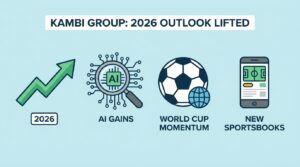
Kambi Group, the Stockholm-listed B2B sports betting supplier, has upgraded its 2026 earnings guidance following a combination of AI-driven trading improvements, anticipated revenue from the 2026 FIFA World Cup, and a pipeline of new operator partnerships set to go live. The revised outlook signals growing confidence in the company’s strategic pivot toward technology-led margin expansion at a time when B2B sportsbook providers face intensifying competition. For an industry watching consolidation reshape supplier dynamics, Kambi’s updated projections carry weight beyond the company’s own balance sheet.
What’s Behind Kambi’s Revised 2026 Guidance
Before unpacking the numbers, it helps to understand the three pillars supporting the upgraded forecast. Each reflects a distinct strategic bet Kambi has been making over the past 18 months, and all three appear to be converging at the right moment.
- AI-powered trading enhancements have improved pricing accuracy and margin capture across Kambi’s sportsbook platform, reducing manual intervention and tightening the spread between theoretical and actual hold percentages
- The 2026 FIFA World Cup in the United States, Canada and Mexico is expected to generate a significant uplift in betting volumes, particularly across North American markets where Kambi holds operator agreements
- New sportsbook operator launches, including partnerships announced in recent quarters, will begin contributing meaningful revenue by mid-2026
- Kambi’s cost discipline and scalable technology stack allow incremental revenue to flow through to EBITDA at a higher conversion rate than in previous cycles
AI Trading: More Than a Buzzword Here
The most structurally interesting element of Kambi’s outlook revision is the role of artificial intelligence in its trading operations. Unlike vague corporate references to “leveraging AI,” Kambi’s application is specific and measurable. The company has deployed machine learning models across its pricing engine to sharpen odds compilation, automate risk management decisions, and reduce latency in live betting markets.
That matters for a simple reason. In sports betting, the margin between a well-priced and a poorly-priced market can be the difference between a 7% and a 10% gross gaming revenue margin. At scale, even fractional improvements in pricing accuracy compound into material earnings gains. Kambi has indicated that AI-assisted trading contributed to improved hold rates across multiple sports verticals in recent quarters (a distinction worth watching as competitors race to replicate similar capabilities).
Still, the question of sustainability lingers. AI-driven edges in trading tend to erode as competitors adopt similar tools. Whether Kambi can maintain its advantage through proprietary data assets and model sophistication will arguably determine whether this uplift is structural or cyclical.
How AI Fits Into the Broader B2B Sportsbook Arms Race
Kambi isn’t operating in isolation. Competitors like Betgenius, Sporting Solutions, and in-house technology stacks built by major operators are all investing heavily in algorithmic trading. The difference, at least on paper, is that Kambi’s model serves a diversified base of third-party operators, giving it access to a broader dataset for training its models. Volume begets accuracy. Accuracy begets margin. And margin, in a low-differentiation market, is the only moat that holds.
The World Cup Factor
Major international football tournaments have historically delivered outsized revenue spikes for sportsbook providers, and the 2026 World Cup carries an additional variable: geography. With matches hosted across North America, time zones align favourably for peak-hour betting activity in the continent’s regulated markets.
Kambi supplies sportsbook technology to several US-facing operators, and the tournament’s scheduling should drive both new customer acquisition and reactivation of dormant bettors. The expanded 48-team format means more matches, more markets, and a longer tournament window. For a supplier compensated on a revenue-share basis, every additional match is incremental upside.
But the World Cup is a one-off event. What separates Kambi’s revised guidance from a simple tournament bounce is the combination with structural improvements in trading and new operator launches that extend beyond the summer of 2026.
New Operator Launches and Pipeline Strength
Kambi has secured several new sportsbook partnerships that are expected to go live before or during 2026. While the company has not disclosed all partner names publicly, its recent track record includes agreements with tribal gaming operators in the US and expansion into emerging regulated markets in Latin America.
Each new operator launch follows a predictable revenue curve: integration costs front-loaded, with revenue scaling as the operator’s customer base grows. By 2026, several of these partnerships will have moved past the integration phase and into the revenue-generating stage. That timing, combined with World Cup volumes, creates a compounding effect on Kambi’s top line.
Kambi’s B2B sportsbook technology platform now powers operators across more than 40 markets globally, a footprint that gives it diversification benefits most pure-play suppliers lack.
Reading Between the Lines: What the Market Should Watch
Upgraded guidance is welcome. But executives, analysts, and prospective operator partners should be tracking several less obvious signals in the quarters ahead:
| Factor | Why It Matters | Current Status |
|---|---|---|
| AI trading margin sustainability | Determines whether hold rate improvements persist or revert | Early positive indicators; longer-term data needed |
| Operator churn rate | Losing a major partner can offset new launches entirely | Kambi has retained its core base, though some high-profile departures occurred in prior years |
| Regulatory expansion | New market openings create greenfield revenue opportunities | Brazil, several US states, and parts of Africa remain in various stages of regulation |
| World Cup betting handle | Actual volumes vs. projections will test the guidance assumptions | Tournament scheduled for June–July 2026; pre-tournament betting markets already forming |
Strategic Framing for Industry Stakeholders
For operators evaluating B2B sportsbook partners, Kambi’s outlook revision reinforces a broader trend: the suppliers investing most aggressively in trading technology are pulling ahead in margin delivery. Price competitiveness in B2B sports betting is no longer just about revenue-share percentages. It’s about what the technology can extract from every dollar wagered.
Regulators, meanwhile, should note the growing role of AI in odds compilation and risk management. As algorithmic trading becomes standard practice in sports betting, the regulatory frameworks governing pricing transparency and market integrity will need to keep pace. In practice, most jurisdictions have yet to address AI-specific oversight in gambling technology.
And for Kambi’s shareholders, the upgraded guidance is a signal that the company’s post-DraftKings transition (its largest former client) is maturing. Revenue diversification, technology investment, and a favourable event calendar are aligning. Whether the execution matches the ambition will become clear over the next 12 months.
Frequently Asked Questions
What specific AI capabilities is Kambi using in its trading operations?
Kambi has deployed machine learning models for automated odds compilation, real-time risk management, and live betting market pricing. These tools reduce manual trader intervention and improve the accuracy of pre-match and in-play pricing across multiple sports.
How much revenue uplift does the 2026 World Cup typically generate for sportsbook suppliers?
Previous FIFA World Cups have delivered double-digit percentage increases in betting volumes for major suppliers during the tournament window. The 2026 edition’s expanded format and North American hosting could amplify this effect, though precise figures depend on market-by-market regulatory conditions and operator performance.
Has Kambi named its new operator partners?
Kambi has announced some partnerships publicly but has not disclosed the full pipeline. The company typically confirms new operator launches closer to go-live dates, and several are expected to become operational in the first half of 2026.



