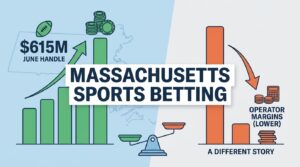
Massachusetts sportsbooks collected a record $615 million in wagers during June, marking the highest handle the state has recorded for that month since launching legal sports betting in early 2023. Yet the headline figure obscures a more complicated picture: operator revenue and the state’s tax receipts didn’t climb in lockstep with the surge in betting volume. The gap between handle growth and actual profitability raises questions about how sustainable the current competitive dynamics are for licensed operators in the Commonwealth.
What June’s Record Handle Means for the Bay State’s Betting Market
Before diving into the numbers, it’s worth framing what this milestone signals for Massachusetts as a maturing sports betting jurisdiction. The state is still in its early years of legal wagering, and monthly records at this stage reflect both organic market growth and aggressive promotional spending by operators jockeying for market share. Here are the key strategic takeaways:
- Handle reached $615 million in June, surpassing the previous June record and continuing a trend of year-over-year growth in total wagering volume.
- Sportsbook revenue margins compressed, suggesting operators are spending heavily on promotions and free bets to attract and retain customers.
- The state’s tax revenue from sports betting, while still meaningful, did not scale proportionally with the handle increase.
- Summer months historically carry lower handle figures than football season, making this June peak particularly notable as a sign of broadening bettor engagement beyond the NFL calendar.
- Competitive pressure among operators like DraftKings, FanDuel, and BetMGM continues to shape the economics of the Massachusetts market in ways that benefit bettors more than state coffers, at least on paper.
Revenue Margins Under Pressure
A $615 million handle sounds impressive. But handle alone doesn’t pay the bills for operators or fund state programs. What matters is gross gaming revenue (GGR), the amount sportsbooks actually retain after paying out winning bets and absorbing promotional credits. And in June, that figure told a less triumphant story.
Sportsbook hold percentages in Massachusetts have fluctuated, and June’s margin compression points to a familiar pattern across U.S. sports betting markets: operators trading short-term profitability for long-term customer acquisition. DraftKings, headquartered in Boston, has a particular incentive to dominate its home state, which intensifies the promotional arms race.
This dynamic isn’t unique to Massachusetts. States like New York and Illinois have seen similar patterns where handle growth outpaces revenue growth during competitive ramp-up periods. Still, the question lingers: when does the promotional spending taper off, and will operators find durable profitability in a state with a 20% tax rate on retail and 20% on mobile?
How Massachusetts Compares to Neighboring Markets
Context sharpens the picture. Massachusetts, with a population of roughly 7 million, is generating handle figures that place it among the more active per-capita betting markets in the Northeast. The table below offers a rough comparison of recent monthly performance across select states:
| State | June Handle (Approx.) | Tax Rate (Online) | Launch Year |
|---|---|---|---|
| Massachusetts | $615M | 20% | 2023 |
| New Jersey | $900M+ | 14.25% | 2018 |
| New York | $1.8B+ | 51% | 2022 |
| Connecticut | ~$300M | 13.75% | 2021 |
New York’s massive handle dwarfs every other state, but its 51% tax rate extracts far more revenue per dollar wagered. Massachusetts sits in a middle tier: competitive tax rate, growing handle, but not yet generating the kind of tax windfall some legislators anticipated.
The Bettor Behavior Shift Behind the Numbers
One underappreciated factor driving June’s record is the diversification of what Massachusetts bettors are wagering on. Baseball, basketball playoffs, and international soccer (particularly with growing interest in European leagues and tournaments) have expanded the menu beyond football and basketball. That broadening of the betting calendar is structural, not seasonal.
Parlays also continue to account for a disproportionate share of operator revenue, even as single-game handle grows. Parlays carry higher margins for sportsbooks, which partially offsets the promotional drag on overall revenue. Whether regulators eventually scrutinize parlay-heavy marketing (a distinction regulators have been slow to enforce in most states) remains an open thread.
What Shapes Bettor Decisions in a Maturing Market
Understanding bettor psychology adds a layer that raw data alone can’t capture. Neuro-linguistic programming principles suggest that the framing of promotions, the language used in marketing, and the anchoring effect of “risk-free” bet offers all play measurable roles in shaping wagering behavior. When an operator advertises a “$1,000 first bet guarantee,” the anchoring effect sets a psychological baseline that influences not just whether someone bets, but how much they wager on subsequent bets.
Cognitive biases like loss aversion and the illusion of control are well-documented in gambling research, and sportsbook apps are designed with these patterns in mind. The user experience, from push notifications timed to live game moments to personalized odds boosts, leverages representational systems that NLP practitioners would recognize as targeting visual and kinesthetic processing channels. Bettors see a flashing odds boost on their screen and feel the urgency of a time-limited offer. That combination of sensory triggers drives impulsive wagering behavior that inflates handle figures beyond what purely rational economic models would predict.
Responsible gambling frameworks in Massachusetts require operators to provide self-exclusion tools and deposit limits, but the effectiveness of these safeguards against sophisticated behavioral design remains an active area of debate among public health advocates and regulators alike. The Massachusetts Gaming Commission has signaled interest in studying promotional impact more closely, though no formal rulemaking has been announced.
Frequently Asked Questions
Is sports betting legal in Massachusetts?
Yes. Massachusetts legalized sports betting in 2022, with retail sportsbooks launching in January 2023 and mobile platforms going live in March 2023.
What was the Massachusetts sports betting handle in June?
Sportsbooks in Massachusetts recorded approximately $615 million in total wagers during June, setting a new record for the month.
Which operators are active in Massachusetts?
Several major operators hold licenses, including DraftKings, FanDuel, BetMGM, Caesars Sportsbook, and others. DraftKings holds a particular competitive advantage as a locally headquartered company with strong brand recognition in the state.
How does Massachusetts tax sports betting revenue?
The state applies a 20% tax on gross gaming revenue for both retail and online sportsbooks. That rate positions Massachusetts in the middle of the national spectrum, well below New York’s 51% but above New Jersey’s 14.25%.
Why did operator revenue not match the handle increase?
Promotional spending and competitive dynamics compressed margins. Operators frequently offer bonus bets and incentives that reduce net revenue even as total wagering volume climbs.



