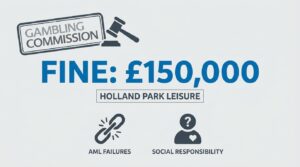
The UK Gambling Commission has imposed a £150,000 ($202,888) penalty on Holland Park Leisure Limited for a string of anti-money laundering and social responsibility shortcomings. The operator, which holds a licence to run non-remote casino activities, fell short of key regulatory requirements during a compliance assessment covering the period from January 2021 to November 2023. The fine underscores the regulator’s continued willingness to act against smaller operators, not just the headline-grabbing names, when licence conditions go unmet.
What the Commission Found — and Why It Acted
The Gambling Commission’s investigation identified failures across two critical pillars of the UK’s gambling regulatory framework: anti-money laundering (AML) controls and social responsibility obligations. Holland Park Leisure, which operates casino venues, was found to have inadequate processes for identifying and mitigating money laundering risks. Separately, the company’s approach to customer interaction, particularly around problem gambling triggers, did not meet the standards set out in its licence conditions and the Commission’s codes of practice.
These are not novel categories of failure. But the specifics matter.
According to the Commission, the operator’s AML risk assessment lacked the depth required to reflect the actual risk profile of its business. Customer due diligence processes were insufficient, and there were gaps in how the company monitored transactions for suspicious activity. On the social responsibility side, Holland Park Leisure did not adequately identify customers who may be experiencing gambling harm, nor did it take timely or proportionate action when warning signs appeared.
The compliance assessment covered nearly three years of operations, from January 2021 through November 2023 (a period during which the wider industry was already under intensified regulatory scrutiny following several high-profile enforcement actions against larger operators).
Strategic Implications for Casino Operators in the UK
Before parsing the takeaways, it is worth noting that this enforcement action fits a broader pattern. The Gambling Commission has steadily expanded its compliance focus beyond remote gambling operators to include land-based venues, where oversight infrastructure can sometimes lag behind regulatory expectations.
- AML deficiencies remain the most common trigger for enforcement. Operators that treat risk assessments as static documents rather than living frameworks continue to draw regulatory attention.
- Social responsibility is no longer a soft obligation. The Commission treats failures in customer interaction with the same gravity as financial crime shortcomings.
- Smaller operators are not insulated from scrutiny. A £150,000 fine for a non-remote casino business signals that the Commission applies its standards uniformly, regardless of operator size or market share.
- The assessment window spanned nearly three years, suggesting the Commission may aggregate evidence over extended periods before acting, which raises the stakes for operators slow to remediate known gaps.
How This Fits the Commission’s Enforcement Trajectory
The Gambling Commission’s enforcement and licensing framework has sharpened considerably since 2020. Regulatory settlements and fines have increased in both frequency and scale, with the regulator making clear that it views AML and social responsibility as inseparable components of a compliant operation. In 2023 alone, the Commission issued multiple penalties against operators across the remote and non-remote sectors, with cumulative fines running into tens of millions of pounds.
Holland Park Leisure’s case, while modest in financial terms compared to penalties levied against major online operators, carries a distinct message. Land-based casino operators face the same regulatory expectations as their digital counterparts. And the Commission has shown it will pursue enforcement even where the sums involved are smaller, provided the underlying failures are material.
The Compliance Gap: Where Operators Keep Stumbling
A recurring theme across Gambling Commission enforcement actions is the gap between policy and practice. Operators frequently have written AML policies that, on paper, appear adequate. Yet implementation falters. Staff training is inconsistent. Escalation procedures exist in manuals but not in daily operations. Customer interaction records are incomplete or lack the detail needed to demonstrate that meaningful engagement occurred.
This disconnect is not unique to Holland Park Leisure. Still, each enforcement action reinforces the regulator’s expectation that compliance must be demonstrable, not merely documented. The Commission has repeatedly stated that it expects operators to be able to evidence their decision-making in real time, not reconstruct it after the fact.
What does this mean for due diligence standards?
Operators holding non-remote casino licences should treat this case as a prompt to audit their own AML and social responsibility frameworks. Key questions include whether customer risk profiles are reviewed dynamically, whether staff are trained to recognise and act on indicators of gambling harm, and whether transaction monitoring systems are calibrated to the specific risk environment of the business.
Frequently Asked Questions
What specific licence conditions did Holland Park Leisure breach?
The operator failed to comply with conditions related to anti-money laundering controls and social responsibility measures, both of which are embedded in the Gambling Commission’s Licence Conditions and Codes of Practice (LCCP). The breaches involved inadequate risk assessments, weak customer due diligence, and insufficient identification of customers at risk of gambling harm.
Is £150,000 a typical fine for these types of failures?
It depends on the operator’s size and the severity of the breaches. For a non-remote casino business, £150,000 represents a significant regulatory action. Larger remote operators have faced fines in the millions for comparable failures, but the Commission calibrates penalties to the scale and circumstances of each case.
Can the operator appeal the decision?
Operators subject to Gambling Commission regulatory settlements generally have the option to contest findings through formal channels. Whether Holland Park Leisure intends to do so has not been publicly confirmed.
Does this affect the operator’s licence status?
The Commission has not indicated that Holland Park Leisure’s licence has been revoked or suspended. The financial penalty and any attached conditions are the primary regulatory outcomes in this instance, though continued non-compliance could escalate matters considerably.
Reading Between the Regulatory Lines
Enforcement actions like this one serve a dual function. They penalise the operator in question, obviously. But they also recalibrate industry expectations. Every published settlement becomes a reference point for other licence holders assessing their own risk exposure. The Gambling Commission understands this signalling effect and uses it deliberately.
For operators in the non-remote casino sector, the lesson is blunt: compliance frameworks need to work in practice, not just exist on a shelf. Whether the broader industry absorbs that lesson before the next fine lands is another question entirely.



