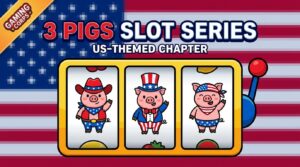
Swedish game developer Gaming Corps has launched a new instalment in its popular 3 Pigs slot franchise, this time drawing on American cultural motifs for its latest release. The game extends a series that has already proven commercially viable across multiple markets. By layering US-themed visuals and mechanics onto an established IP, the studio is making a calculated bet on brand familiarity paired with regional flavour. It’s a move that reflects broader trends in iGaming content strategy, where sequels and spin-offs increasingly drive portfolio growth.
What the US-Themed Launch Signals for Gaming Corps
Expanding an existing slot series rather than building from scratch is not merely a creative decision. It carries measurable strategic weight, particularly for a studio competing in a crowded supplier landscape. Here’s what stands out from this release:
- Franchise leverage: The 3 Pigs series already has player recognition, which reduces the marketing cost of launching a new title and shortens the path to traction with operators
- Market targeting: A US-themed chapter suggests Gaming Corps is actively positioning content for North American distribution channels, where regulated state-by-state markets are expanding
- The timing aligns with a period of heightened competition among European suppliers vying for shelf space with US-facing operators
- Content velocity: Releasing thematic variants of proven games lets studios maintain output cadence without the risk profile of entirely new IPs
Why Sequels Are Reshaping Slot Portfolios
The iGaming content market has shifted. Studios that once relied on high-volume, loosely connected releases are now gravitating toward franchise models, and the economics explain why.
A sequel or themed extension of a known game carries built-in advantages. Players who engaged with earlier versions are more likely to try the new one. Operators, meanwhile, face less uncertainty when onboarding a title that belongs to a series with demonstrated performance data. That dynamic creates a feedback loop: successful series get more sequels, which get more prominent placement, which drives more engagement.
Gaming Corps is hardly alone in this approach. Major suppliers like Pragmatic Play, Play’n GO, and NetEnt have all leaned heavily into sequel strategies over the past two years. But for a smaller studio, the calculus is arguably even more compelling. Without the distribution muscle of a tier-one supplier, Gaming Corps’ slot portfolio strategy depends on maximising the return from every title that gains traction.
Still, there’s a tension here that doesn’t resolve neatly. Sequels can dilute a brand if they arrive too frequently or deviate too far from what made the original work. Whether the US theme adds genuine novelty or simply dresses up familiar mechanics in new art is something only player data will answer.
The US Market Angle
Choosing an American theme is not accidental. The regulated US online casino market continues to expand, with states like Michigan, New Jersey, Pennsylvania, and Connecticut representing significant revenue pools. In 2023, US commercial gaming revenue surpassed $66 billion according to the American Gaming Association, and the online segment’s share keeps climbing.
For European suppliers, entering or deepening their presence in the US means adapting content. That doesn’t always require building games from scratch for American audiences (a distinction regulators have been slow to standardise across states). Sometimes, thematic localisation of existing titles is enough to gain operator interest and pass compliance review.
Whether Gaming Corps has specific US state certifications for this title remains unconfirmed. But the thematic direction alone positions the game as a conversation starter with US-facing operators evaluating new content.
How Thematic Design Influences Player Engagement
Beyond business strategy, the psychology of slot design matters. Neuro-linguistic programming principles and behavioural research both point to the same insight: thematic coherence affects how players perceive and interact with a game. When visual cues, audio design, and narrative framing align around a recognisable cultural framework, players process the experience more intuitively. Cognitive load drops. Engagement duration tends to increase.
A US-themed slot taps into a rich set of associations. Americana imagery, whether it involves diners, highways, or frontier aesthetics, triggers a sense of familiarity for a large player demographic. And familiarity, in behavioural terms, lowers the barrier to initial engagement. Players don’t need to learn a new world; they step into one they already recognise.
This principle extends to how operators merchandise games. Titles with clear thematic hooks are easier to feature in curated lobbies, seasonal promotions, and geo-targeted campaigns. A game with a vague or abstract theme requires more contextual framing to attract clicks. One built around a specific cultural identity does some of that work on its own. The result: a game that fits more naturally into operator marketing calendars, particularly around events like the Fourth of July or Thanksgiving.
Yet theme alone doesn’t sustain retention. Volatility profiles, bonus mechanics, and return-to-player percentages remain the structural drivers of long-term performance. The smartest studios treat theme as the door and math as the room.
Frequently Asked Questions
What is the 3 Pigs slot series by Gaming Corps?
It’s a franchise of online slot games developed by Gaming Corps, built around the 3 Pigs concept. Each new instalment introduces a different thematic layer while retaining core gameplay elements that players recognise from earlier versions.
Is this US-themed slot available in regulated American markets?
Gaming Corps has not publicly confirmed specific US state certifications for this title. The American theme positions it for potential distribution through US-facing operators, but availability will depend on individual state regulatory approvals.
Why do slot developers release themed sequels instead of new games?
Sequels reduce risk. They build on proven player interest, lower operator onboarding friction, and cost less to market than entirely original titles. For smaller studios especially, franchise extensions offer a more efficient path to revenue.
| Factor | New Original Slot | Franchise Sequel / Spin-off |
|---|---|---|
| Player acquisition cost | Higher — no existing awareness | Lower — built-in recognition from prior titles |
| Operator onboarding | Requires full evaluation cycle | Often expedited due to series track record |
| Creative risk | Significant — untested concept | Moderate — core formula validated, theme varies |
| Long-term brand value | Potentially high if breakout hit | Incremental, but compounds with each successful release |



