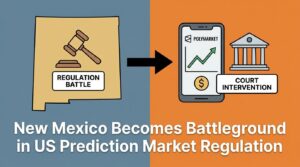
New Mexico has emerged as a pivotal jurisdiction in the escalating legal and regulatory battle over prediction markets in the United States. Polymarket, the blockchain-based prediction market platform, has filed a legal challenge in the state, pushing back against regulatory restrictions that threaten its operating model. The move signals a broader strategic effort by prediction market operators to secure legal footing across US states where the classification of event contracts remains contested. What unfolds in New Mexico could set a precedent that reverberates well beyond state lines.
Why New Mexico Matters for the Future of Event Contracts
The legal and regulatory treatment of prediction markets varies sharply across the United States, and the lack of a unified federal framework has turned individual states into laboratories for competing approaches. New Mexico’s regulatory posture places it squarely in the crosshairs of this debate. Polymarket’s decision to pursue legal action there reflects a calculated bet (arguably a fitting one, given the company’s business) that a favorable ruling could open doors in other jurisdictions wrestling with the same questions.
Below are the strategic takeaways from this development:
- Jurisdictional precedent: A court ruling in New Mexico could influence how other states classify and regulate event-based contracts, particularly those tied to political or economic outcomes.
- Regulatory clarity for operators: Prediction market platforms currently navigate a patchwork of state-level rules. A legal win here would provide a template for challenging restrictive interpretations elsewhere.
- The outcome will likely shape how the CFTC and state regulators coordinate on event contract oversight going forward.
- Investor confidence: Institutional and retail interest in prediction markets has surged since the 2024 US election cycle. Legal certainty in even one state could accelerate capital flows into the sector.
- Competitive dynamics: Platforms like Kalshi, which already hold CFTC approval for certain contracts, are watching closely. A Polymarket victory could level the playing field or complicate it further.
The Regulatory Landscape Polymarket Is Navigating
Prediction markets occupy an uncomfortable space between financial derivatives, gambling, and information markets. The Commodity Futures Trading Commission has historically claimed jurisdiction over event contracts, but its authority is neither absolute nor consistently applied. State gambling commissions, meanwhile, have at times treated prediction market participation as unlicensed wagering.
Polymarket operates on blockchain infrastructure, which adds another layer of complexity. Its contracts settle on-chain, and users interact through crypto wallets rather than traditional brokerage accounts. That architecture has kept the platform largely offshore for US users since a 2022 settlement with the CFTC, in which Polymarket agreed to pay $1.4 million and wind down non-compliant markets.
Still, the company has not abandoned the US market. Its New Mexico filing suggests a more aggressive posture, one aimed at testing whether state-level courts will draw a meaningful distinction between prediction contracts and traditional gambling products.
How This Fits Into a Broader Industry Shift
The prediction market sector has undergone a dramatic transformation over the past 18 months. During the 2024 presidential election, platforms like Polymarket and Kalshi saw trading volumes that dwarfed previous cycles. Polymarket alone reportedly processed billions of dollars in election-related contracts, drawing attention from media outlets, political analysts, and regulators alike.
That surge in visibility has forced a reckoning.
Regulators who previously treated prediction markets as a niche curiosity now face pressure to define clear rules. The CFTC’s approach has been uneven: it approved Kalshi’s election contracts only after a federal court overruled the agency’s initial denial, a sequence that exposed deep internal disagreement about the scope of permissible event trading. Whether state regulators will follow the CFTC’s evolving stance or chart their own course remains one of the unresolved tensions in this space.
State-Level Approaches: A Fragmented Picture
| State | Regulatory Stance | Key Consideration |
|---|---|---|
| New Mexico | Under legal challenge | Polymarket seeking court ruling on event contract classification |
| New York | Restrictive | State gambling laws broadly interpreted to cover prediction markets |
| New Jersey | Moderately permissive | Has allowed certain regulated event contracts through licensed operators |
| Federal (CFTC) | Evolving | Court rulings have forced the agency to reconsider its position on election contracts, though enforcement actions continue against unlicensed platforms |
What Prediction Market Operators Actually Want
At its core, the industry’s ask is straightforward: treat event contracts as a distinct asset class, not as gambling and not as traditional derivatives. Operators argue that prediction markets serve a public information function, aggregating collective intelligence about future events in ways that polls and expert forecasts often fail to capture. Academic research has broadly supported this claim, though critics note that market manipulation risks and thin liquidity can distort price signals in smaller contracts.
The distinction matters for practical reasons. Gambling classification triggers state licensing requirements, age restrictions, and tax treatment that most prediction market platforms are not structured to accommodate. Derivatives classification, on the other hand, brings federal oversight, margin requirements, and compliance costs that can be prohibitive for smaller operators. A third path, one that recognizes event contracts as their own category with tailored regulation, is what most industry participants are lobbying for.
Whether courts or legislatures will create that third path is far from certain.
Frequently Asked Questions
What is Polymarket’s legal argument in New Mexico?
Polymarket is challenging the state’s classification of its event contracts, arguing they should not be treated as gambling products. The platform contends that prediction markets function as information aggregation tools and deserve a regulatory framework distinct from traditional wagering.
Are prediction markets legal in the United States?
It depends on the state and the type of contract. Some event contracts have received CFTC approval, while others remain in a regulatory gray area. No blanket federal authorization exists, and state-level rules vary considerably.
How does this affect retail users?
US-based users have faced restrictions on several major prediction market platforms since 2022. A favorable ruling in New Mexico would not automatically open access nationwide, but it could weaken the legal basis for blanket prohibitions in other states. For now, most US participation in Polymarket technically occurs through offshore access points.
Why are prediction markets attracting regulatory attention now?
The 2024 election cycle drove unprecedented trading volumes and mainstream media coverage. Regulators who had previously deprioritized the sector found themselves under political and public pressure to clarify the rules, particularly after Polymarket’s election odds began influencing news coverage and public discourse in ways that traditional polls did not.



