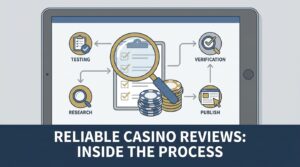
In an industry where trust deficits run deep and marketing noise drowns out substance, the methodology behind a credible casino review has become a subject of genuine professional interest. Reliable reviews sit at the crossroads of first-hand platform testing, investigative research into licensing and ownership structures, and systematic evaluation of player-facing terms. The process matters not just to consumers but to regulators, affiliate networks, and operators themselves, all of whom depend on review integrity to maintain market credibility. What separates editorial-grade assessment from promotional content is, at its core, a question of methodology.
What Makes a Casino Review Credible in 2025
Before examining the mechanics, it helps to frame why this matters now. The global online gambling market continues to expand across newly regulated jurisdictions, and with that expansion comes a flood of new platforms, many of which lack meaningful track records. For industry professionals and players alike, the following points capture the strategic significance of review methodology:
- First-hand deposit and withdrawal testing remains the single most revealing quality signal, exposing gaps between advertised and actual payout timelines
- Licensing verification has grown more complex as operators increasingly hold multiple jurisdictions’ permits, not all of which carry equivalent regulatory weight (a distinction regulators have been slow to standardise)
- Bonus term analysis, particularly wagering requirements and maximum bet rules, often reveals more about an operator’s intent than any marketing claim
- Player complaint patterns aggregated across forums and dispute resolution bodies provide a longitudinal view that snapshot reviews cannot
- Ownership and corporate structure transparency correlates strongly with operational reliability
The Testing Protocol: Beyond Surface-Level Evaluation
A rigorous casino review begins with account registration and identity verification. Testers note how long KYC procedures take, what documentation is requested, and whether the process aligns with the platform’s stated timelines. This alone can be telling. Some operators advertise instant verification but in practice require 48 to 72 hours for manual document review.
Deposit testing spans multiple payment methods. Credit cards, e-wallets, bank transfers, and cryptocurrency options are each evaluated for processing speed, minimum thresholds, and any undisclosed fees. Withdrawal testing is arguably more important. The gap between a platform’s advertised withdrawal window and the actual time funds reach a player’s account is one of the most common sources of complaint in the sector.
Game library assessment goes deeper than counting titles. Testers evaluate software provider diversity, RTP (return to player) transparency, and whether the platform’s game weighting rules for bonus play are clearly documented. A casino offering 3,000 slots means little if 80% of them are excluded from wagering contribution.
Why Licensing Alone Doesn’t Tell the Full Story
Operators frequently display licence badges from jurisdictions like Malta, Curaçao, or the UK Gambling Commission. But the regulatory rigour behind those licences varies enormously. A Curaçao eGaming licence, for instance, historically imposed fewer ongoing compliance obligations than an MGA or UKGC permit. Reviewers who treat all licences as equivalent miss a critical layer of risk assessment.
Still, licensing is a necessary starting point. Unlicensed operators present a categorically different risk profile, and any review framework that fails to flag this distinction is incomplete at best.
Investigative Research: Following the Corporate Trail
Ownership structures in iGaming are notoriously opaque. A single parent company may operate dozens of brands across different jurisdictions, sometimes sharing the same platform infrastructure, customer support teams, and bonus engines. Identifying these connections matters because a pattern of unresolved complaints at one brand often signals systemic issues across the group.
Experienced reviewers cross-reference corporate registries, affiliate programme disclosures, and WHOIS data to map operator networks. Platforms like AskGamblers’ casino complaint resolution database provide aggregated player dispute data that can surface patterns invisible at the individual brand level. This kind of investigative layer separates editorial review from repackaged marketing copy.
The Psychology of Trust in Review Content
From a neuro-linguistic programming perspective, the way review content is framed shapes reader perception in measurable ways. Anchoring bias plays a significant role: when a review leads with a platform’s strongest feature, such as a large welcome bonus, readers tend to evaluate subsequent information relative to that initial anchor. Responsible review methodology deliberately counteracts this by presenting licensing status and complaint history before promotional details.
Representational systems also matter. Some readers process trust signals visually, responding to licence badge placement and site design cues. Others rely on auditory-digital processing, weighing the logical consistency of terms and conditions. Effective reviews address multiple representational channels without defaulting to a single persuasion frame. The sequencing of information, moving from regulatory standing to operational testing to bonus analysis, mirrors a logical trust-building progression that aligns with how professionals typically evaluate risk.
Reframing is another technique worth noting. Rather than stating a casino “has slow withdrawals,” a well-constructed review might note that “withdrawal processing exceeded the platform’s stated 24-hour window by an average of three business days during testing.” The specificity shifts the reader’s internal representation from vague concern to calibrated assessment. And that shift changes decision-making.
Meta-programs, the filters through which individuals process information, vary between “toward” motivation (seeking positive outcomes) and “away from” motivation (avoiding negative ones). A review that only highlights benefits activates one filter while leaving risk-averse readers without the information architecture they need. Balanced methodology serves both orientations.
What Operators and Affiliates Should Watch For
The review ecosystem is not without its own credibility problems. Pay-for-placement models, undisclosed affiliate relationships, and templated reviews that recycle the same language across dozens of brands all erode trust in the category. Operators selecting affiliate partners would do well to audit the editorial independence of review sites linking to their platforms.
| Review Element | What It Reveals | Common Shortcut |
|---|---|---|
| KYC Testing | Actual verification timelines vs. advertised | Skipped entirely; reliance on operator claims |
| Withdrawal Testing | Real payout speed and fee transparency | Quoted from T&Cs without live testing |
| Licence Verification | Regulatory tier and compliance obligations | Badge displayed without jurisdictional context |
| Ownership Mapping | Group-level risk patterns | Brand reviewed in isolation from parent company network |
| Bonus Term Analysis | Playthrough feasibility and hidden restrictions | Headline bonus figure promoted without wagering detail, or with only partial disclosure |
Frequently Asked Questions
How can players verify whether a casino review is independent?
Look for disclosed affiliate relationships, evidence of first-hand testing (screenshots, specific dates), and whether the review addresses negative findings. A review that reads like a product brochure almost certainly is one.
Do all casino licences offer the same level of player protection?
No. Jurisdictions differ substantially in their enforcement capacity, complaint resolution mechanisms, and ongoing audit requirements. A UK Gambling Commission licence, for example, imposes stricter responsible gambling obligations than most offshore alternatives. The licence itself is only as strong as the regulator behind it.
Why does ownership structure matter in a casino review?
Because operational problems tend to be systemic. If a parent company has a history of delayed payouts or unresolved disputes across multiple brands, a new brand under the same umbrella inherits that risk profile whether it acknowledges the connection or not.



