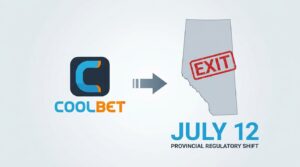
Coolbet, the sportsbook and online casino operator owned by GAN Limited, will cease offering its products in Alberta on July 12. The withdrawal comes one day before Alberta’s new regulated iGaming framework takes effect on July 13, signalling a strategic retreat rather than a bid for a provincial licence. The move leaves Alberta-based players with a narrow window to withdraw funds and close accounts, while raising broader questions about operator viability under Canada’s evolving provincial licensing regimes.
What Coolbet’s Alberta Exit Means for Operators and Players
The timing here is not incidental. Alberta is preparing to launch a regulated online gambling market, and Coolbet’s decision to pull out rather than pursue authorisation under the new regime reflects a calculated business judgment about the cost-benefit equation of compliance in a mid-sized Canadian province.
- Coolbet will shut down sportsbook and casino offerings in Alberta effective July 12, 2025, one day before the province’s regulated iGaming market opens.
- Players in Alberta must withdraw remaining balances before the cutoff date or risk complications in accessing their funds.
- GAN Limited, Coolbet’s parent company, has not publicly indicated plans to apply for an Alberta licence under the new framework.
- The exit underscores a pattern: not every operator currently serving Canadian customers intends to transition into provincially regulated markets.
- Alberta joins Ontario as a province actively building a ring-fenced iGaming ecosystem, though the two differ in scale and regulatory design.
Why Alberta’s Regulatory Shift Is Forcing Operator Decisions
Alberta’s move toward a regulated iGaming market has been anticipated for months. The province is establishing a licensing framework that will require operators to meet specific compliance, responsible gambling, and technical standards before offering products to Alberta residents. For some operators, the economics simply don’t pencil out.
Coolbet, which has maintained a presence across several international markets, appears to have concluded that the Alberta opportunity (a province of roughly 4.6 million people) doesn’t justify the regulatory overhead. That calculus may shift if the market matures or if GAN’s broader North American strategy evolves. But for now, the operator is stepping back.
And while Ontario’s regulated market has attracted dozens of licensed operators since its April 2022 launch, Alberta presents a different proposition. The player base is smaller, the competitive landscape less tested, and the regulatory infrastructure still nascent. Operators weighing entry must consider not just licensing fees and tax rates, but the cost of building compliant technology stacks and responsible gambling programs tailored to provincial requirements.
The Broader Pattern Across Canadian Provinces
Coolbet’s departure fits into a wider trend. As Canadian provinces move from grey-market tolerance toward formal regulation, operators face a binary choice: invest in compliance or leave. Some, like those already licensed in Ontario, have built the infrastructure to scale across provinces. Others, particularly smaller or internationally focused brands, are choosing to exit.
This is not unique to Canada. Similar dynamics played out across European markets over the past decade as countries like Sweden, the Netherlands, and Germany introduced national licensing regimes. In each case, a subset of operators withdrew rather than adapt (a pattern regulators generally view as a sign the framework is working as intended).
Still, every exit creates a gap. Players who lose access to a preferred platform don’t always migrate to licensed alternatives. Some drift toward unlicensed offshore sites, which is precisely the outcome provincial regulators are trying to prevent. Whether Alberta’s framework will include sufficient consumer awareness campaigns and enforcement mechanisms to capture these players remains an open question.
What Players in Alberta Should Do Before July 12
For Coolbet customers in the province, the immediate priority is straightforward: withdraw funds. The operator is expected to honour all outstanding balances, but delays are possible as the shutdown date approaches. Players should log into their Coolbet accounts and initiate withdrawals well before the July 12 deadline to avoid last-minute processing bottlenecks.
Any pending bonuses or promotional credits may be voided upon account closure, depending on the operator’s terms. Players should review their account status carefully.
How GAN Limited’s Strategy Factors In
GAN Limited, which acquired Coolbet in 2021, has been navigating a complex strategic landscape. The company operates both as a B2B technology provider to U.S. casinos and as a B2C operator through Coolbet in international markets. Balancing these two business lines requires disciplined capital allocation, and exiting a market that demands significant compliance investment for uncertain returns is arguably a rational move.
GAN’s Q1 2025 financial results showed the company continuing to prioritize its enterprise software business in the United States, where partnerships with land-based casino operators provide more predictable revenue streams. The Coolbet brand, while valuable in Nordic and Latin American markets, may not be the vehicle GAN chooses for Canadian expansion, at least on paper.
Frequently Asked Questions
When exactly will Coolbet stop operating in Alberta?
Coolbet will cease offering sportsbook and online casino products in Alberta on July 12, 2025. This is one day before Alberta’s new regulated iGaming market officially launches on July 13.
Can I still access my Coolbet account after July 12?
Account access for withdrawal purposes may remain available for a limited period, but active wagering and casino play will be disabled. Contact Coolbet’s support team directly for specifics on post-shutdown account access.
Will Coolbet apply for an Alberta licence in the future?
GAN Limited has not announced any plans to seek an Alberta iGaming licence. The company’s current strategic focus appears oriented toward its U.S. B2B operations and existing Coolbet markets outside Canada.
What alternatives do Alberta players have?
Once the regulated market launches on July 13, Alberta residents will be able to access licensed operators that have received provincial authorisation. The specific list of approved operators has not yet been fully disclosed by the regulator.
Reading the Market Signal
Operator exits ahead of regulatory launches are neither unusual nor inherently alarming. They are, however, informative. Each withdrawal tells regulators something about how the market perceives the balance between opportunity and obligation embedded in the new rules. If too many operators decline to participate, it may suggest the framework is too restrictive or the tax burden too high. If only a handful leave, the regime is likely calibrated well enough to attract meaningful competition.
Alberta’s regulator will be watching closely. The province has the advantage of learning from Ontario’s experience, where early teething problems around advertising standards and responsible gambling enforcement required mid-course corrections. Whether Alberta has absorbed those lessons won’t become clear until the market has been live for several quarters. Coolbet, for its part, will be watching from the outside.