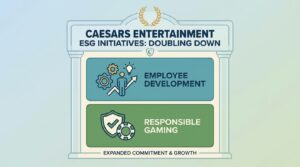
Caesars Entertainment has reinforced its commitment to environmental, social, and governance priorities through a series of investments spanning employee development, community engagement, and responsible gaming programs. The hospitality and gaming giant, which operates dozens of properties across the United States, outlined these efforts as part of its broader corporate responsibility strategy. While many gaming operators have begun publishing sustainability reports, Caesars has been among the more aggressive in tying ESG metrics to operational benchmarks. The timing matters: regulatory scrutiny of the gaming sector’s social impact continues to intensify.
What Caesars’ ESG Push Signals for the Gaming Industry
Corporate responsibility in gaming has shifted from a reputational checkbox to a strategic imperative. Caesars’ latest investments reflect that shift, and the details reveal where the company sees both risk and opportunity.
- Employee development spending signals retention strategy: In a labor market where hospitality turnover remains stubbornly high, Caesars is betting that upskilling programs reduce churn and improve service quality across its portfolio.
- Responsible gaming programs carry regulatory weight. With states continuing to expand legal sports betting, operators that demonstrate proactive harm-reduction measures are better positioned when license renewals come up.
- Community investment programs, often dismissed as PR exercises, increasingly factor into local government decisions about gaming expansion permits and tax incentive negotiations.
- The ESG framework doubles as a risk management tool — particularly as institutional investors apply tighter screens to gaming-sector holdings.
Employee Development: More Than a Retention Play
Caesars has channeled resources into workforce training and career advancement pathways, targeting both frontline hospitality staff and corporate employees. The approach is layered. Entry-level team members gain access to skills certification programs, while mid-career employees can pursue leadership development tracks. This isn’t purely altruistic — the economics are straightforward. Replacing a single hourly hospitality worker costs an estimated $3,000 to $5,000 when recruiting, onboarding, and productivity loss are factored in. Multiply that across a workforce of roughly 50,000, and even modest improvements in retention translate to significant savings.
But there’s a subtler dimension here. By investing in internal mobility, Caesars Entertainment’s workforce programs also build institutional knowledge that competitors struggle to replicate. Whether that advantage holds as the broader hospitality sector ramps up its own talent strategies remains an open question.
Responsible Gaming: Where Compliance Meets Credibility
Arguably the most scrutinized pillar of any gaming company’s ESG portfolio, responsible gaming programs sit at the intersection of regulation, public trust, and long-term market access. Caesars has expanded its responsible gaming initiatives to include enhanced self-exclusion tools, employee training on identifying problem gambling behaviors, and partnerships with third-party organizations focused on gambling addiction research and treatment.
At least on paper, these measures exceed the minimum requirements in most jurisdictions. That distinction matters (a distinction regulators have been slow to enforce uniformly across operators). States like New Jersey, Nevada, and Indiana have each developed their own responsible gaming frameworks, creating a patchwork of compliance obligations that national operators must navigate property by property.
Still, the real test isn’t whether Caesars publishes the right policies. It’s whether those policies produce measurable outcomes — reduced problem gambling rates, higher self-exclusion enrollment, fewer regulatory complaints. The company has not released granular outcome data on these programs, which limits external assessment of their effectiveness.
Community Programs and Local Impact
Caesars’ community investment strategy spans charitable giving, volunteer programs, and partnerships with local organizations in the markets where it operates. These efforts serve a dual purpose: they generate goodwill in communities that host gaming properties, and they provide tangible evidence of local economic contribution during regulatory proceedings.
One detail worth noting is the geographic targeting. Community investments tend to concentrate in markets where Caesars faces competitive pressure or regulatory uncertainty. That pattern suggests a more calculated approach than the broad-based philanthropy framing might imply.
How ESG Shapes Investor Perception in Gaming
Institutional investors have grown more deliberate about ESG screening in the gaming sector over the past three years. The result: a market caught between two frameworks. Traditional valuation models prioritize revenue growth and margin expansion. ESG-conscious capital allocation models weigh governance quality, social impact metrics, and environmental footprint alongside financial performance.
| ESG Pillar | Caesars’ Focus Area | Strategic Relevance |
|---|---|---|
| Environmental | Energy efficiency, waste reduction | Operational cost savings and regulatory compliance |
| Social | Employee development, responsible gaming, community programs | Workforce retention, license security, local government relations |
| Governance | Board diversity, compliance infrastructure | Investor confidence and risk mitigation across jurisdictions |
For Caesars, the calculus is clear enough. ESG investments that reduce regulatory friction and improve workforce stability pay for themselves over a multi-year horizon. And while not all market participants agree on the magnitude of that return, the directional bet aligns with where both capital markets and state regulators are heading.
The Broader Context: Why Gaming’s ESG Moment Matters Now
The U.S. gaming industry generated over $66 billion in commercial revenue in 2023, according to the American Gaming Association. Growth of that scale attracts attention — from legislators, advocacy groups, and communities weighing the costs and benefits of hosting gaming operations. Companies that build credible ESG track records create a buffer against the political and social backlash that has historically accompanied rapid gaming expansion.
Caesars is not alone in this effort. Competitors including MGM Resorts and Wynn Resorts have published their own sustainability reports and expanded responsible gaming programs. What separates operators, in practice, is execution depth and transparency. Publishing a report is easy. Tying executive compensation to ESG outcomes, or submitting to independent audits of responsible gaming program effectiveness, requires a different level of commitment.
Whether Caesars’ current investments cross that threshold will become clearer as reporting cycles mature and regulators begin demanding standardized disclosures across the sector.
Frequently Asked Questions
What specific employee development programs has Caesars introduced?
Caesars has invested in skills certification for frontline workers and leadership development tracks for mid-career employees, aiming to reduce turnover and build internal career pathways across its properties.
How does responsible gaming affect a company’s ability to operate?
Responsible gaming programs directly influence license renewals and regulatory standing. Operators that demonstrate proactive measures — self-exclusion tools, staff training, third-party partnerships — tend to face fewer compliance challenges. In some jurisdictions, these programs are mandatory; in others, going beyond the minimum creates competitive advantage during expansion bids.
Why are ESG investments relevant to gaming companies specifically?
Gaming sits at a unique intersection of entertainment, regulation, and social impact. ESG frameworks help operators manage reputational risk, satisfy institutional investor criteria, and maintain the community relationships that underpin their operating licenses.