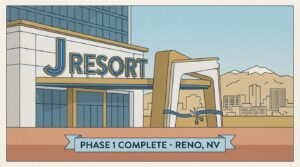
Jacobs Entertainment has finished the first phase of its ambitious $400 million redevelopment of J Resort in downtown Reno, Nevada, marking a significant milestone in the company’s broader plan to reshape the city’s urban core. The project, which has been closely watched by regional gaming and hospitality stakeholders, introduces new hotel rooms, dining venues, and entertainment spaces to a property that had long been seen as underperforming relative to its location. With subsequent phases already in the pipeline, the investment signals a deeper bet on Reno’s trajectory as a destination market rather than merely a pass-through gaming stop.
What the First Phase Delivers for Downtown Reno
Before breaking down the strategic implications, it’s worth understanding the scope of what’s actually been delivered. The initial phase of the J Resort transformation encompasses renovated hotel accommodations, upgraded casino floor space, and several new food and beverage concepts designed to attract both visitors and locals. Jacobs Entertainment has positioned the property as a lifestyle-oriented resort, a departure from the legacy casino-hotel model that has dominated Reno’s downtown corridor for decades.
The $400 million total price tag covers the full multi-phase vision, not just what’s been completed so far. Still, the first phase alone represents a substantial capital deployment in a market where large-scale hospitality investment has been sporadic at best.
Strategic Stakes Behind the J Resort Transformation
Here’s what matters most for industry watchers and regional stakeholders:
- Market repositioning: Jacobs is deliberately moving J Resort away from a budget-tier gaming property toward a mixed-use entertainment destination, a shift that could redefine competitive dynamics in downtown Reno.
- The investment arrives as Reno benefits from population growth and corporate relocations, particularly from the San Francisco Bay Area, creating a broader economic tailwind for hospitality.
- Urban revitalization anchor: J Resort sits within Jacobs Entertainment’s larger Neon Line District project, which aims to transform several blocks of downtown Reno into a walkable entertainment and arts district.
- Phased risk management: By structuring the $400 million commitment across multiple phases, Jacobs retains flexibility to adjust scope and timing based on market conditions and early performance data.
- Completion of Phase 1 gives the company a functioning proof of concept before committing remaining capital, arguably the most prudent approach in a market still proving itself.
The Neon Line District: More Than a Single Property
What separates this project from a typical casino renovation is context. Jacobs Entertainment’s broader Neon Line District initiative envisions a connected urban entertainment zone spanning multiple city blocks in downtown Reno. The district concept includes public art installations, retail, dining, and residential components alongside the gaming resort itself.
That kind of mixed-use thinking has worked in other mid-tier Western markets. But whether Reno’s visitor base and local demographics can sustain a district-level development remains the open question that Phase 1 alone cannot answer.
The company has acquired multiple properties in the surrounding area over recent years, assembling the land position needed to execute the full vision. In practice, this gives Jacobs unusual control over the pace and character of development in a way that few gaming operators enjoy in established downtown corridors.
Reno’s Evolving Competitive Landscape
Reno has long operated in the shadow of Las Vegas, competing for a different traveler profile and drawing heavily from Northern California drive-in traffic. Recent years have shifted that calculus somewhat. The metro area’s population growth (fueled in part by Tesla’s Gigafactory and other industrial investments in the broader Washoe County region) has expanded the local consumer base for hospitality and entertainment spending.
| Factor | Reno Market Context |
|---|---|
| Population trend | Steady growth driven by corporate relocations and housing affordability relative to California |
| Primary visitor source | Northern California drive-in market, roughly 2–4 hours by car |
| Competitive set | Atlantis, Peppermill, Grand Sierra Resort among key regional players |
| Development momentum | Multiple downtown projects underway beyond J Resort, including infrastructure upgrades |
Against this backdrop, Jacobs Entertainment’s bet looks less speculative than it might have five years ago. Yet the competitive set in Reno is not standing still either, and established properties like the Peppermill and Grand Sierra Resort continue to invest in their own offerings.
How Phased Investment Shapes Operator Strategy
There’s a broader lesson embedded in Jacobs’ approach. Large-scale hospitality redevelopments structured in phases allow operators to test market reception before fully committing capital. This is especially relevant in secondary and tertiary gaming markets where demand elasticity is harder to model with precision. Phase 1 completion gives Jacobs real operational data on occupancy rates, food and beverage revenue per visitor, and casino floor performance that will directly inform the scope and timing of Phase 2.
And while the $400 million headline figure grabs attention, the phased structure means the company’s actual exposure at any given point is considerably smaller. That distinction matters for how investors and lenders evaluate the project’s risk profile.
Frequently Asked Questions
What is the total investment planned for J Resort?
Jacobs Entertainment has outlined a $400 million multi-phase redevelopment plan for J Resort in downtown Reno. The first phase is now complete, with additional phases expected to follow based on market performance and strategic priorities.
Where is J Resort located?
J Resort sits in downtown Reno, Nevada, within what Jacobs Entertainment has branded the Neon Line District, a planned mixed-use entertainment corridor.
How does this affect Reno’s downtown?
The project functions as an anchor for broader urban revitalization efforts. Jacobs has acquired surrounding properties to build out a walkable district that extends well beyond the resort’s footprint, which could reshape foot traffic patterns and commercial activity in the area for years.
Is the full $400 million already spent?
No. Only the first phase has been completed. The total figure represents the projected cost across all planned phases, and Jacobs retains flexibility on timing and scope for subsequent stages.



