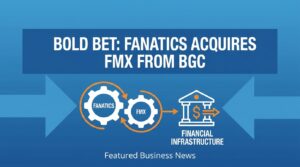
Fanatics, the sports merchandise and betting conglomerate led by billionaire Michael Rubin, is in advanced discussions to acquire a federally regulated futures exchange and clearinghouse from BGC Group. The deal would mark a striking pivot for a company best known for licensed sports apparel and online gambling, thrusting it into the regulated financial infrastructure space. While terms have not been publicly disclosed, the transaction would give Fanatics control of FMX, a platform BGC has been developing to challenge CME Group’s dominance in U.S. interest rate futures.
What the FMX Acquisition Signals for Fanatics and Financial Markets
Before unpacking the mechanics, it’s worth stepping back to consider what this deal reveals about where Fanatics sees its future. The company has already expanded aggressively from collectibles into sports betting and iGaming. Acquiring a regulated exchange infrastructure asset goes considerably further, suggesting Rubin’s ambitions extend well beyond consumer-facing platforms.
- Fanatics would gain ownership of a federally regulated exchange and clearinghouse, assets that carry significant barriers to entry and recurring revenue potential
- The acquisition positions Fanatics as a competitor in the U.S. futures market, directly challenging CME Group’s entrenched position in Treasury and interest rate derivatives
- BGC Group, which invested heavily in building FMX, appears ready to exit after struggling to gain meaningful market share against CME
- For the broader financial services industry, the entry of a non-traditional acquirer into exchange infrastructure raises questions about convergence between fintech, sports betting, and capital markets
- Regulatory approval remains a prerequisite, and the CFTC’s posture toward a sports-betting parent company owning a futures exchange has not been tested
BGC’s Uphill Battle Against CME
BGC Group launched FMX with considerable ambition. The platform was designed to offer U.S. Treasury futures and interest rate products in direct competition with CME Group, which controls an overwhelming share of that market. But dislodging an incumbent in exchange-traded derivatives is notoriously difficult (a distinction the industry has learned repeatedly over the past two decades). Liquidity begets liquidity, and traders gravitate toward the venue where counterparties already cluster.
Despite backing from major Wall Street banks and competitive fee structures, FMX struggled to build the critical mass needed to sustain a viable alternative. BGC’s decision to entertain a sale suggests the firm concluded that the capital required to continue the fight exceeded the strategic return.
That calculus may look different from Fanatics’ vantage point.
Why Fanatics Sees Opportunity Where BGC Saw Diminishing Returns
Rubin has built Fanatics into a sprawling empire valued at roughly $31 billion at its last private funding round. The company’s expansion into sports betting and daily fantasy platforms demonstrated a willingness to enter heavily regulated, capital-intensive markets. Acquiring FMX fits that pattern, arguably amplifying it.
Still, the logic isn’t immediately obvious. Fanatics has no public track record in institutional financial services. What it does have is technology infrastructure built for high-volume, real-time transaction processing across its e-commerce, collectibles, and betting verticals. Whether that translates into the latency-sensitive, compliance-heavy world of futures clearing is an open question.
One possible rationale: Fanatics may view exchange ownership as a long-term infrastructure play that complements its betting operations. Regulated exchanges generate steady fee income from every matched trade, and a clearinghouse collects margin deposits that produce interest revenue. In a higher-rate environment, those deposits become particularly valuable.
The Regulatory Dimension
Any change of ownership involving a CFTC-regulated exchange and clearinghouse requires regulatory approval. The commission will scrutinize whether Fanatics possesses the financial resources, governance structures, and risk management capabilities to operate critical market infrastructure. And while the CFTC has approved non-traditional owners before, the combination of sports betting and futures exchange ownership under one corporate umbrella is, at minimum, novel.
Regulators may also examine potential conflicts of interest. Sports betting companies handle large volumes of event-based risk, and futures exchanges handle financial risk. The operational and compliance firewalls between those activities would need to satisfy regulators that no information leakage or market integrity concerns arise.
How This Reshapes the Competitive Landscape
| Factor | CME Group | FMX (Under Fanatics) |
|---|---|---|
| Market share in U.S. rate futures | Dominant, estimated above 90% | Marginal; still building liquidity |
| Clearing infrastructure | Established, deeply integrated with dealer workflows | Operational but unproven at scale under new ownership |
| Fee structure | Premium pricing supported by network effects | Competitive pricing has been a key differentiator, though insufficient alone to shift volumes |
| Parent company profile | Publicly traded, pure-play exchange operator | Private conglomerate spanning retail, sports, and betting |
The competitive dynamics won’t shift overnight. CME’s moat is structural, not merely financial. Yet a well-capitalized new owner willing to sustain losses while building market share could gradually alter the equation, particularly if Fanatics leverages relationships with banks that were early FMX supporters.
Broader Implications: When Consumer Brands Enter Capital Markets
This potential acquisition sits at the intersection of several trends reshaping financial services. Non-traditional firms have been encroaching on banking, payments, and trading for years. But outright ownership of exchange infrastructure by a consumer brand represents a different magnitude of convergence.
Consider the framing through a strategic lens. Fanatics already processes millions of transactions daily across merchandise, trading cards, and wagers. Each of those verticals requires real-time pricing, risk assessment, and settlement. The operational DNA, at least in broad strokes, shares more with exchange operations than it might first appear. Whether that surface-level similarity holds up under the specific demands of derivatives clearing, where a single risk management failure can cascade across the financial system, remains the harder question.
What’s also worth watching: how institutional market participants react. Banks and asset managers that route order flow to exchanges care deeply about the creditworthiness, governance, and neutrality of the clearinghouse standing between them and counterparty risk. A parent company primarily associated with jerseys and parlays will need to earn that trust through demonstrated operational rigor, not brand recognition.
Frequently Asked Questions
What is FMX?
FMX is a U.S. futures exchange and clearinghouse developed by BGC Group to compete with CME Group in Treasury and interest rate futures markets. It holds federal regulatory approval from the CFTC.
Why would Fanatics want to own a futures exchange?
The acquisition would give Fanatics a regulated financial infrastructure asset generating transaction-based fee revenue and interest income on margin deposits. It aligns with the company’s pattern of entering regulated, high-volume markets and may complement its existing betting and transaction-processing capabilities.
Does this deal require regulatory approval?
Yes. Any transfer of ownership of a CFTC-regulated exchange and clearinghouse must receive commission approval, which involves review of the acquirer’s financial standing, governance, and risk management frameworks. The timeline for such review can vary significantly.
How does this affect CME Group?
In the near term, the impact on CME is likely limited given its dominant market position. Longer term, a well-funded new owner willing to invest in FMX could intensify competitive pressure, particularly on pricing and technology.