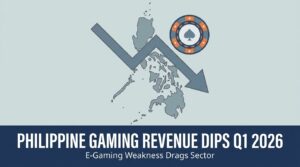
The Philippine gaming sector posted lower first-quarter revenue in 2026, driven primarily by softness in e-gaming operations that offset modest gains elsewhere. The decline marks a notable shift for an industry that had been riding consecutive quarters of growth through much of 2025. Regulators and operators alike are now recalibrating expectations as digital gaming channels — once seen as the sector’s most reliable growth engine — show signs of cooling. The results raise pointed questions about whether the Philippines can sustain its ambitions as Southeast Asia’s premier regulated gaming hub.
What the Q1 2026 Numbers Actually Reveal
Before parsing the strategic implications, the top-line figures deserve a closer look. The revenue contraction was not uniform across all verticals, and the composition of the decline matters as much as its magnitude.
- E-gaming revenue fell sharply, pulling down the sector’s aggregate performance despite relative stability in land-based casino operations
- Integrated resort casinos in Entertainment City and Clark maintained occupancy and table game volumes, suggesting the weakness is concentrated in online and electronic channels
- PAGCOR’s regulatory collections reflected the softer top line, with implications for government revenue targets that depend heavily on gaming contributions
- The quarter-over-quarter trajectory signals a potential inflection point rather than a one-off seasonal dip
- Operators with heavier e-gaming exposure face margin pressure that could accelerate portfolio rebalancing toward physical venues
E-Gaming’s Stumble: Structural or Cyclical?
For the past three years, e-gaming had been the Philippine industry’s standout performer. Licensed platforms proliferated, player acquisition costs dropped, and regulatory clarity from the Philippine Amusement and Gaming Corporation gave operators a framework that attracted both domestic and offshore capital. That trajectory now looks less certain.
Several factors appear to be converging. Tighter enforcement against unlicensed offshore operators — particularly in the wake of the POGO crackdown — has reduced the grey-market activity that, paradoxically, had been funnelling some players toward licensed platforms. At the same time, player spending patterns have shifted. Disposable income pressures tied to persistent inflation in the Philippines may be curbing recreational gambling budgets, especially among the mass-market demographic that e-gaming platforms depend on.
And then there’s competition. Regional neighbours, notably Cambodia and emerging jurisdictions in Southeast Asia, have been building out their own digital gaming frameworks. Whether the Philippine market is losing share or simply maturing is a distinction that won’t become clear for another quarter or two.
Land-Based Resilience Offers a Partial Buffer
Not everything in the Q1 report warrants concern. Integrated resorts in Manila’s Entertainment City corridor — operated by groups including Bloomberry Resorts, Melco, and Universal Entertainment — continued to draw premium and VIP traffic. Table game drop and slot handle remained broadly stable, buoyed by inbound tourism from China, South Korea, and Japan that has yet to fully recover to pre-pandemic peaks but is trending upward.
This resilience matters. It suggests the Philippine gaming ecosystem retains structural advantages in physical hospitality and entertainment that digital-only operators cannot easily replicate. Still, land-based operations carry higher fixed costs, and their growth ceiling is constrained by real estate, licensing caps, and infrastructure bottlenecks that e-gaming was supposed to circumvent.
How Regulatory Posture Shapes What Comes Next
PAGCOR’s evolving role adds another layer. The regulator has been undergoing its own transformation, with proposals to separate its regulatory and operating functions gaining legislative traction. If enacted, this restructuring could alter how gaming taxes are assessed and distributed — a shift that operators are watching closely but cannot yet price into their forecasts (a distinction that makes forward guidance from Philippine-listed gaming stocks particularly unreliable right now).
Enforcement priorities have also tilted. Resources that once targeted offshore operators are increasingly being redirected toward compliance audits of licensed e-gaming platforms. The intent is to shore up consumer protection and anti-money-laundering standards, but the near-term effect is higher compliance costs for operators already facing revenue headwinds.
| Segment | Q1 2026 Trend | Key Driver |
|---|---|---|
| E-Gaming | Decline | Reduced grey-market spillover, consumer spending pressure, regional competition |
| Integrated Resorts | Stable to modest growth | Inbound tourism recovery, VIP segment resilience |
| PAGCOR Collections | Below target | Lower aggregate revenue base across digital channels |
| Regulatory Environment | Tightening | Compliance audits, proposed structural reform of PAGCOR |
Strategic Recalibration: Reading the Signals
For operators, the Q1 results arguably demand a reassessment of capital allocation. Companies that had been channelling investment disproportionately into e-gaming platforms may need to diversify toward hybrid models — combining digital acquisition with physical venue experiences that drive higher per-visit revenue. This is not a pivot away from digital. It is a recognition that the growth assumptions underpinning e-gaming valuations in 2024 and 2025 were, at least on paper, more optimistic than the market now supports.
Investors tracking Philippine gaming equities should pay attention to second-quarter disclosures for signs of whether operators are adjusting marketing spend, renegotiating platform partnerships, or accelerating land-based expansion timelines. The gap between what management teams say on earnings calls and what capital expenditure patterns reveal will be telling.
Frequently Asked Questions
Why did Philippine gaming revenue decline in Q1 2026?
The primary drag came from weaker e-gaming performance, driven by reduced grey-market spillover effects, consumer spending constraints, and growing competition from other Southeast Asian jurisdictions. Land-based operations remained comparatively stable.
Is this decline likely to continue?
That depends on several variables — including tourism recovery trajectories, regulatory reform timelines, and whether operators successfully rebalance their channel mix. A single quarter does not establish a trend, but the structural factors behind the dip are not easily reversed in the short term.
How does this affect PAGCOR’s revenue targets?
Lower gaming revenue directly reduces PAGCOR’s regulatory collections, which fund government programs. If the softness persists, it could complicate fiscal planning and intensify pressure on the regulator to either expand licensing or raise effective tax rates on remaining operators.
What should operators prioritise now?
Hybrid strategies that blend digital reach with physical venue investment appear to offer the most defensible path forward. Operators overly concentrated in e-gaming face the steepest adjustment curve.



