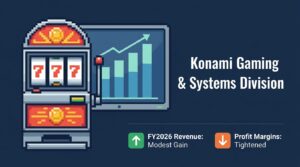
Konami Group’s gaming and systems division recorded a slight uptick in revenue for fiscal year 2026, though profitability in the segment came under visible pressure. The Japanese conglomerate, better known globally for its entertainment franchises, continues to navigate a competitive landscape in the gaming equipment and systems market where margins are increasingly difficult to defend. The results signal a business unit that is growing at the top line but struggling to convert that growth into proportional earnings.
What Konami’s FY2026 Gaming Numbers Reveal for the Industry
Before diving into the specifics, the broader takeaway here is one of strategic tension: Konami’s gaming and systems arm is expanding its footprint, but the cost of doing so appears to be eating into returns. For executives and operators watching the supplier side of the gaming industry, these results carry implications beyond a single earnings report.
- Revenue growth was positive but marginal, suggesting that Konami’s gaming hardware and systems sales are holding steady rather than accelerating in key markets.
- Profit compression points to rising input costs, increased R&D spending, or pricing pressure from competitors in the slot machine and casino management systems space.
- The division’s performance contrasts with Konami’s digital entertainment segment, which tends to deliver higher margins, raising questions about long-term capital allocation priorities within the group.
- For casino operators evaluating supplier partnerships, Konami’s willingness to invest at the expense of short-term margin could translate into better product offerings in the near term
- Market positioning remains intact, but the gap between revenue trajectory and profit trajectory is one that investors and partners will watch closely through FY2027.
Revenue Holds, but Where Did the Margin Go?
Konami’s gaming and systems division has historically operated as a smaller but strategically important piece of the group’s overall portfolio. In FY2026, the segment delivered a revenue figure that edged above the prior year’s mark. That alone isn’t alarming. What draws attention is the profit side of the ledger, where the division appears to have absorbed higher costs without passing them through to customers or offsetting them with volume gains.
Several factors could explain this squeeze. Component costs across the electronics supply chain have remained elevated in certain categories, and Konami’s gaming technology operations are not immune to those pressures. The company has also been investing in next-generation gaming cabinets and system platforms, expenditures that tend to weigh on margins before new products reach scale deployment.
Still, the division is not in retreat. A small revenue gain in a mature, competitive market (one where suppliers like Aristocrat, IGT, and Light & Wonder all jostle for floor space) suggests Konami is at least maintaining its share of operator budgets.
How This Fits Into the Broader Supplier Landscape
The gaming equipment supply market has been in a peculiar phase. Operators emerged from the pandemic era with strong balance sheets and a willingness to refresh aging slot floors, but that replacement cycle is now normalizing. Suppliers who rode the wave of pent-up demand in FY2023 and FY2024 are finding that sustaining those growth rates requires either geographic expansion, product innovation, or aggressive pricing.
Konami has pursued all three to varying degrees. Its SYNKROS casino management system continues to win contracts in North America, and the company has pushed into newer gaming jurisdictions. But each of those moves carries cost. And while competitors like Aristocrat have leaned heavily into digital and recurring-revenue models to smooth out hardware cyclicality, Konami’s gaming division remains more exposed to the traditional sell-and-install model (a distinction that arguably explains some of the margin differential).
The Capital Allocation Question Nobody Is Asking Loudly Enough
Within Konami Group, the gaming and systems division competes for investment dollars against the digital entertainment segment, which includes mobile gaming and esports properties. That internal competition matters.
If the gaming hardware division continues to grow revenue without proportional profit improvement, group leadership may face a difficult calculus: invest more to reach scale, or redirect capital toward higher-margin digital businesses. At least on paper, the digital segment offers a more attractive return profile. In practice, the gaming and systems business provides diversification and access to a regulated, high-barrier industry that carries its own strategic value.
What remains less clear is whether Konami views the current margin compression as a temporary investment phase or a structural feature of competing in this tier of the supplier market.
Operational Signals Worth Tracking
| Metric | FY2025 | FY2026 | Trend |
|---|---|---|---|
| Gaming & Systems Revenue | Baseline | Slight increase | Positive but modest |
| Segment Profit | Baseline | Declined | Margin pressure evident |
| Product Investment | Moderate | Elevated | R&D and new cabinet launches absorbing capital |
| Competitive Position | Stable | Stable | No significant share loss reported |
What Operators and Investors Should Watch Next
For casino operators, Konami’s willingness to absorb margin pressure while investing in product development could yield tangible benefits. New cabinet designs, improved system analytics, and expanded content libraries tend to follow periods of elevated R&D spend. The question is timing: will those products reach market in time to reverse the profit trend before investor patience thins?
Investors, meanwhile, should monitor whether the group’s next quarterly disclosures show any stabilization in segment profitability. A single year of margin compression tied to product investment is defensible. Two consecutive years starts to look like a structural problem.
Frequently Asked Questions
Did Konami’s gaming division lose money in FY2026?
No. The division remained profitable, but profit declined compared to the prior fiscal year despite a small increase in revenue. The issue is margin compression, not outright loss.
What products does Konami’s gaming and systems division sell?
The division manufactures and sells slot machines, electronic gaming cabinets, and casino management systems, including its SYNKROS platform used by operators across North America and other regulated markets.
Is Konami pulling back from the gaming equipment market?
There is no indication of a pullback. The revenue increase, however modest, and continued investment in new products suggest the company remains committed to the segment. Whether that commitment intensifies or moderates will depend on how the next fiscal year unfolds.
How does Konami compare to other gaming suppliers?
Konami is smaller in gaming equipment market share than Aristocrat, IGT, or Light & Wonder, but it maintains a meaningful presence, particularly in systems technology. Its competitive position held steady through FY2026.



