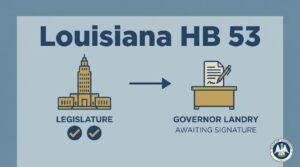
Louisiana’s House Bill 53 has passed through both legislative chambers and now sits on Governor Jeff Landry’s desk, positioning the state to enact a significant regulatory framework for sports betting and online gaming operations. The bill, which attracted bipartisan support during its legislative journey, introduces new compliance obligations for licensed operators while reshaping how the state collects and audits gaming revenue. If signed, Louisiana would join a growing cohort of states tightening oversight of their rapidly maturing legal gambling markets.
What HB 53 Means for Louisiana’s Gaming Landscape
The bill’s passage reflects a broader legislative appetite across the Gulf South to modernize gaming regulation without stifling operator growth. Before diving into the specifics, here are the strategic takeaways that matter most for industry stakeholders:
- Operator compliance costs are likely to rise as HB 53 introduces additional reporting requirements and audit mechanisms tied to gross gaming revenue
- The bill strengthens the Louisiana Gaming Control Board’s enforcement authority, giving regulators sharper tools to act against unlicensed or non-compliant entities
- Tax revenue transparency gets a structural upgrade, with new provisions requiring more granular disclosure of promotional credit deductions
- Smaller operators and affiliates may face disproportionate administrative burdens relative to larger, multi-state platforms
- Governor Landry’s signature is widely expected, given his administration’s stated priorities around fiscal accountability in gaming
Inside the Bill: Compliance and Revenue Provisions
At its core, HB 53 recalibrates the relationship between Louisiana’s gaming regulators and the operators they oversee. The bill mandates quarterly revenue reconciliation reports from all licensed sportsbook and iGaming operators, a shift from the current semi-annual schedule. That alone doubles the touchpoints between operators and the Gaming Control Board.
More consequential, arguably, is the bill’s treatment of promotional credits. Under existing rules, operators can deduct a portion of promotional play from their taxable gross gaming revenue. HB 53 caps those deductions more aggressively and requires itemized reporting on how promotional dollars flow through the system. For operators who have leaned heavily on bonus offers to acquire customers in Louisiana’s competitive market, this changes the math.
Still, the bill stops short of the outright promotional credit bans that some legislators had floated earlier in the session. That restraint suggests a pragmatic recognition: promotional spending remains a primary customer acquisition tool for platforms operating in Louisiana’s sports betting and daily fantasy markets, and eliminating it entirely could push activity toward unregulated channels.
How Does Louisiana Compare to Other States?
Louisiana’s approach with HB 53 lands somewhere between the permissive frameworks of states like New Jersey and the tighter regulatory postures seen in Illinois and New York. The table below offers a snapshot:
| State | Promotional Credit Cap | Reporting Frequency | Regulatory Body Authority |
|---|---|---|---|
| Louisiana (post-HB 53) | Capped with itemized disclosure | Quarterly | Expanded enforcement powers |
| New York | No deductions permitted | Monthly | Broad authority under state gaming commission |
| New Jersey | Generous deduction allowances | Monthly | Division of Gaming Enforcement oversight |
| Illinois | Phased reduction through 2028 | Quarterly | Illinois Gaming Board with expanded audit scope |
What stands out is Louisiana’s hybrid posture. The state isn’t eliminating promotional deductions (a distinction regulators in Albany might view as too lenient), but it’s imposing enough friction to discourage the most aggressive bonus strategies. Whether that balance holds under market pressure remains an open question.
The Enforcement Angle
Beyond revenue mechanics, HB 53 grants the Louisiana Gaming Control Board broader latitude to investigate and penalize operators found in violation of state licensing terms. The bill introduces tiered penalty structures, meaning first-time infractions carry lighter consequences than repeat violations. But the ceiling for penalties has been raised substantially.
This matters now because Louisiana’s legal sports betting market, launched in January 2022, has matured past its initial growth phase. Regulators are shifting from a posture of market facilitation to one of market discipline. And the timing aligns with a national trend: state gaming boards across the country are moving from permissive early-stage oversight toward stricter ongoing compliance regimes.
Strategic Implications for Operators and Affiliates
For multi-state operators like FanDuel and BetMGM, HB 53’s requirements are manageable. These companies already navigate a patchwork of state-level compliance obligations, and Louisiana’s new rules, while more demanding, fit within existing operational infrastructure. The real pressure falls on mid-tier operators and affiliate marketing companies that lack the compliance teams and legal resources of industry leaders.
Affiliate marketers, in particular, should watch how the Gaming Control Board interprets the bill’s provisions around advertising disclosures. HB 53 includes language that could be read to impose co-liability on affiliates for misleading promotional claims made on behalf of licensed operators. At least on paper, that’s a significant expansion of regulatory reach into the marketing supply chain.
Frequently Asked Questions
When will HB 53 take effect if signed?
The bill includes a 90-day implementation window following the governor’s signature, meaning operators would need to adjust their reporting and compliance systems within that timeframe.
Does HB 53 affect retail sportsbooks or only online operators?
Both. The quarterly reporting requirements and promotional credit caps apply to all licensed sports wagering operators in Louisiana, regardless of whether they operate physical or digital platforms.
Could the governor veto the bill?
While technically possible, Governor Landry’s public statements on gaming accountability make a veto unlikely. His office has not signaled any objections to the bill’s final language.
What penalties do operators face for non-compliance?
HB 53 establishes a tiered penalty framework. Fines for initial violations start at lower thresholds but escalate sharply for repeat offenses, with the possibility of license suspension in severe cases.
What Comes After the Signature
Governor Landry’s decision on HB 53 will likely arrive within weeks. If signed, the Louisiana Gaming Control Board faces the operational challenge of scaling its audit capacity to handle quarterly filings from every licensed operator in the state. That’s not a trivial administrative lift, and the board’s current staffing levels may not be sufficient without additional budget allocation from the legislature. The bill creates the mandate. Funding the infrastructure to enforce it is a separate fight entirely.