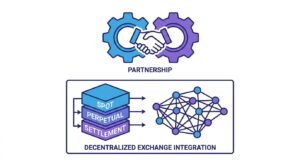
A newly announced agreement between a decentralized exchange (DEX) and an undisclosed infrastructure partner covers a sweeping scope of on-chain trading operations. The deal encompasses spot and perpetual trading, settlement, liquidations, and onboarding flows, signaling a push toward full-stack integration within decentralized finance. While specific financial terms have not been disclosed, the breadth of the arrangement suggests both parties are positioning for a more vertically integrated DeFi ecosystem. And the timing, amid growing institutional scrutiny of decentralized infrastructure, makes this more than a routine protocol handshake.
What This Partnership Actually Covers
Before breaking down the strategic implications, it’s worth mapping the operational surface area this agreement touches. The integration spans five core pillars of decentralized exchange functionality:
- Spot trading: Direct token-to-token swaps executed on-chain, the foundational layer of any DEX
- Perpetual trading: Leveraged derivative contracts without expiry dates, increasingly the volume driver for decentralized platforms
- Settlement infrastructure, which governs how trades finalize and how counterparty risk is managed across the protocol
- Liquidation mechanisms: Automated processes that close undercollateralized positions to protect protocol solvency
- Onboarding flows: User acquisition and wallet-to-protocol connectivity, arguably the weakest link in most DeFi stacks today
That last point deserves particular attention. Onboarding remains a persistent friction point for decentralized platforms competing with centralized exchanges that offer smoother entry ramps. Any partnership that explicitly addresses onboarding alongside trading and settlement mechanics is, at least on paper, attempting to close the gap between DeFi’s technical capability and its user experience deficit.
Why Vertical Integration Is Reshaping DEX Strategy
For years, decentralized exchanges operated as modular components within a broader DeFi stack. Liquidity lived in one protocol, derivatives in another, and settlement was often an afterthought handled by the underlying blockchain itself. That model worked when volumes were low and users were technically sophisticated. It doesn’t scale.
The shift toward vertically integrated DEX architectures reflects a maturing market. Protocols that control the full transaction lifecycle (from onboarding through execution to settlement and liquidation) can optimize latency, reduce slippage, and manage risk more effectively. They can also capture more value per user, a metric that matters increasingly as DeFi growth rates normalize.
Still, vertical integration carries its own risks. Concentrating multiple functions within a single protocol or partnership framework introduces systemic dependencies. If the liquidation engine fails during a volatility spike, the settlement layer is exposed. If onboarding flows are compromised, the entire funnel collapses. The architecture gains efficiency but trades away some of the resilience that modularity provided.
Market Context: Perpetuals Drive Volume, Spot Anchors Trust
Perpetual contracts now account for the majority of trading volume on leading decentralized platforms. According to data from multiple DeFi analytics providers, perpetual trading volumes on decentralized venues have consistently outpaced spot volumes by a factor of three to five in recent quarters. This makes the inclusion of perpetual trading in the partnership particularly significant from a revenue perspective.
But spot trading remains the trust anchor. It’s where price discovery begins, where new tokens find their first liquid markets, and where retail users most commonly interact with decentralized exchange protocols like Uniswap and its competitors. A partnership that bridges both spot and perpetual layers is effectively covering the full spectrum of trader intent, from conservative swaps to leveraged speculation.
| Trading Layer | Primary Function | Revenue Significance |
|---|---|---|
| Spot | Token swaps, price discovery | Moderate; high user count, lower per-trade fees |
| Perpetuals | Leveraged derivatives | High; dominant volume driver with funding rate revenue |
| Settlement | Trade finalization, netting | Indirect; reduces operational cost and counterparty exposure |
| Liquidations | Position closure under collateral thresholds | Variable; spikes during market stress events |
| Onboarding | User acquisition, wallet integration | Strategic; determines top-of-funnel growth capacity |
How Cognitive Framing Shapes DeFi Adoption
Beyond the technical architecture, there’s a behavioral dimension worth examining. Neuro-linguistic programming principles suggest that how users perceive complexity directly influences adoption. DeFi protocols that frame their onboarding as a series of small, achievable steps (rather than a single intimidating process) tend to convert more effectively. This is anchoring at work: the first interaction sets the user’s expectation for everything that follows.
Protocols that bundle onboarding with trading and settlement into a seamless experience are, whether intentionally or not, applying reframing techniques. Instead of asking users to understand five separate systems, they present one integrated surface. The cognitive load drops. The perceived risk drops with it. And conversion rates, historically abysmal in DeFi compared to centralized alternatives, stand to improve meaningfully.
There’s also a rapport-building element. When a platform handles liquidation transparently and settles trades predictably, it builds procedural trust. Users don’t need to understand the mechanics; they need to feel that the system behaves consistently. That consistency, repeated across multiple interactions, creates what behavioral economists call “experienced utility” (a distinction regulators have been slow to incorporate into their frameworks for evaluating decentralized platforms).
Language matters here too. Protocols that describe liquidation as “position protection” rather than “forced closure” see measurably different user responses in A/B testing environments. The substance is identical. The framing is not. Whether this particular partnership leverages such techniques remains to be seen, but the structural ingredients are in place.
What Remains Unresolved
The agreement’s scope is broad, yet several questions linger. How will cross-layer risk be managed when spot and perpetual markets diverge sharply? What governance mechanisms, if any, oversee the liquidation parameters? And perhaps most critically: does this partnership create a dependency that undermines the decentralization thesis it ostensibly serves?
These aren’t hypothetical concerns. In March 2023, several DeFi protocols experienced cascading liquidations that exposed gaps between their settlement assumptions and on-chain reality. A vertically integrated stack doesn’t eliminate that risk. It concentrates it differently.
The partnership signals ambition and operational maturity. Whether it delivers resilience under stress is a question only the next market dislocation will answer.
Frequently Asked Questions
What is a full-stack DEX integration?
It refers to a decentralized exchange that controls or coordinates the entire transaction lifecycle, from user onboarding through trade execution, settlement, and liquidation, rather than relying on separate third-party protocols for each function.
Why do perpetual contracts dominate DEX volume?
Perpetuals allow leveraged exposure without expiry dates, attracting active traders who generate significantly higher volume per user than spot traders. They also produce ongoing funding rate revenue for the protocol.
How does onboarding affect DeFi adoption?
Friction during onboarding is the single largest drop-off point for new DeFi users. Protocols that simplify wallet connection, identity verification where required, and initial trade execution retain substantially more users through their first transaction. The gap between DeFi and centralized exchange onboarding remains wide, though it’s narrowing.