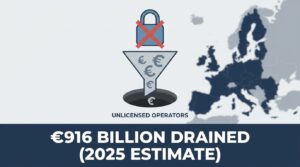
Unlicensed online gambling operations extracted an estimated €916 billion from consumers across the European Union during 2025, according to emerging industry data that has reignited debate over regulatory fragmentation and enforcement gaps within the bloc. The figure, staggering in scale, underscores a persistent challenge: licensed operators compete on uneven ground while unauthorised platforms siphon revenue with minimal consequence. For regulators, the number raises uncomfortable questions about whether current frameworks are fit for purpose (a point several national authorities have quietly conceded in recent consultations).
What the €916 Billion Figure Reveals About EU Gambling Enforcement
Before dissecting the strategic implications, it helps to frame what this estimate actually represents. The sheer volume of unlicensed activity suggests not a fringe problem but a structural one, touching consumer protection, tax revenue, anti-money laundering compliance, and market integrity simultaneously.
- Unlicensed platforms captured revenue roughly equivalent to the GDP of several mid-sized EU member states combined, pointing to systemic enforcement failure rather than isolated incidents
- Licensed operators face competitive disadvantage as unauthorised sites typically offer higher payouts by avoiding regulatory costs, responsible gambling obligations, and taxation
- Consumer exposure to unregulated platforms means weaker protections against problem gambling, fraud, and data misuse
- The estimate intensifies pressure on the European Commission to consider harmonised or at least coordinated cross-border enforcement mechanisms
- Tax authorities across member states are losing billions in potential revenue that could fund public services and responsible gambling programmes
A Patchwork That Leaks
The EU’s approach to online gambling regulation remains stubbornly national. Each member state sets its own licensing regime, tax rates, and enforcement priorities. Germany’s Interstate Treaty on Gambling, for instance, operates under fundamentally different assumptions than Malta’s remote gaming framework or Sweden’s re-regulated market. That fragmentation creates arbitrage opportunities that unlicensed operators exploit with precision.
And while some jurisdictions have invested in IP blocking, payment blocking, and ISP-level restrictions, enforcement remains inconsistent. A platform blocked in one country can redirect traffic through another with minimal friction. The result: a market caught between twenty-seven different regulatory philosophies and a borderless internet that respects none of them.
Still, not every member state has been passive. Countries like the Netherlands, through the Kansspelautoriteit (KSA), have pursued aggressive enforcement actions against unlicensed operators, including substantial fines and public blacklists. Whether these national efforts can scale to match a €916 billion problem is another matter entirely.
Why Licensed Operators Bear the Cost
For companies holding legitimate licences, the competitive distortion is acute. Licensed operators invest heavily in compliance infrastructure. They fund responsible gambling tools, submit to regular audits, pay licensing fees, and remit taxes that can exceed 20% of gross gaming revenue in some jurisdictions. Unlicensed competitors carry none of these costs.
This isn’t merely a profitability concern. It shapes strategic decisions about market entry, product development, and customer acquisition. When a licensed operator spends €50 million annually on compliance in a single market, and an unlicensed rival spends nothing, the pricing gap becomes a gravitational force pulling consumers toward unregulated platforms. Arguably, the current system inadvertently rewards non-compliance.
What remains less clear is how long major industry players will tolerate this dynamic before lobbying efforts shift from national capitals to Brussels in earnest.
The Consumer Protection Dimension
Beyond market economics, the human cost deserves scrutiny. Unlicensed platforms typically lack deposit limits, self-exclusion tools, and age verification systems that regulated markets mandate. Problem gambling rates among users of unauthorised sites are difficult to measure precisely because these platforms operate outside reporting frameworks. But anecdotal evidence from national helplines and addiction services suggests the correlation between unlicensed gambling access and gambling harm is strong.
One sentence captures the tension well: consumers choosing unlicensed platforms often do so for better odds or fewer restrictions, unaware they are trading away every safety mechanism designed to protect them.
How Regulators Might Respond
Several pathways are under discussion, though none has achieved consensus.
| Approach | Potential Impact | Feasibility |
|---|---|---|
| EU-wide licensing framework | High — would eliminate cross-border arbitrage | Low in the near term; requires treaty-level agreement and political will that has historically been absent |
| Coordinated payment blocking | Moderate — disrupts funding flows to unlicensed operators | Medium; requires cooperation from banking sector and fintech providers |
| Shared blacklist database | Moderate — improves visibility across jurisdictions | Higher feasibility; several bilateral agreements already exist |
| Enhanced ISP restrictions | Limited — easily circumvented via VPNs | High technically, low in practical effectiveness |
Reframing the Problem: Perception, Awareness, and Behavioural Shifts
Regulation alone cannot solve a problem this deeply embedded in consumer behaviour. Applying principles from behavioural science and neuro-linguistic programming offers a complementary lens. The language used around gambling, both by operators and regulators, shapes how consumers perceive risk. When unlicensed platforms frame their offerings using words like “freedom,” “no limits,” and “instant withdrawal,” they activate reward-seeking cognitive patterns while suppressing risk awareness.
Licensed operators and public health campaigns could counter this by deploying reframing techniques. Instead of warning consumers about danger in abstract terms, messaging anchored in concrete, personal outcomes tends to be more effective. Phrases like “your deposit has no protection here” or “no one will help you recover losses on this site” create a different mental model than generic “gamble responsibly” disclaimers. The specificity matters. Behavioural research consistently shows that loss-framed messaging outperforms gain-framed messaging when the goal is risk avoidance.
Beyond messaging, the concept of anchoring plays a role. If regulators can establish a strong public anchor associating unlicensed gambling with tangible negative outcomes, such as publicised cases of fraud or unrecoverable losses, consumer decision-making shifts. This is not manipulation; it is accurate information presented in a psychologically effective format. Yet few national regulators have invested meaningfully in this kind of strategic communication, preferring legalistic warnings that most consumers scroll past without reading.
Even the design of licensed platforms matters. Operators who build interfaces that subtly reinforce trust signals, transparent odds displays, visible licensing badges, easy-access self-exclusion buttons, create an experiential contrast with unlicensed sites that, over time, can reshape consumer preferences. The challenge is patience: behavioural change operates on longer timescales than quarterly earnings reports typically allow.
Frequently Asked Questions
Why is unlicensed online gambling so prevalent in the EU?
The EU lacks a unified gambling regulatory framework. Each member state operates independently, creating gaps that unlicensed operators exploit by targeting consumers across borders without holding any valid licence.
How does unlicensed gambling affect consumers directly?
Consumers on unlicensed platforms have no recourse if winnings are withheld, personal data is misused, or deposits disappear. These sites rarely implement responsible gambling safeguards like deposit limits or self-exclusion tools, leaving vulnerable users particularly exposed.
Can the EU create a single gambling licence?
In theory, yes. In practice, member states have historically resisted ceding regulatory control over gambling, viewing it as a matter of national sovereignty and public policy. Any harmonised framework would require significant political negotiation and likely face legal challenges.
What can consumers do to verify if a gambling site is licensed?
Check the website footer for a licensing authority logo and cross-reference it with the relevant national regulator’s public registry. If no licence information is displayed, or the listed authority cannot be verified, treat the platform as unauthorised.