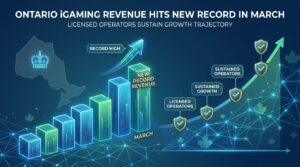
Ontario’s regulated iGaming market delivered yet another record-breaking performance in March, with licensed online gambling operators generating unprecedented revenue figures. The province’s open-market model, now approaching its third anniversary, continues to attract operator investment and player migration from grey-market alternatives. These latest numbers reinforce Ontario’s position as North America’s most closely watched regulated iGaming jurisdiction, and they raise fresh questions about whether other Canadian provinces will follow suit.
What March’s Record Tells Us About Ontario’s iGaming Momentum
The March results did not arrive in isolation. They sit atop a sustained upward curve that has defined Ontario’s regulated market since its launch in April 2022. Before diving into the specifics, here are the strategic takeaways that matter most for operators, investors, and regulators tracking this market:
Michigan’s iGaming Growth Mirrors Ontario’s Success
The impressive growth in Michigan’s iGaming sector, as evidenced by its record-setting revenue of $178.1 million in March 2023, reflects a broader trend in North America. This surge, which marked a 23% increase from the previous month, underscores the rising popularity of online gaming and may serve as a model for other jurisdictions, including Ontario. As Ontario continues to experience similar success, evidenced by its own record-breaking performance, the developments in Michigan provide valuable insights into the dynamics of regulated online gaming. For more details on Michigan’s record revenue, see the full report here: Michigan Sets New Record for Monthly Gross iGaming Revenue.
- Monthly revenue from licensed Ontario iGaming operators reached a new all-time high in March, extending a pattern of consecutive growth periods
- Player spending continues to shift toward regulated platforms, shrinking the grey market’s share of total handle
- The competitive dynamics among dozens of licensed operators are intensifying, with marketing spend and product differentiation becoming critical levers
- Ontario’s model increasingly serves as a regulatory blueprint that other provinces and U.S. states are studying
- Tax revenue flowing to the provincial government from iGaming is becoming a meaningful fiscal line item
A Market That Keeps Outpacing Expectations
When the Alcohol and Gaming Commission of Ontario (AGCO) and its subsidiary iGaming Ontario launched the regulated market, projections were cautiously optimistic. The reality has been considerably more aggressive. Each quarter since launch has broadly outperformed the one before it, and March’s figures suggest that the ceiling, if one exists, remains well out of sight.
What makes Ontario’s trajectory particularly notable is the sheer density of competition. More than 50 licensed operators now hold registrations with iGaming Ontario, spanning sportsbooks, online casinos, and poker platforms. That crowded field has not diluted overall revenue growth (a distinction worth watching as newer entrants try to carve out market share). Instead, it appears to have expanded the total addressable market by drawing players away from unlicensed offshore sites.
Still, not every operator benefits equally from this expansion.
Who’s Winning the Operator Battle?
The largest share of Ontario’s iGaming revenue flows to a handful of dominant players. Bet365’s Ontario-licensed platform has maintained a strong foothold, alongside major North American brands like FanDuel, DraftKings, and BetMGM. These operators benefit from brand recognition, deep marketing budgets, and established customer acquisition pipelines built during the U.S. sports betting expansion.
Smaller operators face a harder calculus. Customer acquisition costs in Ontario have climbed steadily, and the promotional environment remains intense. For mid-tier brands, the path to profitability in the province runs through product specialization or niche audience targeting rather than head-to-head competition with the market leaders on volume.
Revenue Distribution Snapshot
| Operator Tier | Estimated Market Share | Primary Revenue Driver |
|---|---|---|
| Top 5 operators | ~60–65% | Sports betting and casino cross-sell |
| Mid-tier (6–15) | ~20–25% | Casino-first or niche sportsbook positioning |
| Long-tail (16+) | ~10–15% | Specialized verticals, poker, regional branding |
The Grey Market Squeeze Is Working
One of the central promises of Ontario’s regulatory framework was channelization: pulling players out of unlicensed, unregulated environments and into a supervised ecosystem with consumer protections, responsible gambling tools, and tax obligations. By most available indicators, that promise is being kept. The grey market has not vanished, but its share of Ontario’s total online gambling activity has contracted meaningfully since 2022.
AGCO’s enforcement posture has contributed to this shift. The regulator has issued public warnings, blocked payment processing for unlicensed sites, and worked with internet service providers to restrict access. And while enforcement gaps remain, the direction of travel is clear enough that several previously grey-market operators have opted to seek Ontario licences rather than risk exclusion from the province’s 15-million-person market.
How Behavioural Framing Shapes Player Migration
Beyond regulatory mechanics, Ontario’s success in channelizing players reflects something subtler: the power of perceived legitimacy. When a provincial government formally endorses a regulated marketplace, it reframes the act of online gambling from a legally ambiguous activity into a normalized consumer choice. This shift in framing, well understood through neuro-linguistic programming principles, operates on identity as much as incentive.
Players who migrate to licensed platforms are not simply responding to blocked offshore sites or bonus offers. They are, in many cases, responding to a change in how the activity is categorized in their own minds. The language used by regulators and operators matters here. Terms like “safe,” “licensed,” and “Ontario-regulated” function as anchoring cues that associate the regulated market with trust and legitimacy. Operators who embed this language consistently across their marketing and onboarding flows tend to retain migrated players at higher rates.
There is also a loss-aversion dynamic at play. Players who have moved to regulated platforms and built account histories, loyalty points, and betting records perceive a switching cost in returning to grey-market alternatives. That perceived cost, even when the actual financial barrier is negligible, acts as a retention mechanism. Operators who understand this behavioural architecture can design engagement loops that reinforce commitment without relying solely on promotional spend. The most effective retention strategies in Ontario right now are arguably those that make the player feel invested in their own regulated-market identity.
What Comes Next for Ontario’s Model?
The provincial government has not signalled any major regulatory overhaul, but the tax and fee structure governing iGaming Ontario will inevitably face scrutiny as revenue scales. Operators currently pay a 20% revenue share to the province. Whether that rate holds as the market matures, or whether political pressure pushes it higher, remains an open question that could reshape operator economics significantly.
Other Canadian provinces are watching closely. Alberta and British Columbia have both explored variations of Ontario’s open-market approach, though neither has committed to a comparable framework. The longer Ontario’s numbers keep climbing, the harder it becomes for other provinces to justify maintaining monopoly models that capture less revenue and offer fewer consumer protections.
Frequently Asked Questions
How many licensed iGaming operators are active in Ontario?
More than 50 operators currently hold active registrations with iGaming Ontario, covering sports betting, online casino games, and poker.
What tax rate do Ontario iGaming operators pay?
Licensed operators pay a 20% revenue share to the province through iGaming Ontario. This rate has been in place since the market launched in April 2022.
Has Ontario’s regulated market reduced grey-market gambling?
Yes, by most available measures. Channelization rates have improved steadily, driven by a combination of enforcement actions, payment blocking, and the growing appeal of licensed platforms. The grey market has not disappeared entirely, but its footprint in the province has shrunk.
Are other Canadian provinces adopting Ontario’s iGaming model?
Not yet at the same scale. Alberta and British Columbia have explored open-market concepts, but Ontario remains the only province operating a fully competitive, multi-operator regulated iGaming ecosystem.