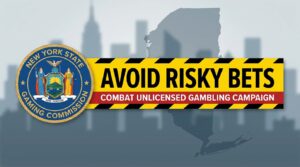
The New York State Gaming Commission has rolled out its “Avoid Risky Bets” public awareness campaign, targeting consumers who may be placing wagers through unlicensed and unregulated gambling operators. The initiative aims to educate bettors across New York about the risks tied to offshore and illegal sportsbooks, while steering them toward licensed alternatives. With the state’s legal sports betting market still maturing, the campaign arrives at a moment when regulators are intensifying efforts to shrink the unlicensed market’s footprint.
What the Campaign Signals for New York’s Betting Landscape
Consumer protection campaigns from state regulators are rarely just about awareness. They tend to surface when the scale of a problem has become difficult to ignore. Below are the strategic takeaways from this initiative:
- Regulatory escalation: The campaign marks a shift from passive enforcement to active consumer engagement, suggesting the Commission views unlicensed operators as a persistent revenue and safety threat.
- Market integrity play: By directing bettors to licensed platforms, the Commission is also protecting the tax base that funds New York’s education and infrastructure programs through gaming revenue.
- The timing coincides with broader national conversations about the gap between legal market availability and consumer behavior, particularly in states with high tax rates on operators.
- Brand differentiation: Licensed operators in New York stand to benefit from the implied endorsement that comes with a state-backed push against their unlicensed competitors.
- Whether the campaign actually moves the needle on consumer behavior remains an open question that no public awareness effort has convincingly answered in any U.S. jurisdiction so far.
Why Unlicensed Gambling Persists in a Legal Market
New York legalized mobile sports betting in January 2022, and the market generated over $2 billion in operator revenue during its first full year. Yet unlicensed operators continue to attract a meaningful share of bettors. The reasons are structural, not mysterious.
New York imposes a 51% tax rate on gross gaming revenue for mobile sportsbooks. That figure is the highest among major U.S. betting states. Operators absorb the cost, but it trickles down to consumers through less competitive odds and fewer promotional offers compared to what offshore books can provide (a distinction regulators have been slow to address publicly). For price-sensitive bettors, the math sometimes favors the unlicensed option, even if the risks are substantial.
Those risks include zero consumer protections on disputes, no responsible gambling safeguards, and exposure to fraud. But awareness of these dangers varies widely among casual bettors, which is precisely the gap the Commission’s campaign is designed to close.
How “Avoid Risky Bets” Works in Practice
The campaign deploys messaging across digital channels, social media, and community outreach to reach New Yorkers who may not realize they’re using unlicensed platforms. The New York State Gaming Commission’s official resources serve as the central hub for identifying licensed operators and understanding consumer rights.
Key elements of the initiative include:
- Educational content explaining how to verify whether a sportsbook holds a valid New York license
- Warnings about common tactics used by unlicensed operators, including aggressive bonus offers and unverifiable payout guarantees
- Partnerships with responsible gambling organizations to provide support for problem gambling
Still, a campaign is only as effective as its reach. And reaching the demographic most likely to use unlicensed books, typically younger, digitally native bettors comfortable navigating offshore platforms, requires more than traditional public service announcements.
The Broader Regulatory Pattern Across U.S. States
New York is not operating in isolation. Several states have launched similar consumer-facing campaigns in the past 18 months. New Jersey, which has the longest-running legal online sports betting market in the country, has periodically issued warnings about unlicensed operators. Illinois and Pennsylvania have taken enforcement actions alongside public messaging.
What makes New York’s effort notable is scale. The state’s population of nearly 20 million, combined with its position as the largest legal sports betting market by handle, means even a modest shift in consumer behavior could translate into significant revenue recovery for licensed operators and, by extension, the state treasury.
What Bettors Should Understand About Licensing and Risk
For consumers navigating this landscape, the practical distinctions between licensed and unlicensed platforms are worth understanding clearly.
| Factor | Licensed Operators | Unlicensed Operators |
|---|---|---|
| Consumer dispute resolution | Regulated by state commission | No formal recourse available |
| Responsible gambling tools | Required by law (self-exclusion, deposit limits) | Rarely offered, never enforced |
| Data protection | Subject to state and federal privacy standards | No oversight; data may be sold or exposed |
| Payout guarantees | Backed by regulatory requirements and bonding | No guarantee of payout; funds may be inaccessible without warning |
| Tax contribution | Revenue funds state programs | Zero contribution to public services |
Shaping Bettor Behavior: The Psychology Behind the Campaign
Campaigns like “Avoid Risky Bets” draw, whether explicitly or not, on principles rooted in behavioral psychology and neuro-linguistic programming. The name itself is a reframing technique: it doesn’t tell consumers what to do so much as it anchors the concept of risk to the act of choosing an unlicensed operator. That linguistic anchor matters.
Effective public health and safety messaging relies on three pillars: salience, framing, and perceived personal relevance. The Commission’s approach appears to lean heavily on framing, positioning unlicensed gambling not as a moral failing but as a poor risk-reward calculation. This is a deliberate rhetorical choice. Bettors, by definition, think in terms of odds and value. Speaking their language increases the likelihood of engagement.
There’s also a loss-aversion dimension at play. Highlighting what bettors stand to lose, including their funds, their data, and their ability to seek recourse, tends to be more persuasive than emphasizing what they gain by switching to a licensed platform. Behavioral research consistently shows that people weigh potential losses roughly twice as heavily as equivalent gains. The campaign’s emphasis on risk rather than reward suggests the Commission, or its advisors, understand this asymmetry.
Yet awareness alone rarely changes entrenched behavior. Sustained messaging, combined with visible enforcement actions against unlicensed operators, creates a feedback loop that reinforces the campaign’s credibility. Without that enforcement component, even well-crafted messaging risks being perceived as noise.
Frequently Asked Questions
How can I check if a sportsbook is licensed in New York?
The New York State Gaming Commission maintains a public list of authorized operators on its website. Any platform not on that list should be treated as unlicensed, regardless of how professional its interface appears.
What happens if I’ve already placed bets with an unlicensed operator?
You won’t face criminal penalties as a bettor in most cases, but you have no legal recourse if the operator refuses to pay out winnings or misuses your personal information. Transitioning to a licensed platform is the most practical step.
Why are odds sometimes better on unlicensed platforms?
Unlicensed operators don’t pay state taxes or comply with costly regulatory requirements. That margin gets passed to consumers as more attractive odds. But the tradeoff is the complete absence of consumer protection, which makes those odds a different kind of gamble entirely.
Does this campaign affect daily fantasy sports or casino games?
The primary focus is sports betting, though the underlying message applies to any form of unlicensed online gambling operating within New York’s borders.



