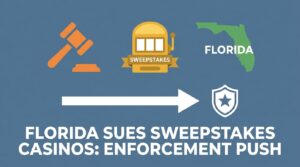
Florida Attorney General James Uthmeier has filed a lawsuit targeting sweepstakes casino operators, escalating the state’s crackdown on what officials characterize as unauthorised gambling platforms operating under the guise of promotional sweepstakes. The legal action, filed in state court, names several operators accused of violating Florida gambling statutes by offering real-money-equivalent gaming experiences without proper licensing. This move positions Florida among the most aggressive states in challenging the sweepstakes casino model that has proliferated across the United States in recent years.
What Florida’s Legal Challenge Signals for the Sweepstakes Industry
The lawsuit arrives at a moment when sweepstakes casinos occupy an increasingly uncomfortable grey area in American gambling law. Before diving into the specifics, here are the strategic takeaways that matter most for industry stakeholders:
- Direct legal confrontation: Florida is not issuing warnings or cease-and-desist letters. Filing suit in court signals the state believes it has sufficient statutory grounds to shut down sweepstakes casino operations entirely.
- Licensing as the core argument: The AG’s office frames these platforms as unlicensed gambling operations, a classification that, if upheld, could expose operators to significant financial penalties and injunctive relief
- Other states watching this case may use a favorable ruling as a template for their own enforcement actions, potentially triggering a domino effect across jurisdictions
- Consumer protection framing: By positioning the lawsuit partly as a consumer protection matter, Florida broadens the legal surface area beyond pure gambling law
- Tribal gaming interests: Florida’s compact with the Seminole Tribe, which grants extensive gambling exclusivity, adds a political dimension that reinforces the state’s motivation to act
The Mechanics of Sweepstakes Casinos and Why Regulators Object
Sweepstakes casinos operate on a model that their proponents argue falls outside traditional gambling definitions. Players purchase virtual currency or receive it through free entry methods, then use that currency to play casino-style games. Winnings can often be redeemed for cash prizes or gift cards. The distinction between this structure and conventional online gambling is, at least on paper, the absence of a direct wager.
Regulators in Florida and elsewhere see it differently.
Their argument centers on the practical reality: consumers spend real money, play games that replicate slot machines and table games, and receive real-money payouts. The sweepstakes label, in this view, functions as a legal fiction designed to circumvent state gambling laws. Attorney General Uthmeier’s filing reportedly relies on this substance-over-form reasoning, contending that the economic reality of these platforms constitutes gambling regardless of how the transaction is structured. Whether courts agree with that characterization will likely hinge on how narrowly or broadly they interpret Florida’s statutory definitions of “gambling” and “lottery.”
How Florida’s Seminole Compact Shapes the Battlefield
Understanding this lawsuit requires acknowledging the Seminole Tribe’s role in Florida’s gambling ecosystem. The 2021 gaming compact between the state and the Seminole Tribe granted the tribe broad authority over sports betting and online gaming in Florida, a deal worth billions in projected revenue-sharing payments. Sweepstakes casinos that operate without tribal authorization or state licensing arguably undercut this arrangement (a distinction regulators have been slow to enforce until now).
The financial stakes are substantial. Florida’s compact with the Seminole Tribe’s Hard Rock gaming enterprise generates hundreds of millions in annual revenue for the state. Every dollar flowing to unlicensed sweepstakes platforms represents potential leakage from that revenue stream. Still, the AG’s office has framed this primarily as a consumer protection and rule-of-law issue rather than a revenue dispute.
A Shifting Regulatory Landscape Across States
Florida is not acting in isolation. Multiple states have moved against sweepstakes casinos over the past 18 months, though approaches vary considerably.
| State | Approach | Status |
|---|---|---|
| Florida | Attorney General lawsuit | Active litigation |
| Washington | Legislative ban on sweepstakes model | Enacted |
| Georgia | Enforcement actions against physical sweepstakes parlors | Ongoing, with mixed judicial outcomes depending on county-level interpretation |
| Pennsylvania | Regulatory guidance classifying certain sweepstakes as gambling | Under review |
What makes Florida’s approach notable is the decision to pursue litigation rather than legislative reform. Lawsuits produce binding precedent. And if the court sides with the AG, the ruling could establish a framework that other attorneys general adopt wholesale.
What Operators and Players Should Anticipate
For sweepstakes casino operators, the immediate risk is injunctive relief. A court order halting operations in Florida would cut off access to one of the largest consumer markets in the country. But the longer-term concern is reputational: a judicial finding that sweepstakes casinos constitute illegal gambling would fundamentally challenge the business model’s viability nationwide.
Players face a different calculus. Funds held in sweepstakes casino accounts could become inaccessible if courts freeze operator assets during litigation. Consumer protection claims embedded in the lawsuit may eventually yield restitution mechanisms, though such processes tend to move slowly and recover only a fraction of losses.
Arguably, the most consequential outcome would be a detailed judicial opinion parsing the boundary between sweepstakes promotions and gambling. The industry has thrived in ambiguity. A clear ruling in either direction reshapes the terrain entirely.
Frequently Asked Questions
Are sweepstakes casinos legal in Florida?
Their legality is contested. Florida’s Attorney General has filed suit arguing they violate state gambling laws, but no court ruling has definitively resolved the question yet. Operators maintain their sweepstakes model falls outside gambling statutes.
What could happen to sweepstakes casino players in Florida?
Players are not typically targeted in enforcement actions. The lawsuit focuses on operators. That said, access to platforms and account balances could be disrupted if courts issue injunctions or asset freezes during the proceedings.
How does this affect other states?
A ruling against sweepstakes operators in Florida would not automatically apply elsewhere, but it would provide persuasive legal authority that other state attorneys general could cite in their own enforcement efforts. The precedent matters more than the jurisdiction.
Why is Florida acting now?
Several factors converge: the growth of sweepstakes platforms, the state’s financial interest in protecting its Seminole compact revenue, and a broader national trend toward regulatory scrutiny of unlicensed gaming operations.