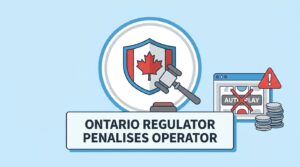
The Alcohol and Gaming Commission of Ontario (AGCO) has imposed a penalty on an igaming operator for deploying an auto-play function on slot games offered to players in the province. The enforcement action underscores Ontario’s increasingly assertive posture toward responsible gambling compliance, particularly around features that regulators view as accelerating play without meaningful player intervention. While the specific financial penalty and operator name form part of the AGCO’s public compliance record, the case carries broader implications for every licensed operator in the market.
What Ontario’s Auto-Play Enforcement Signals for Operators
Auto-play has long occupied an uncomfortable grey zone in regulated gambling markets. Some jurisdictions tolerate it with restrictions; others have moved to ban or severely limit it. Ontario’s action here lands firmly on the restrictive side, and operators ignoring that signal do so at their own risk.
- The AGCO treated the presence of an auto-play function on slot games as a direct violation of its responsible gambling standards, not merely a technical oversight.
- Operators in Ontario must now treat auto-play removal as a compliance priority on par with AML and KYC obligations.
- The penalty reinforces a pattern: Ontario’s regulator is willing to act on product-level features, not just marketing or financial misconduct.
- For suppliers providing game content to Ontario-licensed operators, this creates downstream pressure to ensure platform configurations strip out auto-play before deployment.
- Other Canadian provinces watching Ontario’s regulatory experiment may adopt similar stances, widening the compliance footprint.
Why Auto-Play Draws Regulatory Scrutiny
At its core, auto-play allows a slot game to spin repeatedly without requiring the player to initiate each round. The feature is convenient. It is also, arguably, the single most effective mechanism for detaching a player from conscious decision-making during a session. Regulators in the UK moved against it years ago, and the Alcohol and Gaming Commission of Ontario has now made its own position unambiguous.
The concern is not hypothetical. Research into gambling harm consistently identifies session duration and loss of control as key risk factors. Auto-play compresses both: it removes the natural pause between spins that might otherwise prompt a player to check their balance, reconsider their stake, or simply stop. That pause, brief as it is, functions as a micro-intervention point. Without it, losses can accumulate faster than a player registers them.
Still, not all market participants agree on this point. Some operators argue that auto-play with configurable loss limits and session timers can coexist with responsible gambling frameworks. The AGCO, at least on paper, has rejected that argument.
Ontario’s Compliance Landscape Is Getting Tighter
This penalty did not arrive in isolation. Since Ontario opened its regulated igaming market in April 2022, the AGCO has steadily expanded its enforcement activity across advertising standards, bonus terms transparency, and now game functionality. The trajectory is clear: the regulator is moving from market-building mode into market-disciplining mode.
What makes Ontario’s approach distinctive is the granularity. Rather than issuing broad guidance and hoping for voluntary compliance, the AGCO has shown a willingness to examine individual game features and hold operators accountable for configurations that may have been acceptable in other jurisdictions. That creates a compliance burden that is real and specific.
| Compliance Area | AGCO Enforcement Trend | Operator Impact |
|---|---|---|
| Advertising & Promotions | Multiple penalties issued since 2022 | Creative and media teams must pre-clear all Ontario-facing content |
| Responsible Gambling Features | Auto-play ban now enforced via penalty | Game configuration audits required before Ontario deployment |
| AML / KYC | Ongoing monitoring aligned with FINTRAC expectations | Enhanced due diligence processes for high-risk players |
| Bonus Terms | Transparency requirements tightened | Wagering requirement disclosures must be prominent and unambiguous |
The Supplier Question Nobody Is Asking Loudly Enough
When an operator gets penalised for a game feature, the immediate liability falls on the licensee. But the auto-play function typically originates with the game supplier, not the operator. Most B2B content providers offer configurable builds that can enable or disable features by jurisdiction. The question is whether those configurations were correctly applied before the games went live in Ontario.
This creates a tension that the current regulatory framework does not fully resolve. Operators bear the compliance responsibility, yet they depend on suppliers to deliver compliant product. And when something slips through, the operator absorbs the penalty while the supplier faces, at most, reputational pressure. Whether the AGCO eventually extends direct accountability to content suppliers remains an open thread in Ontario’s regulatory evolution.
Broader Market Implications
Ontario is the largest regulated igaming market in Canada, and its regulatory choices carry weight beyond provincial borders. Saskatchewan, Alberta, and other provinces have watched Ontario’s experiment closely, and enforcement patterns established by the AGCO tend to influence how other jurisdictions frame their own standards.
For international operators entering or expanding in Canada, the lesson is operational: do not assume that a game build approved in Malta, Gibraltar, or the Isle of Man will pass muster in Ontario without modification. Jurisdictional configuration management is no longer a nice-to-have. It is a compliance essential.
Frequently Asked Questions
What is auto-play in online slot games?
Auto-play is a feature that allows slot games to spin continuously for a set number of rounds without the player manually initiating each spin. Regulators increasingly view it as a risk factor for gambling harm because it removes natural pause points during play.
Why did the AGCO penalise an operator for this feature?
The AGCO considers auto-play inconsistent with its responsible gambling standards. The feature was present on slot games accessible to Ontario players, which the regulator treated as a compliance violation rather than a minor technical issue.
Does this affect all igaming operators in Ontario?
Yes. Every operator licensed by the AGCO should treat this enforcement action as a clear signal that auto-play functions on slot games are not permitted in the Ontario market. Compliance teams should audit their game libraries accordingly.
Are game suppliers also liable?
Under the current framework, the licensed operator bears primary responsibility. However, suppliers providing game content should ensure their Ontario configurations disable auto-play before delivery, as operator penalties can strain commercial relationships and invite future regulatory attention toward the supply chain.